

Master the rules before you break them. According to new research, not even humanity’s greatest minds were exempt from this timeless rule—including Galileo Galilei, whose contributions to astronomy were nothing short of revolutionary.
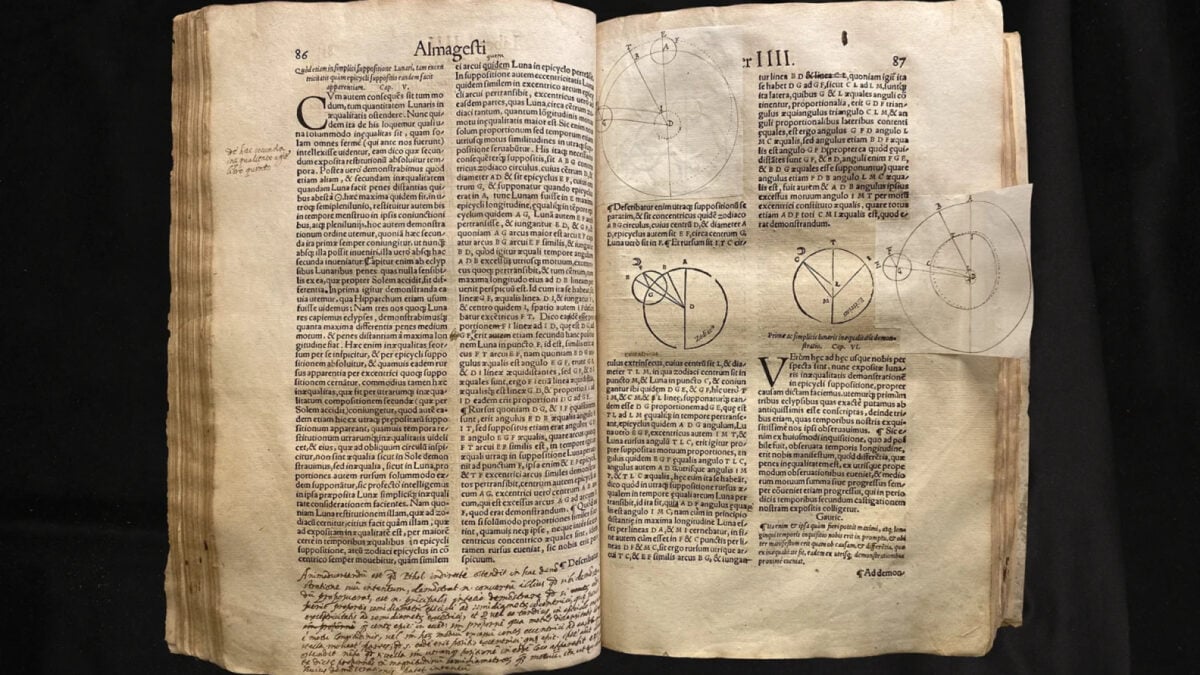
Italian historian Ivan Malara was studying a 1551 copy of Ptolemy’s Almagest, an influential text from the 2nd century that canonized geocentrism—the idea that Earth lies at the center of the universe. In the book, Malara found some notes written in oddly familiar handwriting—which leading Galileo scholars confirmed was likely from the great astronomer.
“These texts reveal the image of a Galileo who was not only an astute reader of the Almagest but also a profound connoisseur of Ptolemy’s sophisticated mathematical demonstrations,” Malara wrote for Il Sole 24 Ore, according to a translated version of the commentary.
The discovery was announced in a recent statement from the National Central Library of Florence, Italy. A paper on the findings will be submitted to the Journal for the History of Astronomy, according to Malara.
From the man himself
Galileo’s notes in his copy of the Almagest were likely written around 1590—20 years before his observation of the Moon and Jupiter, and roughly 40 years before he was placed under house arrest for heresy, his support support for heliocentrism, or that the Earth orbited the Sun.
A telltale sign that the notes were Galileo’s was a transcription of Psalm 145, Malara explained to Science, as some historical records had testified Galileo “prayed each time he sat down with the Almagest.”
In addition, handwriting specialists at the Galileo Museum and Florence’s central library confirmed the annotations highly resembled the scholar’s writing, annotating styles, and abbreviations. The annotator also had some critique for Ptolemy’s ideas, which mirrored those present in Galileo’s later works.
Behind the scenes
Galileo’s familiarity with Ptolemy’s geocentric system wasn’t anything new to researchers. For instance, Galileo’s earlier writings demonstrated a “thorough knowledge of Ptolemy’s mathematical demonstrations and even [claimed] to have composed a commentary on the Almagest,” according to the National Central Library of Florence.
However, historians had typically attributed Galileo’s rejection of geocentrism to anything but careful math, instead presenting him as a “big-picture sort of guy—not interested in the nitty-gritty technical details of astronomy,” James Evans, a historian of astronomy at the University of Puget Sound, told Science.
Finding Galileo, the revolutionary
Malara was convinced that Galileo’s academic pursuits were more nuanced. Specifically, he hypothesized that the mathematical framework of the Almagest gave Galileo the theoretical tools he needed to later understand another influential text: De revolutionibus orbium coelestium by Nicolaus Copernicus.
“Admittedly, these were two opposing cosmological systems: Copernicus’ heliocentric and Ptolemy’s geocentric,” Malara noted in his commentary. “However, it is also true that they were both formulated in the same mathematical language and made use of largely shared astronomical techniques.”
If anything, Galileo’s respect for Ptolemy’s mathematical demonstrations simultaneously drove the scholar away from geocentrism, Malara argued. That is, Ptolemy’s own mathematical logic appeared to work better with Copernicus’s heliocentric view of the universe. This sophisticated interpretation of two influential—perhaps controversial—texts brought Galileo to his revolutionary contributions to modern astronomy, Malara said.
A predestined “eureka”?
Indeed, the new findings uncover a fascinating, perhaps underappreciated, aspect of Galileo’s revolutionary ideas. It’s tempting to frame him as someone who confidently rejected ancient wisdom in search of the truth—and you wouldn’t be totally wrong—but Malara’s discovery suggests reality was much more nuanced.
That is, Galileo’s groundbreaking observations came more from a place of respect, rather than contempt, for ancient wisdom than we’re inclined to believe. Again, master the rules before you break them.
First Appeared on
Source link





Leave feedback about this