

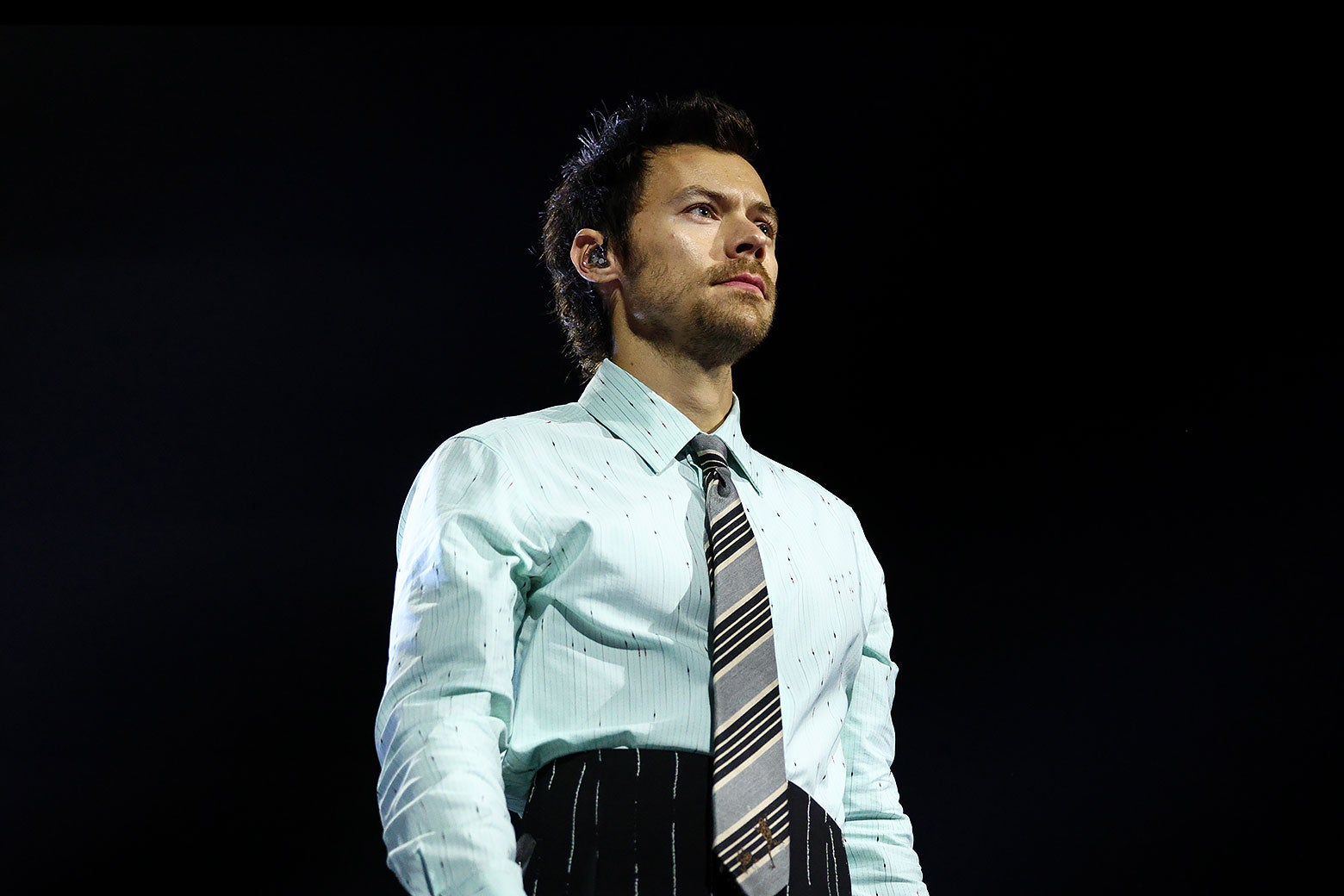
Welcome, children, to Chapter 4 of the solo Harry Styles story, in which our hero discovers a somewhat more original way to make the “It’s not easy being famous” record. He calls it Kiss All the Time. Disco, Occasionally., henceforth KATDO.
This is a category of album nearly every major star ends up releasing eventually, after hitting certain career peaks—say, a best-album Grammy (for 2022’s Harry’s House), combined with an undeniable song of the summer (“As It Was”) and a record-breaking two-year, 173-date international tour (“Love on Tour”)—and facing the emotional vertigo that follows. In some cases (post-Thriller Michael Jackson, Blackout-onward Britney Spears, possibly Taylor Swift right now), circumstances get so extreme that the star stops making anything but “It’s not easy being famous” records, which is usually the beginning of a long slide.
This new, darker, but also more rhythm-driven album by Styles—that fawnlike cross-generational charmer, that Timothée Chalamet of pop in his similarly singular popularity and slender white Zillennial anti-macho masculinity—is a mixed enough affair that I’m not ruling out a downward spiral to come. Our Harry, however, has made several smart decisions. First, he ducked out of the spotlight for more than two years after that exhausting tour, moved to Italy for a while, trained as a marathon runner, and went dancing in Berlin nightclubs, where he said he regained an idea of himself as one of the crowd rather than the performer being watched. Or maybe gained it for the first time, considering he’s been well known since he joined a certain boy band via a British TV talent show when he was 16, now exactly half his life ago. Overall, he tried to reboot to human-being factory settings as much as is possible while remaining ridiculously famous and revoltingly rich.
This affords a modicum of perspective not available if instead, like Styles’ long-ago girlfriend Swift, you write and record your new album on days off from your own impossibly grueling tour, so the recent experiences available to write from have taken place mostly in stadiums and a private jet.
Through this period, Styles also went through a mostly failed shot at an acting career, a related very public breakup with his Don’t Worry Darling director Olivia Wilde, and the death of one of his former One Direction bandmates. Smart decision No. 2: He does not directly address any of that on KATDO. What he does address is what it’s like to live a life in which people expect you to do so. As he croons on “Paint by Numbers,” the penultimate track here, “It’s a little bit complicated when / They put an image in your head and now you’re stuck with it.” That’s already a more interesting subject than the usual fame-sucks fodder about being on the road, missing home, feuding with other celebs or the media, and ill-advisedly doing drugs and screwing around. (Well, these are partly songs about ill-advisedly doing drugs and screwing around, just not on the road.)
Styles is asking himself how much, after a decade and a half of celebrity, he even remains a real person, as opposed to the sum of people’s reactions to him—“It’s hard to tell when the thoughts are my own” (“Season 2 Weight Loss”)—including the things he’s allowed to get away with: “You can romanticize your shortcomings, ignore your agency to stop / Write a ballad with the details, while skimming off the top” (“The Waiting Game”). While the rest of us may not have managers and publicists orchestrating our everyday existences, even the least public person has wondered how programmed we are by family, friends, society, algorithms, etc., not only what constrains us but also where we may not be accountable enough, for example because we’re assured we’re right to pursue every career advancement, every consumer good.
The lyrics here—which a lot of reviewers are expressing puzzlement over today—are easier to parse if you notice that there’s been a general shift in the way Styles is using one word: you. Before now, the you in Styles’ songs has usually been the conventional pop you, the same as in One Direction songs: a romantic interest the track is nominally directed to (whose identity fans might have theories about) but who simultaneously the listener can imagine themself to be.
That you is much reduced here, to make way for a more reflexive one, a you that is really I, with the second person as a distancing mechanism so the singer can step back and interrogate himself. “God knows your life is on the brink / And your therapist’s well fed / The fix of all fixes, unintimate sex,” he sings to or at himself on one of the key tracks here, “Are You Listening Yet?”—or, rather, wryly sing-raps at himself in a manner reminiscent equally of the Pet Shop Boys of “West End Girls,” the David Byrne of “Once in a Lifetime,” the early 2000s U.K. grime rap of the Streets, and maybe even the, um, OMC of New Zealand’s OMC and their 1995 novelty hit “How Bizarre.”
When the you on this album is the erotic kind, it’s usually either a brief fling or someone Styles notices himself being detached from. They seem like side characters standing in for more complex webs of relationships, including with the world at large and with his audience—the listener playing the part not so much of lover to be wooed as collective to be beseeched: “Hoping you will love me now / Do you love me now? / Do you? Do you? / Do I let you down?” he sings, again on “Season 2 Weight Loss.” That title refers to the glow-up TV actors often get when their series have become successful enough to be renewed, and he’s described it in interviews as a song about gaining new confidence. But the song (and that phenomenon), to me, sounds not secure but troublingly needy, and is one of the places here where I doubt or even worry over the reality of Styles’ introspective turn.
Smart decision No. 3 is the most obvious, and the one that might compensate for such shortcomings: It’s the way KATDO switches up Styles’ sound. During his continental sabbatical, he got much more into electronic music at the clubs and in his running playlists—for instance Jamie xx, who will open for Styles at his long string of shows in New York this fall. In particular, he attended a couple of shows by LCD Soundsystem, whose immersive beats-and-synths polyrhythms Styles credits with helping renew his own craving to create. In that light, the verse patter on “Are You Listening Yet?” could also be heard as a mellower version of James Murphy’s talk-singing style.
On Harry’s House, Styles and his ongoing writing and production partners Kid Harpoon and Tyler Johnson emphasized gently exploratory pop-funk, like a more polite Prince or perhaps a more singer-songwritery Bruno Mars. On the two albums before that, it was a kind of neo-soft-rock. What we get here instead are many harder bass and drum lines—the drums both electronic and, on some tracks, live, courtesy of Tom Skinner of the U.K. jazz group Sons of Kemet and the Radiohead offshoot the Smile. An eccentric palette of analog synth sounds provides texture, and so do the more aggressive electronic treatments of Styles’ voice on several songs, as well as the counterpoints and choruses from a “house gospel choir.” Elsewhere, however, his singing is kept more familiarly buoyant and airy, and acoustic guitars, piano, and chamber strings emerge like birds returning in spring. It all makes for more unpredictable listening, and a rebuttal to the charge that this fluent showman is all Styles and no substance.
Yet you also could say that it’s true to form, in that he’s long been known to hop aboard the latest retro fad. When he first went the other way from One Direction, it was in the midst of a wave of Fleetwood Mac and Elton John nostalgia, and on his first solo album, Styles took full advantage of that. The past couple of years have seen a revival of the indie-to-pop crossover moment of the 2000s and 2010s—as seen on the soundtrack of Heated Rivalry, along with the “indie sleaze” trajectory in fashion. So, sure, Harry, why not LCD Soundsystem and Radiohead? It’s in the nature of the pure pop animal that his “spontaneous” enthusiasms will end up tracking the scent of a trend. This time around, his timing is not quite as ideal, though, given that Murphy and LCD Soundsystem have been under fire for letting Elon Musk’s SpaceX use their music for a Super Bowl commercial, as well as having been in bed with tech and crypto bros in other ways. The band’s biggest fans, myself included, have been wondering about where it now stands on the spectrum of cool to cringe.
But such questions of cultural capital are really outside Styles’ purview, when his way has always been to render things uncool but to assert that they were better off for it. Musically, it’s hard to deny what the influence has done for him. You’ve probably already heard the prime example of his new, LCD Soundsystem–esque sound on the album’s one advance single, “Aperture.” It’s a slow-burn audio construct in which units of sound are first patiently scattered into the track beds, then start bursting like popcorn and finally like fireworks, to be met by arching choruses of “We belong together / It finally appears / It’s only love.” There’s even perhaps a slightly higher-tech and less existential update on Leonard Cohen’s famous line about “the crack in everything / That’s how the light gets in” when Styles sings, “Aperture lets the light in.” This song has also already produced two fantastic visual renditions, both of them testaments to Styles’ willingness to at least try to match his pop-girlie peers in physical commitment to razzle-dazzle: the way the official video shifts from action-movie fight to modern-dance pas de deux, then his joyful weaving in and out of the choreography on the recent BRIT Awards, face fully aglow, jazz hands sparkling, high-waisted pinstripe trousers shimmering.
“Aperture” is the first track on the album, but in a lot of ways it feels like the narrative resolution. It is the answer to which the rest of the album poses the questions, as if a voice-over should intercede after it plays that intones something like “Two years earlier …”
The other big dancy winner is “Dance No More.” When the title says Disco, Occasionally, this is that occasion, and it really goes for it, with a handclap beat, Moog-y arpeggios, background vocal yips and mutters, and Chic-esque bass and guitar licks. Set at a dubious club where “I see no water or friends / But the music keeps hitting me like a 10 out of 10,” it laments that “DJs don’t dance no more”—i.e., that celebrity DJ culture has separated the DJ from the crowd—and at once summons up and mourns the democratic dance-floor utopia that Styles got a glimpse of in Berlin.
The other upbeat tunes are less triumphant, a couple forgettable, but most have some standout element. “Ready, Steady, Go!” (named for an early British TV forerunner of Top of the Pops) sounds as if it could have been on Harry’s House, until we hit the section with the Depeche Mode–like stabby descending synths and new-wave piano lines, plus a smattering of Styles singing in Italian. The panoply of programmed drums on the aforementioned “Are You Listening Yet?” evokes Remain in Light–era Talking Heads (likely via LCD’s frequent channeling), while Styles drawls, “If you must join a movement, make sure there’s dancing,” paraphrasing the T-shirt-ready lefty aphorism often not-quite-accurately attributed to the early-20th-century anarchist Emma Goldman.
Then there are the two ballads, “Coming Up Roses” and “Paint by Numbers,” which seem too close as Songs 8 and 11, respectively, of the 12. The former is a gorgeous but conventional love song with a very Paul Simon–style vocal melody and a totally Paul McCartney string quartet. For some fans, it will be the swoony courtship song they were missing, but personally, I don’t give a damn about a word of it. Whereas the latter is another intelligent look into the album’s theme, set against a much less captivating sonic backdrop.
And perhaps the most oddball song on this very oddball (for something so mainstream) album is the closer, “Carla’s Song,” which is literally an account of playing Simon & Garfunkel’s “Bridge Over Troubled Water” to someone who’d never heard it before and totally blowing her mind. Is this Styles’ deliberately basic-bitch version of an LCD Soundsystem cultural-reference song like “Daft Punk Is Playing at My House”? It’s at once kind of ridiculous and kind of sweet, a pure celebration of how transporting a song can be, after an album that’s mostly felt very conflicted about a life of making songs.
While I’ve been mounting a defense of the meaning they carry, a lot of Styles’ words do leave me conflicted. His writing goes some distance to justify the extensive contemporary misuse of the word lyricism when people just mean lyrics. Lyricism conveys deep sentiments expressed sensually in a work of art. But Styles does often seem to practice “lyricism,” in the sense that his words are “lyric-ish,” vague approximators and placeholders for ideas you can piece together if you ignore the spamlike junk that often seems randomly peppered in. (Vulture today called it his “lyrical vagueposting.”) Even the album’s title seems to be groping for something it never quite grasps, constantly reminding me of the widespread mishearing of Kiss’ signature anthem as “I want to rock and roll all night / And part of every day.”
On the other hand, cryptic nonsense has always been a part of pop, going all the way back to “Tutti Frutti” and “the pompatus of love.” There is a kind of rough generosity in this, signaling both performer and listener not to sweat the semantics and to go for the sensation. There’s also a hidden dignity behind the silliness, in the singer’s being allowed to keep the secret of what exactly they mean, which is one potential protection against the breakdown of privacy and personality this whole album considers. Maybe someday we’ll think of “But you call Leon / You call it only in my head” from “Ready, Steady, Go!” much the way we think of “I am the walrus, goo goo g’joob.”
Ultimately, Styles’ smartest move here was to make an album about questioning himself at exactly the moment a backlash against him seemed to be forming—that he’s the “Dull 2020s Pop Guy” or the “Potemkin” pop star because his management manipulates the charts and the media (as every pop star’s management tries to do). It’s not exactly a secret that Harry Styles is an “industry plant”—the U.K. watched the industry plant him on broadcast TV! But I also think that during his absence, his successors and weaker clones have reflected back poorly on him, while meanwhile the general cultural mood, for all-too-familiar reasons, has turned much more sour and suspicious. Being distrustful of Harry Styles? He’s trying to get ahead of that trend too.
First Appeared on
Source link




Leave feedback about this