

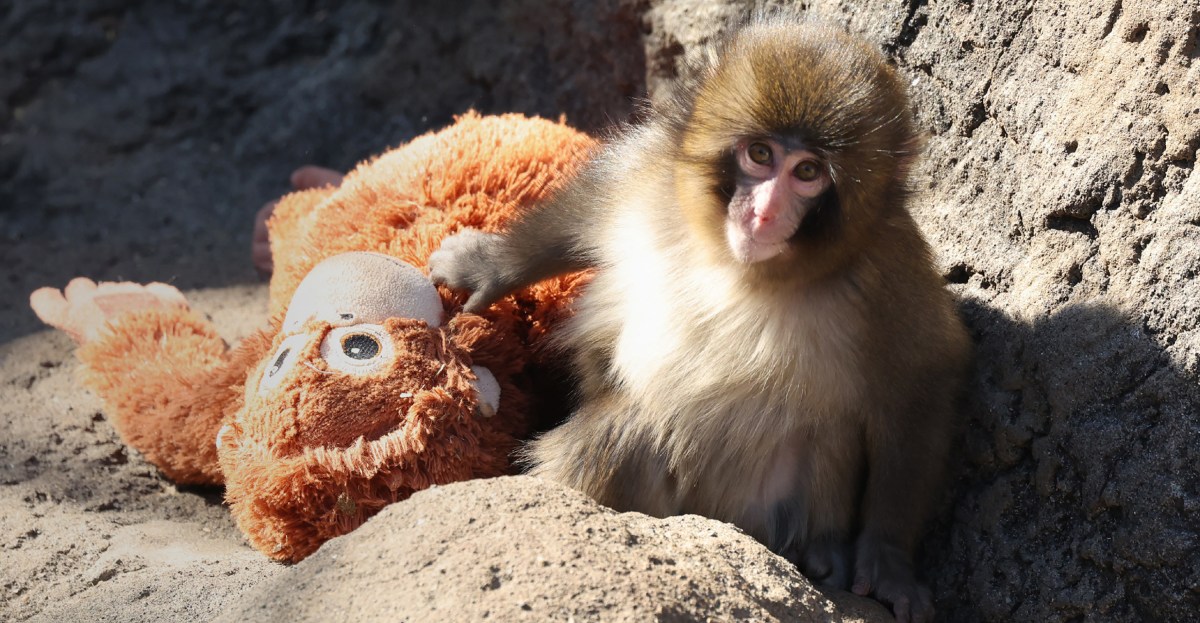
Much like their human cousins, baby macaques crave comfort.
Punch, a forlorn-looking young Japanese macaque monkey, went viral last week after being pictured clinging to an orange IKEA orangutan plushie at Japan’s Ichikawa City Zoo. Abandoned by his mother after being born in captivity, baby Punch has struggled to make friends in his concrete enclosure, even as his far-flung human fans fall madly, swiftly, deeply in love.
As easy as it is to love Punch, though, it is much harder to address the structures that put him in this position in the first place. While the internet loves baby animals, it often fails them when they’re not in the spotlight.
Take Moo Deng, for example, the pygmy hippopotamus who went viral for her sass after biting zookeepers at the height of brat summer in 2024. Just last week, a conservationist raised concerns about the “sad” state of Moo Deng’s and her mother’s enclosure, which zoo officials now plan to expand. And despite the mini hippo’s astronomical fame, there has been no accompanying surge in funding to protect Moo Deng’s endangered kin in the wild, of which there are only 2,500 left.
It’s also worth noting here that, as a general rule, whether you’re a macaque or a pygmy hippo, most zoos are no great place to raise a family. My colleague Kenny Torrella has written about the acute psychological distress — dubbed “zoochosis” — that some animals experience in captivity, which could also help explain part of Punch’s own painful maladjustment.
As a result of their small enclosures and lack of stimulation, animals with zoochosis develop strange compulsive behaviors — like pacing or rocking back and forth — and in some disturbing cases, self-harm, like hair pulling or self-biting.
What your favorite internet-famous baby animal really needs
Just as most zoos exist primarily for human entertainment, so too do most viral animal sensations. “We seek out cuteness because it feels good,” Joshua Paul Dale, who wrote a book on the subject, told National Geographic in 2024. In theory, “feeling the desire to protect, care for, and play with a cute baby or animal, even if it’s only an image on our social media feed, encourages empathy and compassion.”
But in practice, viral cuteness rarely translates into improved conditions or profound shifts in empathy for suffering animals, famous or otherwise.
This matters because even as the world dotes on Punch, rightfully sensing his capacity for complex emotions, it could be doing a lot more to protect him and animals like him.
As Vox senior reporter Marina Bolotnikova has written, Japanese macaques — alongside rhesus macaques, baboons, and squirrel monkeys — are among the research animals used for testing drugs and other treatments.
Before Punch, there was the researcher Harry Harlow’s infamous monkey lab, where, in a 1950s study of infant-maternal bonding, baby rhesus macaques were traumatically separated from their mothers right after birth and given a surrogate monkey-shaped doll covered in a terry towel. More recently, the National Institutes of Health defunded a set of vision experiments by the Harvard University neuroscientist Margaret Livingstone that involved sewing shut the eyelids of infant monkeys.
You might assume that because this kind of testing is very expensive — costing up to$50,000 to purchase each monkey — and ethically uncomfortable, to put it lightly, that such treatment only occurs because it is absolutely scientifically necessary. That’s not the case.
“Past research in primates might have contributed to the advancement of medicine, but it is evident that the advanced methods now available have rendered it virtually obsolete,” Michael Metzler, an emergency physician at Pioneer Memorial Hospital, told Bolotnikova. “These monkey studies divert funds and attention from the more valuable human-centered studies.”
In a very rare win for science under the Trump administration, the tide is turning, to some extent, against this kind of flagrantly cruel animal experimentation, especially on monkeys. But millions of animals still suffer from isolating captivity and exploitation in labs, zoos, circuses, or the exotic pet trade.
Making the world a better place for animals like Punch doesn’t come from views online or a visit to the zoo, but from sustained pressure for better animal welfare. There’s the Physicians Committee for Responsible Medicine, which advocates specifically for animal-free scientific research, for example, and Born Free USA, where you can “adopt a monkey” rescued from exploitative places like zoos and labs. The International Primate Protection League also focuses on promoting the conservation and protection of primates worldwide, while the Macaque Coalition is a network of organizations specifically concerned with the abuse or exploitation of macaques globally.
If you would really do anything for Punch, if he activated your parental instincts like no other macaque has before, then advocating for better conditions for animals like him is probably the best place to start. I assure you, he already has plenty of plushies.
First Appeared on
Source link





Leave feedback about this