

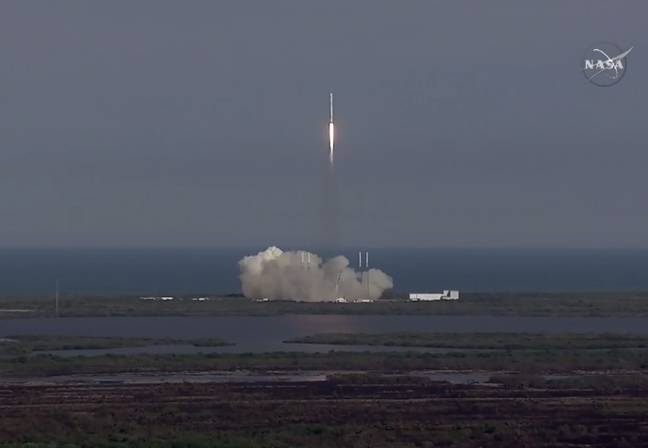
The SpaceX Falcon 9 rocket that burned up over Europe last year left a massive lithium plume in its wake, say a group of scientists. They warn the disaster is likely a sign of things to come as Earth’s atmosphere continues to become a heavily trafficked superhighway to space.
In a paper published Thursday, an international group of scientists reports what they say is the first measurement of upper-atmosphere pollution resulting from the re-entry of space debris, as well as the first time ground-based light detection and ranging (lidar) has been shown to be able to detect space debris ablation.
The measurements stem from a SpaceX Falcon 9 upper stage that sprung an oxygen leak about a year ago, sending it into an uncontrolled re-entry. Then it broke up and rained debris down on Poland. The rocket not only littered farm fields, but also injected lithium into the Mesosphere and Lower Thermosphere (MLT), where ground-based sensors detected a tenfold increase at an altitude of 96 km about 20 hours after the rocket re-entered the atmosphere, according to the paper.
Lithium was selected for the study because of its considerable presence in spacecraft, both in lithium-ion batteries and lithium-aluminum alloy used in the construction of spacecraft. A single Falcon 9 upper stage, like the one that broke up over Poland and released the lithium plume, is estimated to contain 30 kg of lithium just in the alloy used in tank walls.


By contrast, around 80 grams of lithium enter the atmosphere per day from cosmic dust particles, the researchers noted.
“This finding supports growing concerns that space traffic may pollute the upper atmosphere in ways not yet fully understood,” the paper notes, adding that the continued re-entry of spacecraft and satellites is of particular concern given how the composition of spacecraft is different from natural meteoroids.
“Satellites and rocket stages introduce engineered materials such as aluminium alloys, composite structures, and rare earth elements from onboard electronics, substances rarely found in natural extraterrestrial matter,” the paper explained. “The consequences of increasing pollution from re-entering space debris on radiative transfer, ozone chemistry, and aerosol microphysics remain largely unknown.”
The effect on Earth’s atmosphere posed by spacecraft and satellite re-entry is one that’s been a growing concern for astrophysicists like Harvard sky-watcher Jonathan McDowell, who has echoed similar concerns to The Register as the European scientists raised in their paper.
“Using the upper atmosphere as an incinerator” is a massive blind spot, McDowell told us in a discussion last year. He said today that he hadn’t yet had a chance to review the Falcon 9 lithium plume paper, but told us it’s important research to further our understanding of a largely unknown risk to the planet and all life on it.
As we noted previously, the US National Oceanic and Atmospheric Administration has reported that roughly 10 percent of sampled sulfuric acid particles in the stratosphere contain aluminum and other exotic metals consistent with the burn-up of rockets and satellites. The body believes that number could grow to as much as 50 percent in the coming years as launch cadences, and re-entries, increase.
“Beyond this single event, recurring re-entries may sustain an increased level of anthropogenic flux of metals and metal oxides into the middle atmosphere with cumulative, climate-relevant consequences,” the researchers explained in the Falcon 9 paper.
This latest bit of research from Europe shows that we can at least trace atmospheric space launch aerosols to their source, the research team says, no matter how many unknowns remain to be discovered.
They also warn that “coordinated, multi-site observations” and “whole-atmosphere chemistry-climate modelling” will be needed to better understand how re-entry emissions influence atmospheric chemistry and particle formation.
We reached out to the authors for more information, including the potential health effects if any, and will update this if we hear back. ®
First Appeared on
Source link






Leave feedback about this