

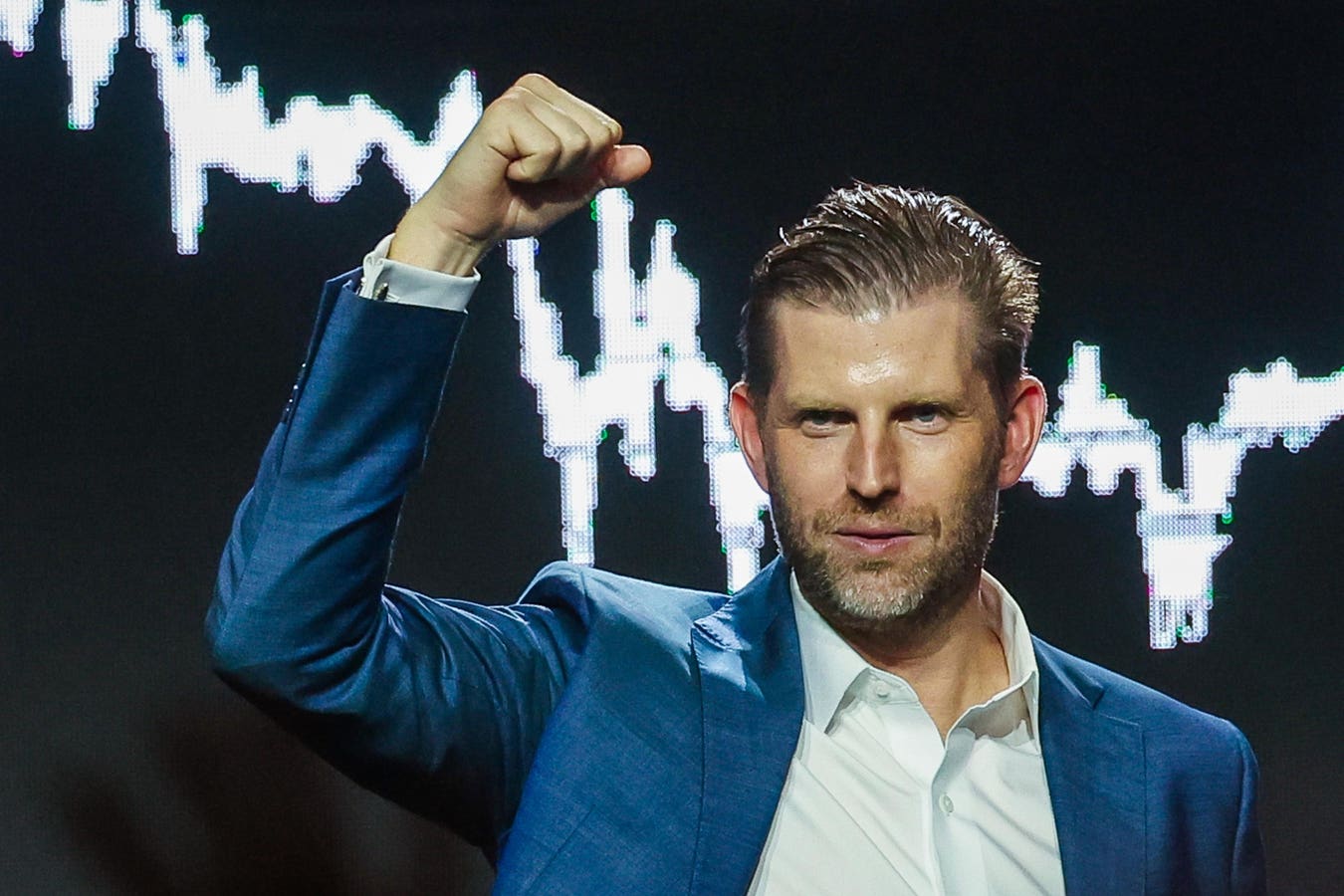
Pumping up a crowd isn’t just helpful in politics. Ask Eric Trump, whose bitcoin business attracted throngs of people, then dumped piles of overpriced stock on them.
Photo by Daniel Ceng/Anadolu via Getty Images
Eric Trump jumped on an earnings call in February ready to do what Trumps do best—sell. His company, American Bitcoin, had debuted just a year earlier and was already trading on the Nasdaq. “We are fast becoming the leader in the bitcoin world, and I truly think we have the greatest brand of all,” Eric said. “I want to recognize Mike, Asher, Matt and everybody at American Bitcoin.”
It was a noteworthy closing—“and everybody at American Bitcoin”—given that there is hardly anyone else at American Bitcoin. An annual report filed one month after the earnings call stated that the company has just two full-time employees, presumably chief executive Mike Ho and president Matt Prusak. Maybe there are a couple of others—Ho also serves as an executive at another company. Someone who worked in investor relations at Ho’s other company for less than a year now calls herself “chief of staff” at American Bitcoin on her LinkedIn page. Another person says she started as American Bitcoin’s social-media manager in January. (Asher Genoot, the executive chairman, sits on a five-person board with Ho and three independent directors.)
The Trump family learned long ago that there is money to be made in acting like things are bigger than they actually are. Fred Trump, Donald’s father, allegedly juiced his profits by duping authorities into thinking his projects cost more than they actually did. Donald Trump lied to banks (and media outlets like Forbes) about the value of his assets, leading a New York judge to conclude that he committed fraud. Eric Trump got caught up in that case, too, and was banned from serving as an officer or director of any New York corporation for two years. He created his own company anyway, incorporated in Delaware and headquartered in Florida, then marketed it in a way that would make his forefathers proud.
Eric Trump’s newest bitcoin venture may be selling a story more than a business. As he tells it, American Bitcoin can print money by mining bitcoin for roughly half of what it is worth. But a closer look at the numbers calls into question whether the company can mine bitcoin profitably at all, let alone with such massive margins. Representatives of Eric Trump, the Trump Organization and American Bitcoin did not respond to repeated requests for comment. Plenty of people trust in the president’s son, putting real money at stake. When American Bitcoin hit the public markets on Sept. 3, investors valued Eric Trump’s company—with an estimated $270 million of bitcoin on its balance sheet—at $13.2 billion.
Over the last eight months, American Bitcoin has taken advantage of that astronomical valuation, dumping shares to buy more bitcoin. The much-diluted stock is now down 92% from its peak. Given that Eric Trump seems to have invested little to get involved with the venture in the first place, he’s still doing fine, having boosted his personal fortune from an estimated $190 million to $280 million through a stroke of financial alchemy. Other insiders have done well, too. The everyday investors who bought into the sales pitch, by contrast, are down an estimated $500 million.
Eric Trump, left, distinguished himself inside the Trump family as the charitable son, starting a fundraiser at his father’s golf course to raise money for St. Jude Children’s Research Hospital shortly after graduating from college.
Photo by Bobby Bank/WireImage
Eric Trump’s first big standalone project wasn’t a condo tower—it was a charity. He graduated from Georgetown in 2006 with a degree in finance and management, eager to make an impact on the world. His older siblings, Don Jr. and Ivanka, were already inside Trump Tower by then, working on real-estate deals. Rolling on the New Jersey turnpike one day, as Eric later recalled in an interview with Forbes, his mind moved to other pursuits—specifically how he might make a difference in the world. So began his formative entrepreneurial venture, a nonprofit named the Eric Trump Foundation.
The group did a lot of good. More of a fundraising organization than an operating charity, it routed over $16 million to St. Jude Children’s Research Hospital. But as the years passed, the group—and Eric himself—started to look more Trumpian, with a dishonest sales pitch, weak governance and sketchy financials, according to a review of documents obtained by Forbes through a freedom of information request, despite objections from the nonprofit’s legal team. Eric Trump told donors he limited expenses and ensured that virtually all their money went straight to St. Jude, in part because his dad let him use Trump clubs for free and famous people agreed to perform “pro bono.” But checks and invoices uncovered by Forbes indicate that more than $500,000 went to other charities, over $500,000 went to Trump properties, at least $90,000 went to various performers and more than $35,000 went to a chauffeur service that drove passengers including Eric’s mom, a cast member of “The Real Housewives” and a sprinter van of people headed to a Hooters restaurant.
At his day job inside his father’s business, Eric spent much of his early years working on hotels, where he learned many things, including how much easier it is to make money branding businesses than actually building them. The Trump Organization defaulted on a loan against a hotel it constructed in Chicago in 2008, took its Atlantic City portfolio into bankruptcy in 2009, then struggled to make money on its Washington, D.C. hotel year after year. Ultimately, the Trumps shifted their hotel empire toward an “asset-light” approach, as it’s known in the industry, focused more on managing and licensing than developing.
Eric’s other training ground: his father’s golf portfolio, where he witnessed the benefits of unorthodox financing structures. In the 1980s and 1990s, golf clubs often took deposits from people when they joined, promising to pay the money back with zero interest after 30 years. Those liabilities sat on the books of the clubs, scaring off many investors when the properties went up for sale. Not Donald Trump, though. He approached the liabilities fearlessly, eventually taking on about $250 million of them. That allowed him to build a collection of a dozen golf properties around the country while acting like the liabilities barely existed—for years, he valued them at zero on his personal balance sheets. By the time the money started coming due, the properties were worth far more than what the elder Trump owed.
In January 2017, when Donald Trump went to the White House, Eric and his brother Don Jr. took over operations of their father’s portfolio. Eric did not seem to have much of a vision, other than hoping to do things the way his dad did. “We’re not a company that sells assets,” he told Forbes from his perch on the 25th floor of Trump Tower in February 2017. “We buy things. We make them beautiful.” The Trump heirs experimented with new ventures, including two mid-tier hotel brands, but didn’t have much success. With the business struggling and their dad’s cash reserves depleted, they ended up spending the next seven years largely doing what Eric said they would not—selling assets, an estimated $411 million of them in all.
Then came a new moneymaking opportunity: the 2024 election.
A return to the presidency meant business opportunities for the president’s children, pictured Jan. 20, 2025 at their father’s second inauguration.
Photo by Kenny Holston-Pool/Getty Images
Just two weeks after Donald Trump defeated Kamala Harris, the company that would become American Bitcoin was incorporated in Delaware. It wasn’t always a crypto play. Hussain Sajwani, a developer who had partnered with the Trump family on a golf project in Dubai, visited Mar-a-Lago in January to announce a $20 billion investment in American data centers to capitalize on the artificial intelligence boom. “That man knows what he’s doing,” the president-elect said. Within weeks, Trump’s sons revealed plans to pursue a similar strategy with a company named American Data Centers, which Eric Trump deemed “crucial for the development of AI infrastructure in the United States.”
Then he changed course a month later. Through mutual friends, Eric and Don Jr. hooked up with two entrepreneurs, Asher Genoot and Mike Ho, who already had a business like the Trumps wanted to create, a data-center giant named Hut 8. In addition to AI exposure, that company had significant bitcoin-mining operations, which meant it owned a lot of machines capable of solving complicated puzzles to unlock cryptocurrency. Not long after artificial intelligence burst onto the scene, the amount of bitcoin awarded for each solved puzzle fell by 50%, making it much more expensive to mine bitcoin. Industry-wide, investors shifted computing resources to artificial intelligence, and Hut 8’s institutional shareholders pushed Genoot to follow the herd.
But Genoot and Ho, with backgrounds in branding and arbitrage, landed on a more creative solution: Get the Trumps to ditch their data-center idea by offering a 20% stake in the bitcoin-mining equipment. Then, with the first family on board, spin the hardware into publicly traded, Trump-fueled hype machine.
The deal structure seemed tailored to appeal to someone familiar with hotels. While the machines hum away, American Bitcoin operates as if it were an asset-light hospitality brand. Hut 8 retains the real estate, runs the data centers, handles back-office functions, even provides the executives—Prusak once worked for Hut 8, and Ho still does, simultaneously serving as American Bitcoin’s CEO and Hut 8’s chief strategy officer. That allows the Trumps to focus on their strength: salesmanship.
“I’ll never forget saying to them, ‘Listen, it’s got to have two words in it,” Eric Trump later recalled in a video interview with CoinDesk. “It has to have ‘America.’ And it has to have ‘Bitcoin.’ And one of the two guys said, ‘Listen, Eric. American Bitcoin. That’s got to be the name.’”
Investors went wild for American Bitcoin the moment it hit the public markets, briefly boosting Eric Trump’s estimated net worth above $1 billion.
Photo by Michael M. Santiago/Getty Images
For as long as Eric Trump has been a part of the crypto community, he has been spreading a myth about why he became involved. “I got canceled by every single bank in the country,” he said at a conference in Wyoming last August. “Because my father is a political guy, we were getting debanked,” he added about a week later in Hong Kong. “Every single one of the big banks, they started canceling us,” he claimed in Palm Beach earlier this year. “Guess what we did? We went out, and we got into DeFi because we realized it was the future of finance.”
But that’s not quite what happened. Sure, Capital One and JPMorgan Chase closed some Trump accounts in 2021, six years after Donald Trump got into politics. The president’s reputation was under strain at the time, not only from the January 6 riot but also from a sprawling investigation by the New York attorney general. A judge ultimately concluded that the Trump Organization had committed fraud and would likely do so again. Still, plenty of banks were open to doing business with the Trumps—even JPMorgan Chase, which helped refinance two of the largest loans in the Trump portfolio shortly after closing certain accounts. Having exited the White House low on cash and high on leverage, Trump needed help from big lenders, and that is exactly what he got: From January 2021 to mid-2022, the former president—with his sons Eric and Don Jr. at his side—refinanced nearly $700 million of debt as part of a wholesale restructuring of his balance sheet.
So why did Trump really get into crypto? A more plausible explanation is that he spotted an opportunity to extend his licensing business, hawking non-fungible tokens in the same way he sold sneakers and guitars. He began with NFT trading cards, digital images featuring Trump stylized as a superhero. They sold out in a day and ultimately provided the former president with more than $7 million in cash and crypto. Every penny counted for a guy contending with a roughly half-billion-dollar judgement from the fraud suit. (An appellate justice later threw out the penalty, citing disagreement with the size of the fine but not with the finding that Trump committed fraud.) Later crypto projects provided hundreds of millions in additional liquidity, leading to increasingly large bets from the first family, such as a separate deal announced last May to plow roughly $2 billion into cryptocurrency via the Trump Media and Technology Group.
Piling up bitcoin became the trade of the year in 2025, with more than 200 public companies copying the playbook of Michael Saylor’s Strategy, which amassed more than $50 billion of bitcoin on its balance sheet, exploded in value when the price surged last year, then tanked more recently. American Bitcoin stood out from the crowd for an obvious reason: Its connection to the first family. But the day American Bitcoin hit the public market on Sept. 3, Eric Trump logged onto a Spaces conversation on X with a more numbers-driven pitch. “We’re literally mining every day bitcoin for roughly $57,000, $58,000 a coin,” he said, noting that a single bitcoin cost about twice as much at the time. “We couldn’t have better fundamentals.”
It was a compelling case, though one made by a guy who had been glossing over unflattering expenses since his days hosting charity fundraisers. Fifty-some thousand dollars covered the cost to run American Bitcoin’s machines. But add in other expenses—like purchasing those machines, marketing the company and allocating capital—and you get to a much higher number, more like $92,000 per bitcoin at the time, enough to turn a profit only if crypto prices stayed high.
Accounting for depreciation is especially important in the case of American Bitcoin because of an unorthodox financing strategy it adopted from Hut 8. In August and September, American Bitcoin splurged on a roughly $330 million upgrade to its fleet of miners. But rather than hand over cash up front, Eric Trump’s company pledged bitcoin and secured an option for how it would ultimately pay. If the price of bitcoin goes up, the company can fork over an estimated $330 million in cash and retain the pledged bitcoin. But if the price of bitcoin declines, American Bitcoin can hand over the crypto.
Since the big purchase, bitcoin has dropped about 30%. That means that, at this point, it seems likely that American Bitcoin will forfeit its pledged crypto to cover the cost of the machines. But here’s the thing: American Bitcoin’s total pledge amounts to 3,090 bitcoin (as of March 25), and the company has only mined an estimated 1,800 bitcoin. In other words, if prices don’t rebound, every single bitcoin the company has mined so far will likely be wiped out when the options begin expiring around August 2027.
Not that investors necessarily understand that. The company has another 15 months or so to decide whether it’s going to pay for its machines in crypto or cash, and in the meantime, the mined bitcoin remains on the company’s balance sheet. The result: American Bitcoin looks far more robust than it actually is. The company makes this bitcoin stash a centerpiece of its pitch to investors, while downplaying the fact that all of it may have to be turned over to pay for the machines that mined it.
Beyond the marketing appeal, it’s easy to see why the Trumps might have been intrigued by this method of payment, given that they took advantage of similarly unorthodox financing to build out a collection of golf courses. They ended up in good shape on that bet, however, because the value of the assets actually went up.
Eric Trump has turned into a regular at crypto conferences around the world, like this one in Hong Kong, touting his belief in bitcoin.
Photo by Daniel Ceng/Anadolu via Getty Images
About 70% of the crypto inside American Bitcoin doesn’t come from mining at all—it comes from simply selling stock and buying bitcoin on the open market. Therein lies the foundational secret of American Bitcoin. Why did Hut 8 essentially hand over a 20% stake in its bitcoin-mining machines to a barely created data center business? Probably because, in the age of meme stocks and MAGA mania, a Trump connection can draw in enough dumb money to push a stock to the stratosphere. Then, with shares trading at prices that make little sense, the company can sell its own stock and reinvest the money in bitcoin, accumulating mountains of crypto. It’s hype-fueled arbitrage: Convince investors a company is super valuable, then sell shares when you know they’re absurdly priced. So long as the charade generates more money than the 20% stake in the machines are worth, it turns into a profitable exercise for the insiders who set it up—if not for the everyday traders buying the stock.
The dumping began almost immediately. In the 27 days after American Bitcoin went public, with buzz abounding, the company sold 11 million shares for $90 million, cashing out at an average price of about $8 per share. After the outsiders working the deal took their cut—$2 million in this case—American Bitcoin purchased an estimated 725 bitcoins. Trading continued as the stock drifted downward. From the start of October to mid-November, American Bitcoin offloaded 7 million shares for $44 million, collecting a little over $6 per share. Then, around late November, after a big plunge in the price of bitcoin, the company went all-in, unloading 47 million shares for about $106 million (roughly $2.25 per share) to close out the year.
It wasn’t just the company ditching stock. When the lockup provisions for early investors began to expire around the start of December, shares fell by 48% over two trading days. High-profile cheerleaders tried to inject some confidence. Crypto evangelists Cameron and Tyler Winklevoss—whose efforts to cozy up to the Trump family have included super-PAC donations and support for the White House ballroom—pledged their allegiance. Same with short-lived White House communications director Anthony Scaramucci. Conference host Grant Cardone said he was “a long-term investor, not a trader” and then noted that his tweet was “not financial advice.” American Bitcoin’s social-media account reposted all this to its followers. Cardone and the Winklevoss twins did not respond to requests for comment, and a representative for Scaramucci declined to answer questions.
The price of bitcoin continued to slide, especially when the Fed halted its rate cuts in January. The company stuck to its strategy, selling 84 million shares for $111 million from Jan. 1 to March 25 and purchasing about 1,430 additional bitcoin, according to Forbes calculations. Count up everything, and American Bitcoin spent an estimated $525 million from its founding to late March on crypto that is now worth $390 million—torching $135 million of shareholder money in the process.
Eric Trump praised the United Arab Emirates on stage at a crypto conference in Dubai last year. “The rest of the world has to be careful of the UAE for one reason,” he told the audience. “They always arrive at the word ‘yes.’”
Photo by GIUSEPPE CACACE/AFP via Getty Images
American Bitcoin keeps mining. But with the value of bitcoin down 31% since the company hit the public market, the economics are increasingly perilous. Fine-tuning a fleet of new machines helped drive the cost of running the equipment down to about $47,000 per bitcoin mined. But the all-in cost—including overhead, amortization and depreciation—still stands at an estimated $90,000 per bitcoin, or about $13,000 more than bitcoin is currently worth. Shares are down 29% since the start of the year.
What happens to Eric Trump’s company if investors stop buying into the fantasy that it prints money? The president’s son can simply cross his fingers and hope that the price of bitcoin shoots back up. It is, after all, a wildly volatile asset. A gain of 35% should allow American Bitcoin to pay for the machines with cash, keep its crypto, and turn that $135 million trading loss into a slight profit, according to Forbes calculations. The president’s son could claim the wild ride was all part of the plan.
Or, if he doesn’t want to just leave the success of the company up to chance, Eric Trump could perhaps find some foreign investors who are eager to help. Sheikh Tahnoon bin Zayed Al Nahyan of the United Arab Emirates has already developed ties to another Trump crypto venture, steering an estimated $375 million to the president and his sons. Tahnoon’s investment has so far produced questionable financial returns, but the UAE did receive help from President Trump in pursuing its AI ambitions. The country is now reportedly seeking relief from the United States amid economic challenges created by the war in Iran.
Mike Ho, the CEO of American Bitcoin, resided in the UAE as recently as November 2023, though a representative for the company did not respond to inquiries about where he lives today. Regardless, Ho was in the gulf nation last October, speaking with a journalist from Arabian Gulf Business Insight when he mentioned talks with an investment group named ADQ and an energy firm called TAQA, both of which are connected to Sheikh Tahnoon. A spokesperson for American Bitcoin told Forbes in October that Ho was referring to conversations that predated the launch of American Bitcoin. But a transcript of the conversation recently obtained by Forbes suggests that American Bitcoin is open to overseas deals.
“I’ve met with a lot of sovereigns here over Hut and under American Bitcoin,” Ho said, according to the transcript. “There’s always conversations going on.” When pressed on whether he would consider bitcoin-mining operations in the region, Ho responded, “We’re always monitoring this. I’ve had conversations with ADQ and TAQA. We’ve looked at the portfolio. The UAE has a ton of excess power, and bitcoin mining is a great way to monetize that excess generation.”
Spoken like a man who knows an easy arbitrage opportunity when he sees one.
First Appeared on
Source link


Leave feedback about this