

Unlock the Editor’s Digest for free
Roula Khalaf, Editor of the FT, selects her favourite stories in this weekly newsletter.
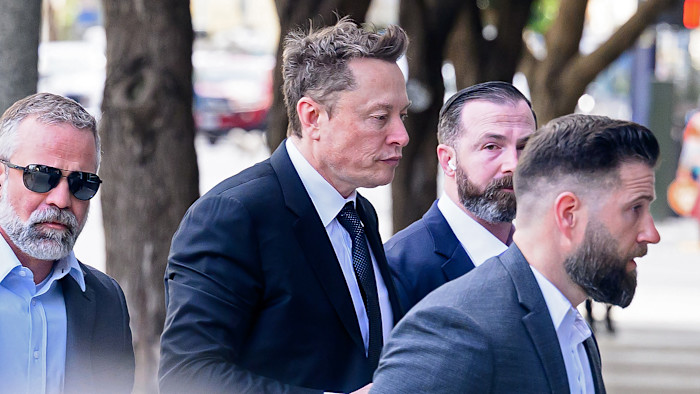
Elon Musk has acknowledged that the tweet at the centre of a multibillion-dollar lawsuit over his $44bn acquisition of Twitter “may not have been my wisest” as the world’s richest man defends himself from allegations of market manipulation in court.
He told a San Francisco jury on Wednesday that his post was not intended to manipulate Twitter’s stock price in the midst of the takeover battle.
A group of Twitter investors has alleged they lost money after Musk threatened to walk away from the deal to gain leverage during takeover talks, despite being aware he would be legally forced to complete the $44bn buyout.
After signing a binding agreement to buy the company in April 2022 and waiving his rights to conduct due diligence, Musk soon started raising concerns about the number of bots on the platform.
On May 13 he tweeted the deal was “temporarily on hold” unless the company could prove that “spam/fake accounts do indeed represent less than 5% of users”. The stock fell 9 per cent when markets opened that day.
The trial marks the latest instance of legal scrutiny around Musk’s prolific use of Twitter, which he has since rebranded as X and merged with his other companies xAI and SpaceX.
Musk said the post was made in the early hours of the morning and he did not run it past any advisers or friends first.
“It may not have been my wisest tweet,” Musk told the court. “I am not sure I would call it incredibly stupid . . . but if it led to this trial, it probably qualifies as such.”
Musk said his “on hold” comments were literal and akin to saying he would be late to a meeting, not that he would not turn up. He added he did not consider whether investors would believe the takeover was now in doubt.
Soon after the 2022 tweet, Musk doubled down on the bot and spam allegations, posting four days later that the deal “cannot go forward”. He appeared at a conference in Miami to accuse Twitter of lying in its regulatory filings and said, “You can’t pay the same price for something that is much worse than they claimed.”
When Twitter chief executive Parag Agrawal protested that the bot data was accurate, Musk sent him a poop emoji on Twitter.
Twitter shares eventually fell to just above $30, a third below the deal price. The shareholders who are now suing sold their stock at the lower price, only for the acquisition to close in October on its original terms at $54.20 per share after the company’s board sued Musk to close the deal.
Lawyers for the plaintiffs claimed Musk was following suggestions from his bankers that he pursue a “rope a dope” or “jujitsu strategy” to initially propose a lucrative deal before threatening to back out.
Musk denied the claim and contended that he was “simply speaking my mind” and trying to save the platform when raising concerns about bots.
He added it is impossible to predict the reaction of markets to his comments, which often behave like a “manic depressive”, and that “people tend to read too much into things that I do”.
The plaintiffs allege Musk misled the market because he knew, or should have known, that the takeover agreement did not allow him to conduct extra checks after he waived his rights to due diligence to make the deal more attractive to the Twitter board. The deal contract also had stiff penalty clauses to stop the billionaire walking away.
The lawyers also showed emails to Musk and his top lieutenants from bankers at Barclays on May 9 ahead of his “on hold” tweet.
“This could present you with an opportunity to revisit price,” the banker wrote. “It may not be a costless ask, as you will have to be perceived as being willing to risk paying the reverse break fee. However, the threat of walking away may be sufficient to get them to agree to a lower price.”
A later email from Barclays after the tweet said investors were now giving the deal “50/50 odds” and the share price would not move higher because they feared “more tweets with deal implications”.
Musk replied: “Matches my understanding of things.”
Shareholders are expected to ask for billions in damages if the jury rules in their favour.
“Musk believes he can say or do whatever he wants anytime he wants, regardless of the consequences,” an attorney for the four plaintiffs said. After getting cold feet on the deal and struggling to sell enough Tesla stock to finance it, he started “a public spectacle to trash the company and drive stock price down”.
Musk grew frustrated during questioning, accusing the lawyers of formulating questions “designed to mislead the jury” and trying to “put words into my mouth”.
He added he had not had time to read his deposition transcripts or prepare for the hearing because he has “an insane workload, 100 hours a week”.
During the two-week trial plaintiffs plan to call on several of Musk’s top lieutenants including his lawyer Alex Spiro, who recused himself from acting as an attorney in the case because he is also a witness.
On Tuesday, they questioned the head of his family office Jared Birchall, who said Musk’s tweets about the deal were made in frustration and work never stopped on the deal.
Musk is scheduled to appear in a separate trial in Oakland next month. He has sued OpenAI and its CEO Sam Altman in an attempt to block the $730bn start-up’s transformation from a non-profit to a for-profit company. Musk was a co-founder of OpenAI in 2015 but left three years later after his attempts to buy it were rebuffed.
First Appeared on
Source link


Leave feedback about this