

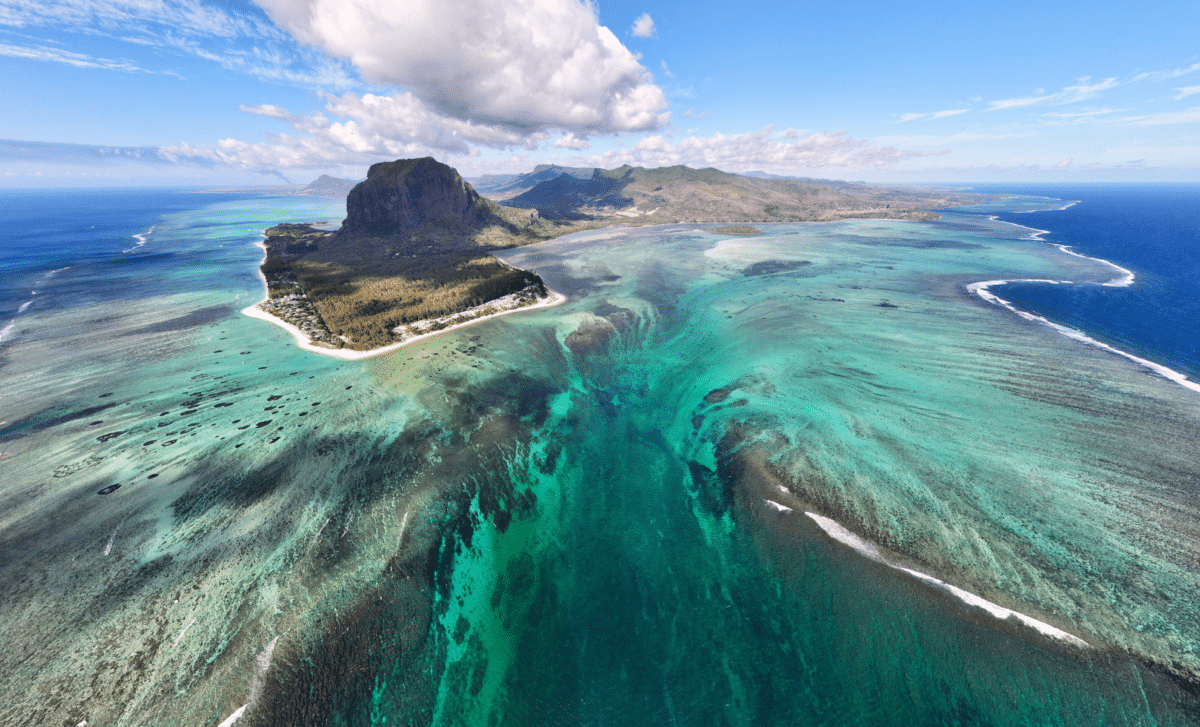
For centuries, waterfalls have captured the imagination of travelers and scientists alike. From Niagara Falls to Angel Falls, these dramatic cascades are usually easy to spot, roaring over cliffs and sending mist high into the air. Yet the largest waterfall on Earth is completely invisible from the surface. Hidden beneath the frigid waters between Iceland and Greenland lies the Denmark Strait cataract, a massive underwater cascade plunging nearly 11,500 feet toward the ocean floor. According to research highlighted by the NOAA National Ocean Service, this colossal flow of dense Arctic water is the tallest waterfall on the planet and one of the most powerful drivers of ocean circulation.
A Massive Waterfall Hidden Beneath The Arctic Ocean
Unlike the waterfalls seen on land, the Denmark Strait cataract forms through a completely different process. Instead of river water spilling over a cliff, this underwater giant is created by the movement of dense ocean water masses. Cold, salty water from the Nordic Seas becomes heavier than the surrounding water and sinks as it moves south toward the Atlantic Ocean. When this dense water reaches a submerged ridge on the seafloor between Iceland and Greenland, it plunges downward, forming a massive underwater cascade stretching hundreds of miles across the seafloor.
The drop itself is astonishing. Scientists estimate the waterfall descends roughly 11,500 feet, making it more than three times taller than Angel Falls, the tallest waterfall on land. Yet despite its scale, it remains hidden under layers of ocean water and produces none of the dramatic visual effects that usually define waterfalls. Marine geologist Mike Clare, leader of marine geosystems at the U.K.’s National Oceanography Centre in Southampton, explained how subtle the phenomenon can appear in the deep ocean. “If we visualize it, it looks like a relatively low-gradient slope,” Clare previously told Live Science. “If you were down there, you probably wouldn’t notice a whole heap going on,” he said. Instead of a roaring cascade, the flow behaves more like a massive underwater current sliding silently down a submerged incline.
How Scientists Discovered The Planet’s Largest Waterfall
The existence of the Denmark Strait cataract was confirmed through decades of oceanographic research involving temperature sensors, salinity measurements, and deep-water monitoring instruments. Data collected across the strait revealed a powerful stream of extremely dense water moving southward before plunging into the deeper Atlantic basin. According to the NOAA National Ocean Service, the flow can exceed 3 million cubic meters of water every second, making it one of the most significant underwater flows on the planet.
This enormous cascade forms where cold Arctic water meets relatively warmer Atlantic water. Differences in temperature and salinity create strong density contrasts that force the heavier water downward. As the dense water passes over a ridge on the seafloor, gravity pulls it into a descending current that spreads across a vast underwater slope. Oceanographers describe this process as a dense water overflow, a phenomenon that occurs in several polar regions but reaches its most dramatic scale in the Denmark Strait. Because the cascade is submerged beneath more than half a mile of ocean water, scientists rely on advanced instruments such as deep-sea profilers, autonomous underwater gliders, and seafloor sensors to track the flow and measure its speed.
(Image credit: NOAA National Ocean Service)
Why This Underwater Giant Matters For Earth’s Climate
Beyond its impressive size, the Denmark Strait cataract plays a critical role in the global ocean circulation system known as the Atlantic Meridional Overturning Circulation (AMOC). This circulation acts like a giant conveyor belt that moves heat, oxygen, and nutrients around the planet. When dense Arctic water sinks and flows southward through the cataract, it helps pull warmer surface water northward from lower latitudes, including water carried by the Gulf Stream. This exchange influences weather patterns across the North Atlantic, especially in Europe.
Researchers are paying increasing attention to how climate change could affect this hidden waterfall. Changes in Arctic temperatures, melting sea ice, and shifts in salinity may alter the density of water masses that feed the cascade. Marine scientist Anna Sanchez Vidal, a professor at the University of Barcelona who led a research expedition to the strait in 2023, described the striking contrast between the calm surface and the immense activity occurring far below. “At the surface, you have typical sunny Arctic conditions,” she previously told Live Science. Beneath those calm waters, however, millions of tons of dense water are constantly sliding into the deep ocean, quietly powering one of the most important engines in Earth’s climate system.
A Powerful Natural Process Still Largely Unseen
Despite decades of research, the Denmark Strait cataract remains one of the least directly observed large-scale phenomena in the ocean. Scientists have mapped its structure and measured its flow using instruments, yet no expedition has captured a complete visual record of the entire cascade. The immense depth, powerful currents, and remote Arctic location make direct observation extremely challenging. As technology advances, oceanographers hope to create detailed three-dimensional maps of the underwater slope and monitor how the flow changes through seasons and long-term climate shifts.
What makes this phenomenon remarkable is not only its scale but also its invisibility. Ships can sail above the strait without noticing anything unusual, while beneath them lies the largest waterfall on Earth, silently shaping the movement of the oceans. The Denmark Strait cataract stands as a reminder that some of the planet’s most powerful natural forces operate far from view, hidden in the depths where ocean physics and climate are deeply intertwined.
First Appeared on
Source link






Leave feedback about this