

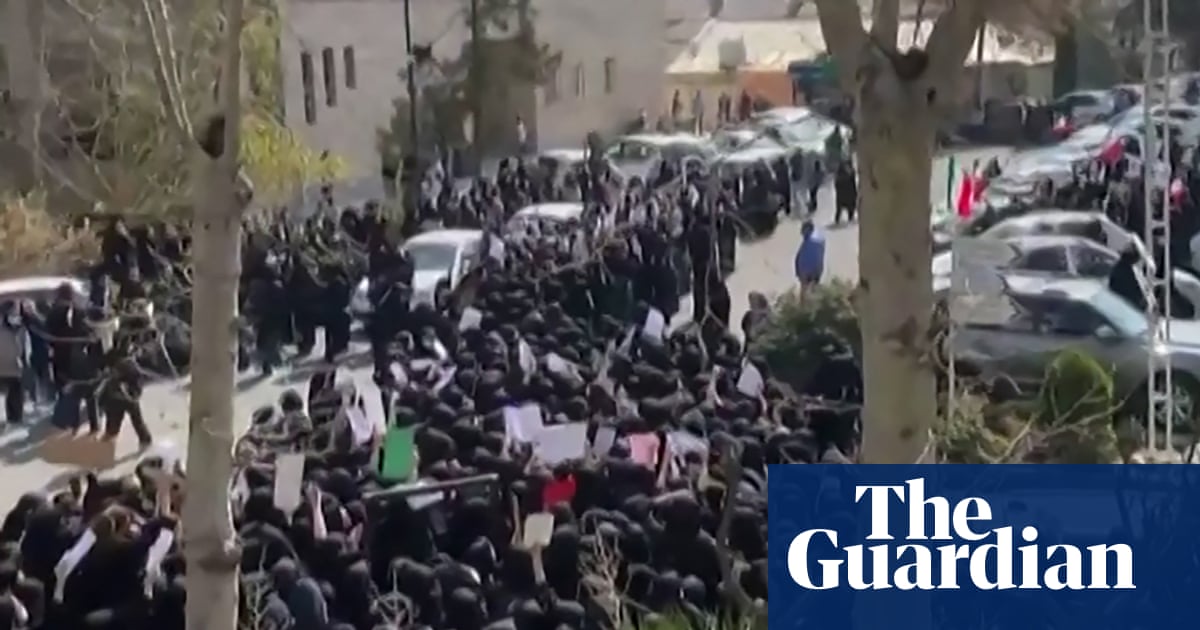
Students at universities in Iran have held a third consecutive day of protests just over a month after the violent suppression by security services of mass street demonstrations left thousands dead.
The protests came amid tensions between Iran and the US. Washington has built up military forces and pressure in the Middle East as it negotiates with Tehran – with the next round in Geneva on Thursday. Donald Trump has warned “really bad things will happen” if there is no deal.
Iran would retaliate “ferociously” against any attack, the foreign ministry spokesperson, Esmail Baghaei, said on Monday.
The demonstrations on Monday spread to campuses including all-women Al Zahra University in Tehran, where anti-government slogans were chanted and an Iranian flag was burned and torn, but did not move to the streets.
A Telegram channel for Iranian students, Anjmotahed, said an attack by the Basij state-backed militia at Sharif University in Tehran left several students injured and an ambulance arrived at the campus. Universities have sent text messages to students warning them of disciplinary consequences.
In a bid to ridicule Iran’s supreme leader, Ayatollah Ali Khamenei, some students climbed trees in the campus and hung toy mice from its branches – a way of saying he was hiding underground like a mouse. Reports said students chanted “death to the dictator”, “for every one killed, a thousand will follow” and “the blood that has been spilled will never be washed away”.
Student representatives who met Iran’s vice-president, Mohammad Reza Aref, at the weekend told him that it was an insult to claim that terrorists had been responsible for the killings during the January protests. “The response to the people’s protests had been given in bullets,” they said.
The renewed protests serve as a further reminder that Trump has not yet fulfilled his pledge to “Iranian patriots” during the January demonstrations that “help is on its way”.
Domestic media coverage of the university protests has been kept to a minimum as the authorities directed universities to ban photographed demonstrators from campus. Students in Iran are supposed to be free from police interference, leading to clashes between students and authorities.
Mohammad Khatami, Iran’s president from 1997 to 2005, has called for the release of all those arrested, saying they are accused of nothing but despair and protest.
Often seen as less critical of the regime than other reformists, Khatami’s remarks mark a change from his initial response to the protests, which he said had been engineered by the US and Israel.
Separately Iranian reformists complained they had been banned from standing for Tehran city council, the first time such political interference – which is common in parliamentary and presidential politics – had spread to local authority level.
Khamenei is facing the gravest crisis of his 36-year tenure, with an economy struggling under the weight of international sanctions and growing unrest since the major protests in January.
In a further ominous sign for the government, five political parties representing Iranian Kurds have agreed to form a coalition to bring down the government. The statement said the Iranian government had lost all legitimacy but remained standing due to the fragmentation of the opposition. It said the coalition stood in solidarity with other nations in Iran and are willing to work in solidarity with all opponents of the Islamic Republic.
The fragmented signs of internal dissent come at an awkward time for the government as the secretary of the Supreme National Council Security Council, Ali Larijani, prepares to meet Omani mediators on Tuesday in Muscat ahead of the major talks on a future nuclear deal due to be held in Geneva on Thursday.
The foreign minister, Abbas Araghchi, has said Iran will put forward proposals to reassure the US that Iran has no plan or means to build a nuclear bomb.
The US willingness to accept Iran’s proposals heavily depends on Trump’s personal response, but Iran appears to be willing to revert to what is known as the Additional Protocol, an agreement that gives the UN nuclear weapons inspectorate enhanced access to Iran’s bombed nuclear sites.
In Geneva, Iran’s deputy foreign minister for legal and international affairs Kazem Gharibabadi told the UN human rights council that countries should turn to diplomacy instead of sanctions and war.
Speaking at the council session, Gharibabadi warned that if war did break out its effects “will not be limited to just the two sides, but will encompass the region”.
He said states that have tried “sanctions and war with Iran” should “experience diplomacy and respect”.
He added: “It is unfortunate that human rights advocates want to teach the Iranian people, who got rid of the Pahlavi dictatorship 47 years ago, a lesson in democracy!”
Iran was on Monday reported to have in December agreed a secret €500m arms deal with Russia to acquire thousands of advanced shoulder-fired missiles to help fill the major hole in Iran’s air defences.
The agreement, signed in Moscow, commits Russia to deliver 500 man-portable Verba launch units and 2,500 9M336 missiles over three years.
First Appeared on
Source link
Leave feedback about this