

Eddy, T. D. et al. Global decline in capacity of coral reefs to provide ecosystem services. One Earth 4, 1278–1285 (2021).
Rocha, J., Peixe, L., Gomes, N. C. M. & Calado, R. Cnidarians as a source of new marine bioactive compounds—an overview of the last decade and future steps for bioprospecting. Mar. Drugs 9, 1860–1886 (2011).
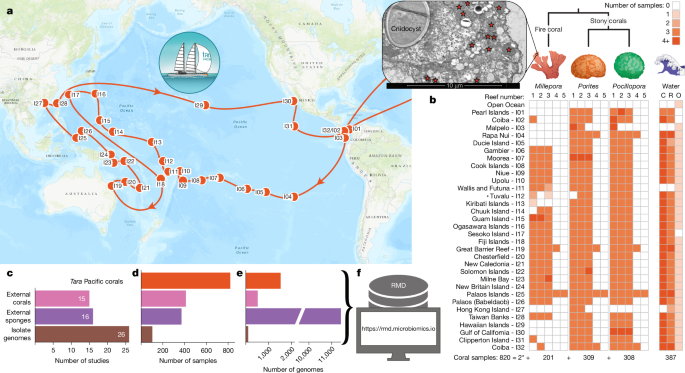
Planes, S. et al. The Tara Pacific expedition—a pan-ecosystemic approach of the ‘-omics’ complexity of coral reef holobionts across the Pacific Ocean. PLoS Biol. 17, e3000483 (2019).
Smith, S. V. Coral-reef area and the contributions of reefs to processes and resources of the world’s oceans. Nature 273, 225–226 (1978).
Fisher, R. et al. Species richness on coral reefs and the pursuit of convergent global estimates. Curr. Biol. 25, 500–505 (2015).
Knowlton, N. The future of coral reefs. Proc. Natl Acad. Sci. USA 98, 5419–5425 (2001).
Intergovernmental Panel on Climate Change (IPCC). Global Warming of 1.5 °C: IPCC Special Report on Impacts of Global Warming of 1.5 °C above Pre-industrial Levels in Context of Strengthening Response to Climate Change, Sustainable Development, and Efforts to Eradicate Poverty (eds Masson-Delmotte, V. et al.) (Cambridge Univ. Press, Cambridge, 2022).
Rohwer, F., Seguritan, V., Azam, F. & Knowlton, N. Diversity and distribution of coral-associated bacteria. Mar. Ecol. Prog. Ser. 243, 1–10 (2002).
Galand, P. E. et al. Diversity of the Pacific Ocean coral reef microbiome. Nat. Commun. 14, 3039 (2023).
Muscatine, L. & Porter, J. W. Reef corals: mutualistic symbioses adapted to nutrient-poor environments. BioScience 27, 454–460 (1977).
Voolstra, C. R. & Ziegler, M. Adapting with microbial help: microbiome flexibility facilitates rapid responses to environmental change. BioEssays 42, e2000004 (2020).
Ritchie, K. B. Regulation of microbial populations by coral surface mucus and mucus-associated bacteria. Mar. Ecol. Prog. Ser. 322, 1–14 (2006).
Kobayashi, M. et al. Marine natural products. XXXIV. Trisindoline, a new antibiotic indole trimer, produced by a bacterium of Vibrio sp. separated from the marine sponge Hyrtios altum. Chem. Pharm. Bull. 42, 2449–2451 (1994).
Bertin, M. J. et al. Spongosine production by a Vibrio harveyi strain associated with the sponge Tectitethya crypta. J. Nat. Prod. 78, 493–499 (2015).
Romero, F. et al. Thiocoraline, a new depsipeptide with antitumor activity produced by a marine Micromonospora. J. Antibiot. 50, 734–737 (1997).
Blockley, A., Elliott, D. R., Roberts, A. P. & Sweet, M. Symbiotic microbes from marine invertebrates: driving a new era of natural product drug discovery. Diversity 9, 49 (2017).
Newman, D. J. From large-scale collections to the potential use of genomic techniques for supply of drug candidates. Front. Mar. Sci. 5, 401 (2018).
Sweet, M. et al. Insights into the cultured bacterial fraction of corals. mSystems 6, e0124920 (2021).
Pye, C. R., Bertin, M. J., Lokey, R. S., Gerwick, W. H. & Linington, R. G. Retrospective analysis of natural products provides insights for future discovery trends. Proc. Natl Acad. Sci. USA 114, 5601–5606 (2017).
Blin, K. et al. antiSMASH 5.0: Updates to the secondary metabolite genome mining pipeline. Nucleic Acids Res. 47, W81–W87 (2019).
Pachiadaki, M. G. et al. Charting the complexity of the marine microbiome through single-cell genomics. Cell 179, 1623–1635 (2019).
Nayfach, S. et al. A genomic catalog of Earth’s microbiomes. Nat. Biotechnol. 39, 499–509 (2021).
Loureiro, C. et al. Comparative metagenomic analysis of biosynthetic diversity across sponge microbiomes highlights metabolic novelty, conservation, and diversification. mSystems 7, e00357-22 (2022).
Paoli, L. et al. Biosynthetic potential of the global ocean microbiome. Nature 607, 111–118 (2022).
van de Water, J. A., Tignat-Perrier, R., Allemand, D. & Ferrier-Pagès, C. Coral holobionts and biotechnology: from Blue Economy to coral reef conservation. Curr. Opin. Biotechnol. 74, 110–121 (2022).
Leopold-Messer, S. et al. Animal-associated marine Acidobacteria with a rich natural-product repertoire. Chem 9, 3696–3713 (2023).
Voolstra, C. R. et al. Disparate genetic divergence patterns in three corals across a pan-Pacific environmental gradient highlight species-specific adaptation. NPJ Biodivers. 2, 15 (2023).
Lombard, F. et al. Open science resources from the Tara Pacific expedition across coral reef and surface ocean ecosystems. Sci. Data 10, 324 (2023).
Jain, C., Rodriguez-R, L. M., Phillippy, A. M., Konstantinidis, K. T. & Aluru, S. High throughput ANI analysis of 90K prokaryotic genomes reveals clear species boundaries. Nat. Commun. 9, 5114 (2018).
Ruscheweyh, H.-J. et al. Cultivation-independent genomes greatly expand taxonomic-profiling capabilities of mOTUs across various environments. Microbiome 10, 212 (2022).
Sunagawa, S., Woodley, C. M. & Medina, M. Threatened corals provide underexplored microbial habitats. PLoS ONE 5, e9554 (2010).
Sunagawa, S. et al. Structure and function of the global ocean microbiome. Science 348, 1261359 (2015).
Novichkov, P. S., Wolf, Y. I., Dubchak, I. & Koonin, E. V. Trends in prokaryotic evolution revealed by comparison of closely related bacterial and archaeal genomes. J. Bacteriol. 191, 65–73 (2009).
Giovannoni, S. J., Cameron Thrash, J. & Temperton, B. Implications of streamlining theory for microbial ecology. ISME J. 8, 1553–1565 (2014).
Hentschel, U., Piel, J., Degnan, S. M. & Taylor, M. W. Genomic insights into the marine sponge microbiome. Nat. Rev. Microbiol. 10, 641–654 (2012).
Voolstra, C. R. et al. The coral microbiome in sickness, in health and in a changing world. Nat. Rev. Microbiol. 22, 460–475 (2024).
Kautsar, S. A., van der Hooft, J. J. J., de Ridder, D. & Medema, M. H. BiG-SLiCE: a highly scalable tool maps the diversity of 1.2 million biosynthetic gene clusters. GigaScience 10, giaa154 (2021).
Ghurye, J. S., Cepeda-Espinoza, V. & Pop, M. Metagenomic assembly: overview, challenges and applications. Yale J. Biol. Med. 89, 353–362 (2016).
Carroll, A. R., Copp, B. R., Davis, R. A., Keyzers, R. A. & Prinsep, M. R. Marine natural products. Nat. Prod. Rep. 39, 1122–1171 (2022).
Schwarzer, D., Finking, R. & Marahiel, M. A. Nonribosomal peptides: from genes to products. Nat. Prod. Rep. 20, 275–287 (2003).
MarinLit: a Database of the Marine Natural Products Literature (Royal Society of Chemistry, accessed 12 March 2025); https://marinlit.rsc.org/.
Burkhardt, I., de Rond, T., Chen, P. Y.-T. & Moore, B. S. Ancient plant-like terpene biosynthesis in corals. Nat. Chem. Biol. 18, 664–669 (2022).
Crits-Christoph, A., Diamond, S., Butterfield, C. N., Thomas, B. C. & Banfield, J. F. Novel soil bacteria possess diverse genes for secondary metabolite biosynthesis. Nature 558, 440–444 (2018).
Repka, L. M., Chekan, J. R., Nair, S. K. & van der Donk, W. A. Mechanistic understanding of lanthipeptide biosynthetic enzymes. Chem. Rev. 117, 5457–5520 (2017).
Zhang, Q., Yu, Y., Vélasquez, J. E. & van der Donk, W. A. Evolution of lanthipeptide synthetases. Proc. Natl Acad. Sci. USA 109, 18361–18366 (2012).
Cavener, D. R. GMC oxidoreductases. A newly defined family of homologous proteins with diverse catalytic activities. J. Mol. Biol. 223, 811–814 (1992).
Sützl, L., Foley, G., Gillam, E. M. J., Bodén, M. & Haltrich, D. The GMC superfamily of oxidoreductases revisited: Analysis and evolution of fungal GMC oxidoreductases. Biotechnol. Biofuels 12, 118 (2019).
Pola, S. in Scope of Selective Heterocycles From Organic and Pharmaceutical Perspective Ch. 1 (ed. Varala, R.) (IntechOpen, 2016).
Cox, C. L., Doroghazi, J. R. & Mitchell, D. A. The genomic landscape of ribosomal peptides containing thiazole and oxazole heterocycles. BMC Genomics 16, 778 (2015).
Steinberg, D. A. et al. Protegrin-1: a broad-spectrum, rapidly microbicidal peptide with in vivo activity. Antimicrob. Agents Chemother. 41, 1738–1742 (1997).
Hoeksema, B. W., Cairns, S. & Samimi-Namin, K. World List of Scleractinia (accessed 20 November 2023); https://www.marinespecies.org/scleractinia.
Limborg, M. T., Winther-Have, C. S., Morueta-Holme, N., Gilbert, M. T. P. & Rasmussen, J. A. The overlooked biodiversity loss. Trends Ecol. Evol. 39, 889–891 (2024).
Planes, S. & Allemand, D. Insights and achievements from the Tara Pacific expedition. Nat. Commun. 14, 3131 (2023).
Deshuraud, R. et al. From genome wide SNPs to genomic islands of differentiation: the quest for species diagnostic markers in two scleractinian corals, Pocillopora and Porites. Preprint at bioRxiv https://doi.org/10.1101/2022.10.21.513203 (2022).
Pesant, S. et al. Tara Pacific samples provenance and environmental context—version 2. Zenodo https://doi.org/10.5281/ZENODO.4068292 (2020).
Belser, C. et al. Integrative omics framework for characterization of coral reef ecosystems from the Tara Pacific expedition. Sci. Data 10, 326 (2023).
Pfeifer, C. R. et al. Quantitative analysis of mouse pancreatic islet architecture by serial block-face SEM. J. Struct. Biol. 189, 44–52 (2015).
Leblud, J., Moulin, L., Batigny, A., Dubois, P. & Grosjean, P. Artificial coral reef mesocosms for ocean acidification investigations. Biogeosci. Discuss. 11, 15463–15505 (2014).
Meyer, J. L., Gunasekera, S. P., Scott, R. M., Paul, V. J. & Teplitski, M. Microbiome shifts and the inhibition of quorum sensing by Black Band Disease cyanobacteria. ISME J. 10, 1204–1216 (2016).
Cai, L. et al. Metagenomic analysis reveals a green sulfur bacterium as a potential coral symbiont. Sci. Rep. 7, 9320 (2017).
Sato, Y. et al. Unraveling the microbial processes of black band disease in corals through integrated genomics. Sci. Rep. 7, 40455 (2017).
Wang, L. et al. Corals and their microbiomes are differentially affected by exposure to elevated nutrients and a natural thermal anomaly. Front. Mar. Sci. 5, 101 (2018).
Robbins, S. J. et al. A genomic view of the reef-building coral Porites lutea and its microbial symbionts. Nat. Microbiol. 4, 2090–2100 (2019).
Yang, S.-H. et al. Metagenomic, phylogenetic, and functional characterization of predominant endolithic green sulfur bacteria in the coral Isopora palifera. Microbiome 7, 3 (2019).
Lima, L. F. O. et al. Modeling of the coral microbiome: the influence of temperature and microbial network. mBio 11, e02691-19 (2020).
Messyasz, A. et al. Coral bleaching phenotypes associated with differential abundances of nucleocytoplasmic large DNA viruses. Front. Mar. Sci. 7, 555474 (2020).
Ngugi, D. K., Ziegler, M., Duarte, C. M. & Voolstra, C. Genomic blueprint of glycine betaine metabolism in coral metaorganisms and their contribution to reef nitrogen budgets. iScience 23, 101120 (2020).
Vohsen, S. A. et al. Deep-sea corals provide new insight into the ecology, evolution, and the role of plastids in widespread apicomplexan symbionts of anthozoans. Microbiome 8, 34 (2020).
Santoro, E. P. et al. Coral microbiome manipulation elicits metabolic and genetic restructuring to mitigate heat stress and evade mortality. Sci. Adv. 7, eabg3088 (2021).
Keller-Costa, T. et al. Metagenomic insights into the taxonomy, function, and dysbiosis of prokaryotic communities in octocorals. Microbiome 9, 72 (2021).
Cárdenas, A. et al. Greater functional diversity and redundancy of coral endolithic microbiomes align with lower coral bleaching susceptibility. ISME J. 16, 2406–2420 (2022).
Palladino, G. et al. Metagenomic shifts in mucus, tissue and skeleton of the coral Balanophyllia europaea living along a natural CO2 gradient. ISME Commun. 2, 65 (2022).
Agarwal, V. et al. Metagenomic discovery of polybrominated diphenyl ether biosynthesis by marine sponges. Nat. Chem. Biol. 13, 537–543 (2017).
Jahn, M. T. et al. A phage protein aids bacterial symbionts in eukaryote immune evasion. Cell Host Microbe 26, 542–550 (2019).
Busch, K. et al. Microbial diversity of the glass sponge Vazella pourtalesii in response to anthropogenic activities. Conserv. Genet. 21, 1001–1010 (2020).
Engelberts, J. P. et al. Characterization of a sponge microbiome using an integrative genome-centric approach. ISME J. 14, 1100–1110 (2020).
Glasl, B. et al. Comparative genome-centric analysis reveals seasonal variation in the function of coral reef microbiomes. ISME J. 14, 1435–1450 (2020).
Pascelli, C. et al. Viral ecogenomics across the Porifera. Microbiome 8, 144 (2020).
Storey, M. A. et al. Metagenomic exploration of the marine sponge Mycale hentscheli uncovers multiple polyketide-producing bacterial symbionts. mBio 11, e02997-19 (2020).
Nguyen, N. A. et al. An obligate peptidyl brominase underlies the discovery of highly distributed biosynthetic gene clusters in marine sponge microbiomes. J. Am. Chem. Soc. 143, 10221–10231 (2021).
Rusanova, A., Fedorchuk, V., Toshchakov, S., Dubiley, S. & Sutormin, D. An interplay between viruses and bacteria associated with the white sea sponges revealed by metagenomics. Life (Basel) 12, 25 (2021).
Robbins, S. J. et al. A genomic view of the microbiome of coral reef demosponges. ISME J. 15, 1641–1654 (2021).
Dharamshi, J. E. et al. Genomic diversity and biosynthetic capabilities of sponge-associated chlamydiae. ISME J. 16, 2725–2740 (2022).
Kelly, J. B., Carlson, D. E., Low, J. S. & Thacker, R. W. Novel trends of genome evolution in highly complex tropical sponge microbiomes. Microbiome 10, 164 (2022).
Morganti, T. M. et al. Giant sponge grounds of Central Arctic seamounts are associated with extinct seep life. Nat. Commun. 13, 638 (2022).
Pankey, M. S. et al. Cophylogeny and convergence shape holobiont evolution in sponge–microbe symbioses. Nat. Ecol. Evol. 6, 750–762 (2022).
Engelberts, J. P. et al. Metabolic reconstruction of the near complete microbiome of the model sponge Ianthella basta. Environ. Microbiol. 25, 646–660 (2023).
Thompson, C. C. et al. Genomic taxonomy of vibrios. BMC Evol. Biol. 9, 258 (2009).
Kimes, N. E. et al. Temperature regulation of virulence factors in the pathogen Vibrio coralliilyticus. ISME J. 6, 835–846 (2012).
Bondarev, V. et al. The genus Pseudovibrio contains metabolically versatile bacteria adapted for symbiosis. Environ. Microbiol. 15, 2095–2113 (2013).
Ushijima, B. et al. Vibrio coralliilyticus strain OCN008 is an etiological agent of acute Montipora white syndrome. Appl. Environ. Microbiol. 80, 2102–2109 (2014).
Asahina, A. Y. & Hadfield, M. G. Draft genome sequence of Pseudoalteromonas luteoviolacea HI1, determined using Roche 454 and PacBio single-molecule real-time hybrid sequencing. Genome Announc. 3, e01590-14 (2015).
Meyer, J. L. et al. Draft genome sequence of Halomonas meridiana R1t3 isolated from the surface microbiota of the Caribbean Elkhorn coral Acropora palmata. Stand. Genomic Sci. 10, 75 (2015).
Ding, J.-Y., Shiu, J.-H., Chen, W.-M., Chiang, Y.-R. & Tang, S.-L. Genomic insight into the host-endosymbiont relationship of Endozoicomonas montiporae CL-33T with its coral host. Front. Microbiol. 7, 251 (2016).
Franco, T., Califano, G., Gonçalves, A. C., Cúcio, C. & Costa, R. Draft genome sequence of Vibrio sp. strain Evh12, a bacterium retrieved from the gorgonian coral Eunicella verrucosa. Genome Announc. 4, e01729-15 (2016).
Keller-Costa, T., Silva, R., Lago-Lestón, A. & Costa, R. Genomic insights into Aquimarina sp. strain EL33, a bacterial symbiont of the gorgonian coral Eunicella labiata. Genome Announc. 4, e00855-16 (2016).
Wan, X., Miller, J. M., Rowley, S. J., Hou, S. & Donachie, S. P. Draft genome sequence of a novel Luteimonas sp. strain from coral mucus, Hawai’i. Genome Announc. 4, e01228-16 (2016).
Henao, J. et al. Genome sequencing of three bacteria associated to black band disease from a Colombian reef-building coral. Genom. Data 11, 73–74 (2017).
Braun, D. R. et al. Complete genome sequence of Dietzia sp. strain WMMA184, a marine coral-associated bacterium. Genome Announc. 6, e01582-17 (2018).
Kumari, P., Badhai, J. & Das, S. K. Draft genome sequence of Marinomonas fungiae strain AN44T (JCM 18476 T), isolated from the coral Fungia echinata from the Andaman Sea. Genome Announc. 6, e00112-18 (2018).
Raimundo, I., Silva, S. G., Costa, R. & Keller-Costa, T. Bioactive secondary metabolites from octocoral-associated microbes: new chances for blue growth. Mar. Drugs 16, 485 (2018).
Rodrigues, G. N., Lago-Lestón, A., Costa, R. & Keller-Costa, T. Draft genome sequence of Labrenzia sp. strain EL143, a coral-associated Alphaproteobacterium with versatile symbiotic living capability and strong halogen degradation potential. Genome Announc. 6, e00132-18 (2018).
Silva, S. G., Lago-Lestón, A., Costa, R. & Keller-Costa, T. Draft genome sequence of Sphingorhabdus sp. strain EL138, a metabolically versatile Alphaproteobacterium isolated from the gorgonian coral Eunicella labiata. Genome Announc. 6, e00142-18 (2018).
Tandon, K., Chiang, P.-W., Chen, W.-M. & Tang, S.-L. Draft genome sequence of Endozoicomonas acroporae strain Acr-14T, isolated from Acropora coral. Genome Announc. 6, e01576-17 (2018).
Deb, S., Badhai, J. & Das, S. K. Draft genome sequences of two Vibrio fortis strains isolated from coral (Fungia sp.) from the Andaman Sea. Microbiol. Resour. Announc. 9, e01225-19 (2020).
Almeida, J. F. et al. Marine sponge and octocoral-associated bacteria show versatile secondary metabolite biosynthesis potential and antimicrobial activities against human pathogens. Mar. Drugs 21, 34 (2022).
Li, J. et al. Cultured bacteria provide insight into the functional potential of the coral-associated microbiome. mSystems 7, e00327-22 (2022).
Shi, S.-B., Cui, L.-Q., Zeng, Q., Long, L.-J. & Tian, X.-P. Nocardioides coralli sp. nov., an actinobacterium isolated from stony coral in the South China Sea. Int. J. Syst. Evol. Microbiol. 72, 005342 (2022).
Nurk, S., Meleshko, D., Korobeynikov, A. & Pevzner, P. A. metaSPAdes: a new versatile metagenomic assembler. Genome Res. 27, 824–834 (2017).
Li, H. & Durbin, R. Fast and accurate short read alignment with Burrows-Wheeler transform. Bioinformatics 25, 1754–1760 (2009).
Kang, D. D. et al. MetaBAT 2: an adaptive binning algorithm for robust and efficient genome reconstruction from metagenome assemblies. PeerJ 7, e7359 (2019).
Parks, D. H., Imelfort, M., Skennerton, C. T., Hugenholtz, P. & Tyson, G. W. CheckM: assessing the quality of microbial genomes recovered from isolates, single cells, and metagenomes. Genome Res. 25, 1043–1055 (2015).
Eren, A. M. et al. Anvi’o: an advanced analysis and visualization platform for ‘omics data. PeerJ 3, e1319 (2015).
Bowers, R. M. et al. Minimum information about a single amplified genome (MISAG) and a metagenome-assembled genome (MIMAG) of bacteria and archaea. Nat. Biotechnol. 35, 725–731 (2017).
Olm, M. R., Brown, C. T., Brooks, B. & Banfield, J. F. dRep: a tool for fast and accurate genomic comparisons that enables improved genome recovery from metagenomes through de-replication. ISME J. 11, 2864–2868 (2017).
Olm, M. R. et al. Consistent metagenome-derived metrics verify and delineate bacterial species boundaries. mSystems 5, e00731-19 (2020).
Chaumeil, P.-A., Mussig, A. J., Hugenholtz, P. & Parks, D. H. GTDB-Tk: a toolkit to classify genomes with the Genome Taxonomy Database. Bioinformatics 36, 1925–1927 (2019).
Parks, D. H. et al. A standardized bacterial taxonomy based on genome phylogeny substantially revises the tree of life. Nat. Biotechnol. 36, 996–1004 (2018).
Hyatt, D. et al. Prodigal: prokaryotic gene recognition and translation initiation site identification. BMC Bioinf. 11, 119 (2010).
Laslett, D. & Canback, B. ARAGORN, a program to detect tRNA genes and tmRNA genes in nucleotide sequences. Nucleic Acids Res. 32, 11–16 (2004).
Milanese, A. et al. Microbial abundance, activity and population genomic profiling with mOTUs2. Nat. Commun. 10, 1014 (2019).
Paradis, E. & Schliep, K. ape 5.0: an environment for modern phylogenetics and evolutionary analyses in R. Bioinformatics 35, 526–528 (2019).
Salazar, G. et al. Gene expression changes and community turnover differentially shape the global ocean metatranscriptome. Cell 179, 1068–1083 (2019).
Fu, L., Niu, B., Zhu, Z., Wu, S. & Li, W. CD-HIT: Accelerated for clustering the next-generation sequencing data. Bioinformatics 28, 3150–3152 (2012).
Huerta-Cepas, J. et al. Fast genome-wide functional annotation through orthology assignment by eggNOG-mapper. Mol. Biol. Evol. 34, 2115–2122 (2017).
Huerta-Cepas, J. et al. eggNOG 5.0: a hierarchical, functionally and phylogenetically annotated orthology resource based on 5090 organisms and 2502 viruses. Nucleic Acids Res. 47, D309–D314 (2019).
Kanehisa, M. & Goto, S. KEGG: Kyoto encyclopedia of genes and genomes. Nucleic Acids Res. 28, 27–30 (2000).
Buchfink, B., Xie, C. & Huson, D. H. Fast and sensitive protein alignment using DIAMOND. Nat. Methods 12, 59–60 (2015).
Tatusova, T. et al. NCBI prokaryotic genome annotation pipeline. Nucleic Acids Res. 44, 6614–6624 (2016).
Kautsar, S. A. et al. MIBiG 2.0: a repository for biosynthetic gene clusters of known function. Nucleic Acids Res. 48, D454–D458 (2020).
Gavriilidou, A. et al. Compendium of specialized metabolite biosynthetic diversity encoded in bacterial genomes. Nat. Microbiol. 8, 726–735 (2022).
Navarro-Muñoz, J. C. et al. A computational framework to explore large-scale biosynthetic diversity. Nat. Chem. Biol. 16, 60–68 (2020).
Kautsar, S. A., Blin, K., Shaw, S., Weber, T. & Medema, M. H. BiG-FAM: the biosynthetic gene cluster families database. Nucleic Acids Res. 49, D490–D497 (2021).
Kolmogorov, M., Yuan, J., Lin, Y. & Pevzner, P. A. Assembly of long, error-prone reads using repeat graphs. Nat. Biotechnol. 37, 540–546 (2019).
Ruscheweyh, H.-J. et al. Tara Pacific 16S rRNA data analysis release. Zenodo https://doi.org/10.5281/ZENODO.4073268 (2022).
Jumper, J. et al. Highly accurate protein structure prediction with AlphaFold. Nature 596, 583–589 (2021).
Lohans, C. T. & Vederas, J. C. Structural characterization of thioether-bridged bacteriocins. J. Antibiot. 67, 23–30 (2014).
Bösch, N. M. et al. Landornamides: antiviral ornithine-containing ribosomal peptides discovered through genome mining. Angew. Chem. Int. Ed. 59, 11763–11768 (2020).
Fuchs, S. W. et al. Entianin, a novel subtilin-like lantibiotic from Bacillus subtilis subsp. spizizenii DSM 15029 T with high antimicrobial activity. Appl. Environ. Microbiol. 77, 1698–1707 (2011).
Bhushan, R. & Brückner, H. Marfey’s reagent for chiral amino acid analysis: a review. Amino Acids 27, 231–247 (2004).
Conway, J. R., Lex, A. & Gehlenborg, N. UpSetR: An R package for the visualization of intersecting sets and their properties. Bioinformatics 33, 2938–2940 (2017).
Lex, A., Gehlenborg, N., Strobelt, H., Vuillemot, R. & Pfister, H. UpSet: visualization of intersecting sets. IEEE Trans. Vis. Comput. Graph. 20, 1983–1992 (2014).
Krassowski, M. krassowski/complex-upset: v1.3.5. Zenodo https://doi.org/10.5281/zenodo.3700590 (2020).
Wickham, H. in ggplot2: Elegant Graphics for Data Analysis (ed. Wickham, H.) 189–201 (Springer, 2016).
Gu, Z., Eils, R. & Schlesner, M. Complex heatmaps reveal patterns and correlations in multidimensional genomic data. Bioinformatics 32, 2847–2849 (2016).
Cheng, J., Karambelkar, B. & Xie Y. leaflet: create interactive web maps with the JavaScript ‘leafletʼ library. https://doi.org/10.32614/CRAN.package.leaflet (v.2.1.2, 2023).
Wiederkehr, F. et al. Unusual enzymology and peptide natural products from novel Acidobacteriota spp. associated with reef-building corals. Zenodo https://doi.org/10.5281/ZENODO.14050210 (2024).
Paoli, L., Wiederkehr, F., Ruscheweyh, H.-J. & Sunagawa, S. Coral microbiomes as reservoirs of novel genomic and biosynthetic diversity. Zenodo https://doi.org/10.5281/ZENODO.10182966 (2025).
Paoli, L. & Wiederkehr, F. SushiLab/reef-microbiomics-paper: initial release for archiving at zenodo. Zenodo https://doi.org/10.5281/zenodo.10201847 (2023).
Tara Pacific Consortium. Tara Pacific expedition participants. Zenodo https://doi.org/10.5281/zenodo.3777759 (2020).
Apprill, A., Weber, L. G. & Santoro, A. E. Distinguishing between microbial habitats unravels ecological complexity in coral microbiomes. mSystems 1, e00143-16 (2016).
First Appeared on
Source link





Leave feedback about this