

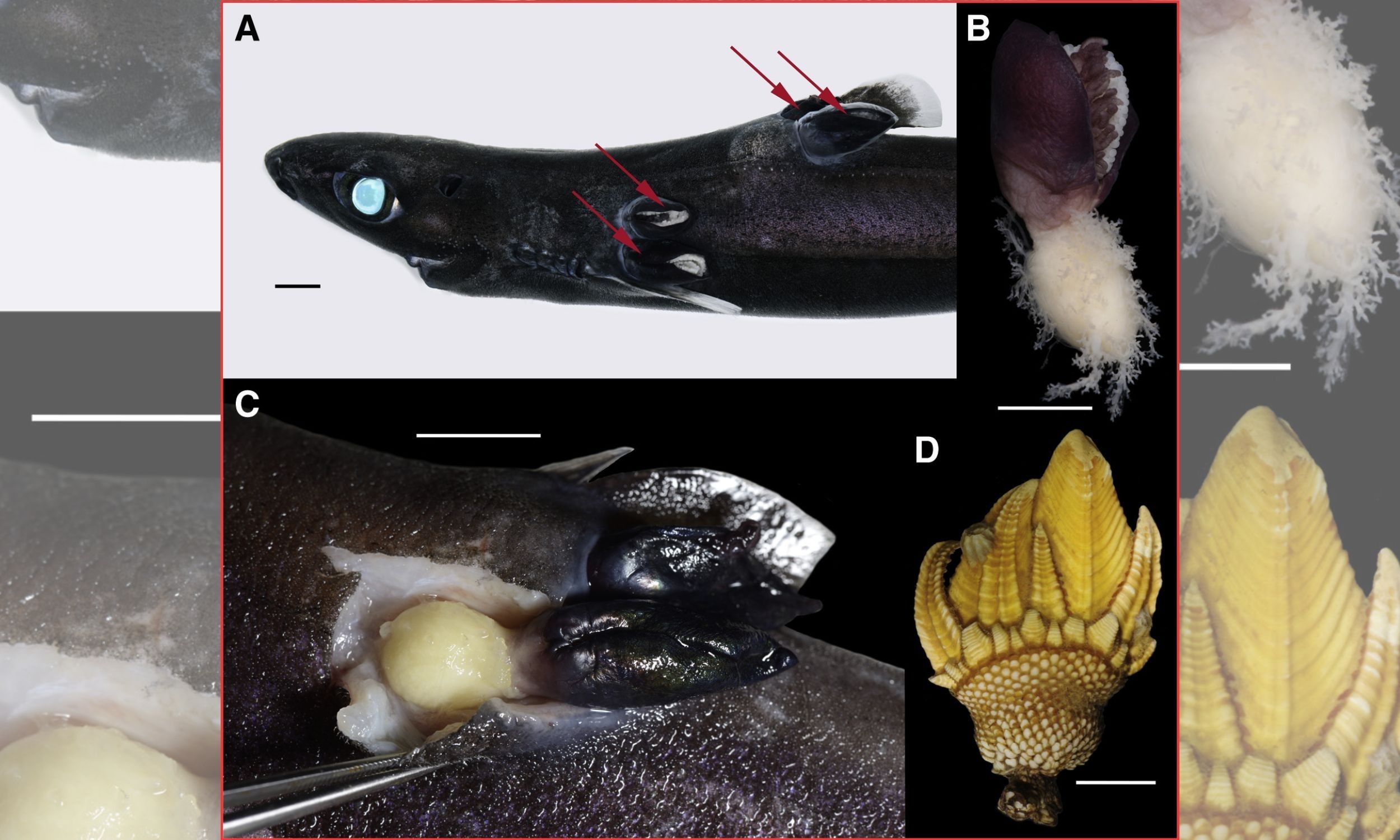
A common shoreline barnacle has been documented piercing deep-sea sharks and extracting nutrients directly from their flesh, marking a complete transition from filter feeding to parasitism.
That shift captures an evolutionary turning point in living form, revealing how an ordinary marine animal can cross into a radically different way of life.
A fjord transformation
Deep in Norway’s Sognefjord, small lantern sharks now carry yellow, stalked growths anchored firmly in their skin.
By dissecting those growths, Henrik Glenner at the University of Bergen (UiB) demonstrated that they are barnacles called Anelasma squalicola whose modified stalk penetrates shark tissue and functions as a feeding organ.
Rather than clinging to rock and sweeping plankton from the water, this species embeds root-like threads into living flesh and draws nutrition directly from its host.
Because the animal still retains the body plan of a typical stalked barnacle, its transformation exposes a rare evolutionary bridge that demands closer examination of how such a change could occur.
From rock to shark
Most barnacles begin life as drifting larvae before cementing themselves onto hard surfaces and growing protective shell plates.
In typical species, feathery appendages called cirri, jointed feeding limbs that sweep plankton from water, extend rhythmically to capture food.
In Anelasma squalicola, those cirri remain but no longer function for feeding, leaving the embedded stalk as the sole source of nutrition.
That anatomical change marks a decisive break from suspension feeding and signals a complete reliance on a living host.
A documented evolutionary link
A detailed phylogenetic analysis, DNA-based mapping of evolutionary relationships, published in 2014 confirmed that Anelasma squalicola evolved from ordinary stalked barnacles rather than from long-standing parasites.
Genetic data placed it as the closest living relative of Capitulum mitella, a rock-dwelling species harvested for food in East Asia.
That placement revealed that parasitism did not arise from already parasitic lineages but from free-living filter feeders.
The finding provided a rare example of a major lifestyle shift preserved in living form rather than inferred only from fossils.
A deepwater hotspot
Lantern sharks in the Sognefjord, including species such as Etmopterus spinax, live between about 328 and 3,281 feet below the surface.
In these dark waters, researchers have found unusually high numbers of sharks carrying the barnacle, suggesting a concentrated population.
Because people rarely see these sharks, the extent of infestation went unnoticed until targeted sampling began.
Such clustering raises the possibility that local conditions in the fjord favor the parasite’s survival and spread.
Why here and now
Barnacles have existed for hundreds of millions of years, leaving an extensive fossil record that documents gradual changes in shell plates and body plans.
Yet abrupt transitions between feeding strategies are seldom observed directly in modern species.
Glenner notes that fossil evidence suggests such shifts can occur rapidly in evolutionary terms, leaving little trace of intermediate stages.
Watching this change unfold in a confined fjord offers scientists a rare window into how new ecological roles emerge.
How the feeding works
Once attached, the parasite’s stalk expands into branching tissue that increases surface area inside the shark.
Those rootlets absorb nutrients directly from surrounding tissue and fluids rather than from the water column.
Microscopic studies have shown that the digestive tract remains present but often empty, reinforcing that blood and tissue supply most nourishment.
That internal anchoring also secures the barnacle firmly against currents and host movement.
Risks to sharks
Black lantern sharks in the fjord appear to tolerate multiple parasites at once, sometimes carrying them in pairs near dorsal fins.
Even so, the embedded stalk damages tissue and likely diverts energy from growth and reproduction.
Sharks have avoided such parasites for roughly 400 million years of evolution, making this association strikingly recent.
If the barnacle expands beyond the fjord, deeper-water shark populations elsewhere could face similar pressure.
An uncertain future
Researchers see two possible paths ahead for this unusual lineage.
Either the parasite fails to spread and disappears as an evolutionary experiment, or it succeeds and expands into other oceans.
Limited sightings outside Norway suggest it remains rare globally, though isolated cases have been reported near Greenland.
Continued monitoring will determine whether this fjord-bound phenomenon becomes a wider marine concern.
A living evolutionary moment
Observations from the Sognefjord show that a familiar crustacean can abandon filtering plankton and adopt a blood-feeding lifestyle within the span of a single evolutionary branch.
Whether the parasite endures or fades, the event offers a rare glimpse of how dramatic biological change can unfold in plain sight.
The study is published in the Zoological Journal of the Linnean Society.
—–
Like what you read? Subscribe to our newsletter for engaging articles, exclusive content, and the latest updates.
Check us out on EarthSnap, a free app brought to you by Eric Ralls and Earth.com.
—–
First Appeared on
Source link






Leave feedback about this