

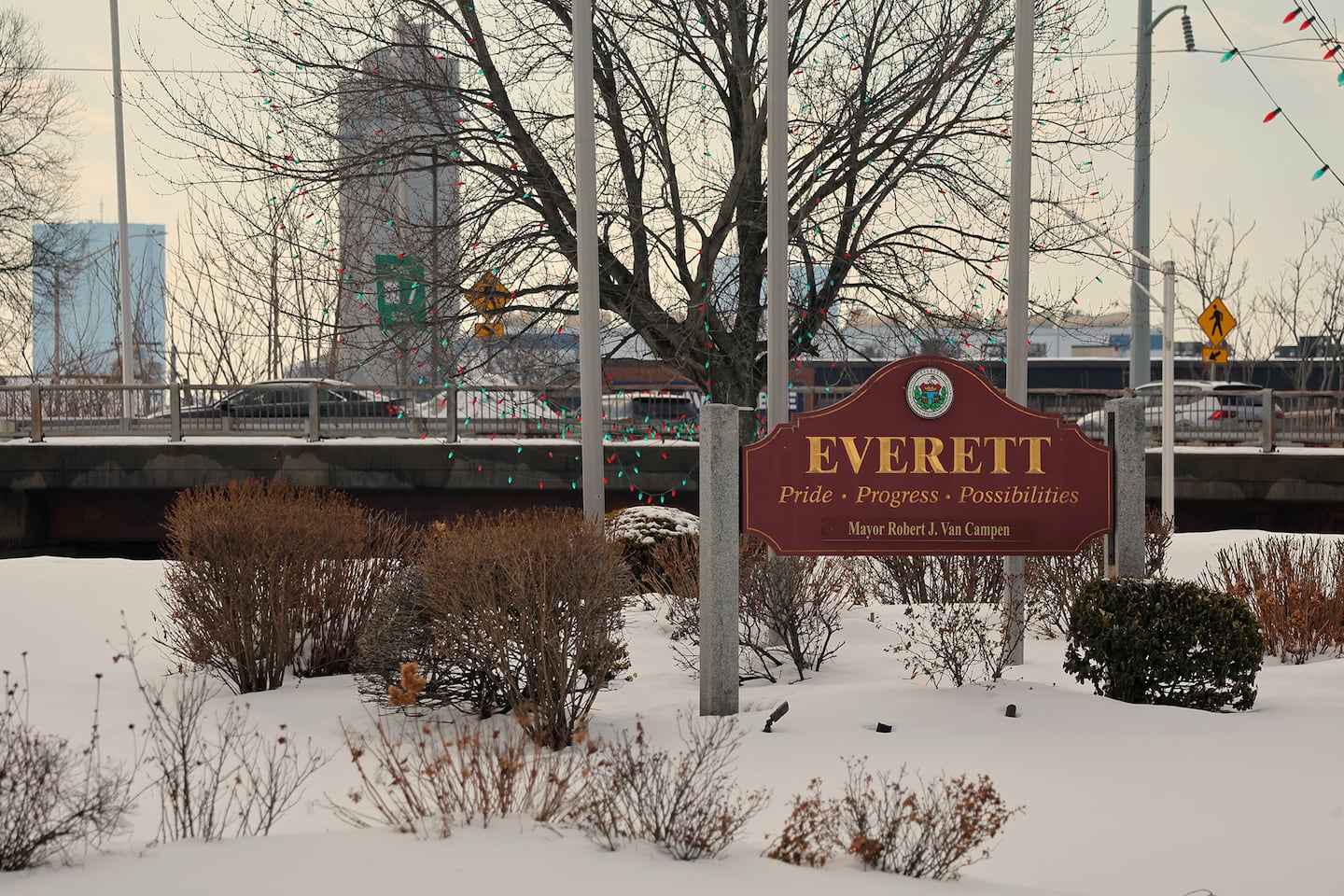
Perhaps that will change.
A web of projects — including an extended Silver Line route, a new pedestrian and cycling bridge connecting Everett to Somerville, and a possible commuter rail stop — could make it easier to ride a bike, bus, or train in and out of some parts of the city.
City officials also hope the projects will create easier access to the flagship developments on the horizon, including a new professional soccer stadium set to rise on the banks of the Mystic River.
“We have to plug in all the right public transit options in order to make it all work,” Van Campen said.
Today, transit trips between Boston’s urban core and Everett’s downtown can take around 30 to 45 minutes, barring severe traffic (not uncommon) or T misfortunes (not infrequent). The quickest journeys can often require transfers between buses and trains, depending on the destination.
Accessing nearby cities has long “felt like a hassle to a lot of people,” said Ilias Benmokrane, 20, an Everett native and transit wonk studying at Boston University. “To go anywhere, you [have] got to do a laundry list of things.”
Benmokrane recalled spending three hours a day — bus to Orange Line to Green Line and back — on commutes between his apartment and his high school near Boston University. Benmokrane’s father, a cook at a veterans care facility in Chelsea, resorted to purchasing a car because the bus line linking him to work was too infrequent, Benmokrane said.
Plenty of Everett residents would benefit from smoother transit.
Almost one–third of Everett workers traveled to jobs in Boston in 2023, according to census tallies. Another 10 percent traveled to Cambridge or Somerville.
“We have a huge pool of workers that work at Logan Airport, or they work in the service sector in Cambridge — they work at the restaurants, the labs,” said Jay Monty, Everett’s director of transportation. “We’ve never had really great direct access to those points.”
Buying and maintaining a car, meanwhile, can be a burdensome expense. According to census data, around 15 percent of Everett residents live below the poverty line, about 1½ times the statewide rate. Everett’s median household income, just over $85,000, is about 80 percent of median Massachusetts household earnings.
Revere Beach Parkway severs Everett in two. The southern half of the city is dominated by the Encore casino and what remains of the city’s industrial base, symbolized by the soaring smokestacks of a decommissioned power plant on the banks of the Mystic.
The bulk of Everett’s 50,000 residents live north of the parkway. The city’s “downtown” features low-slung storefronts housing Latin American supermarkets, Brazilian restaurants, and pizzerias. Church steeples and apartment blocks peer over them.
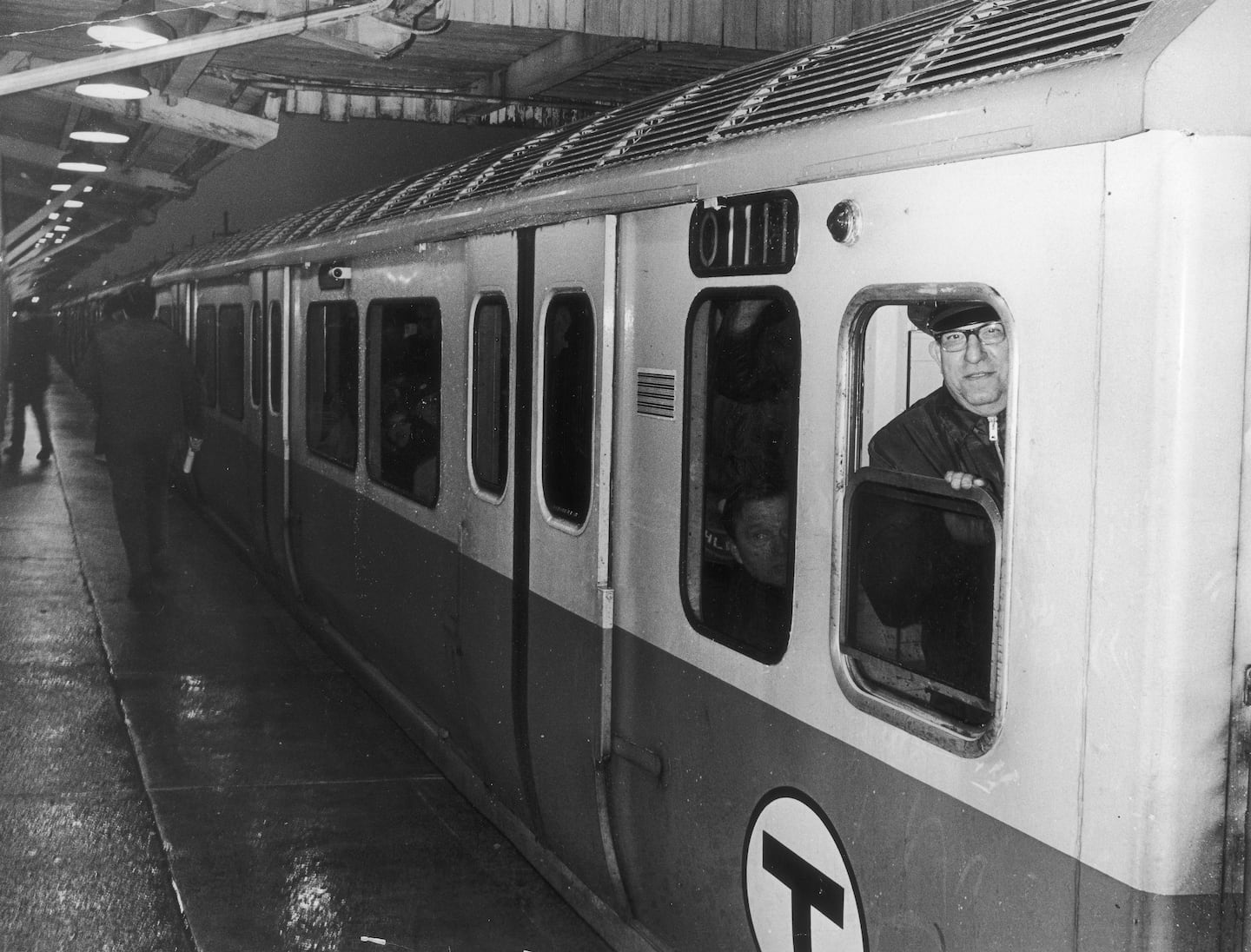
Everett was for decades the northern terminus of what’s now known as the Orange Line. Trains would trundle into an above-ground station that opened in 1919 along Broadway, near Washburn Street. Anyone hoping to find vestiges of the station today will instead encounter a Honda dealership, a McDonald’s, and a Public Storage. The T still operates vehicle repair facilities close by.
Everett lost the station in the 1970s after the T elected to level the elevated portion of the Orange Line carving through Charlestown to Everett and reroute the service along its current alignment, which ends in Malden, Everett’s northern neighbor.
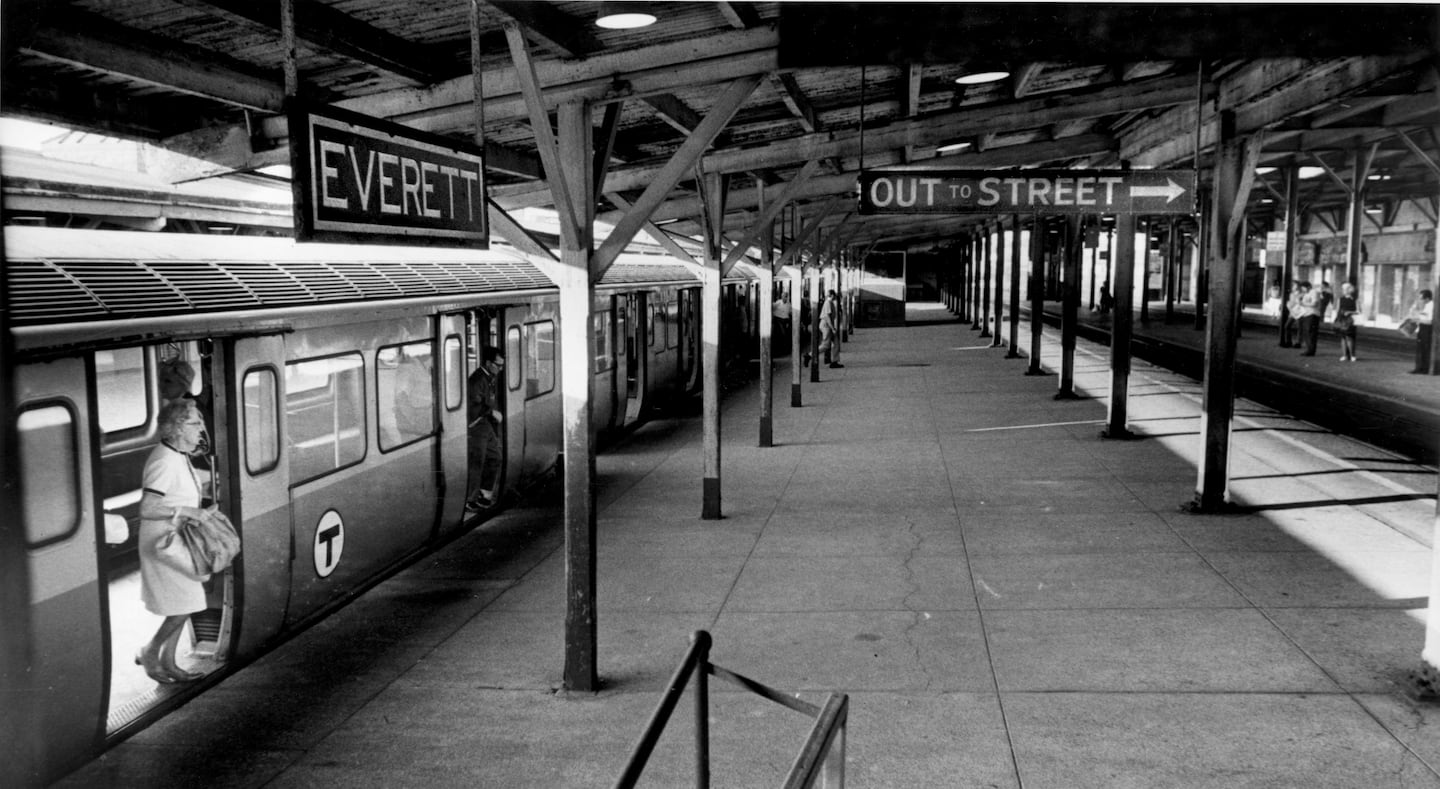
“We would love to have a subway in Everett. That would be the dream,” said Monty. “In the meantime, we’ve got to take the projects that are realistic and do the best we can with them.”
Other transit tweaks have yielded big dividends in recent years, city officials and advocates said.
The T’s 109 bus wheezes through the heart of Everett. The agency in 2024 stretched the route’s terminus from Sullivan Square in Charlestown to Harvard Square and increased its frequency, strengthening and simplifying an essential transit connection to Cambridge.
That year, the T also rerouted the 104 bus, stringing it from Malden Center to Logan by way of downtown Everett and Chelsea.
The T plans to eventually extend the Silver Line 3 bus through Everett, linking Chelsea’s commuter rail station to Sullivan Square.
The agency said the $95 million undertaking will increase the route’s daily ridership by thousands. Eighty percent of the route will feature bus lanes, ostensibly freeing buses from crippling thickets of traffic. The agency in 2024 received $22 million in federal aid to build a dedicated busway from Sweetser Circle to the Alford Street Bridge, which links Everett to Charlestown.
But the agency doesn’t know when it expects to open the extension, and its capital budget doesn’t set aside money for the project “due to budgetary constraints,” according to T officials.
The city could also land a commuter rail station, though exactly where it might be located is a matter of dispute.
Former Everett mayor Carlo DeMaria and Wynn Resorts, which runs the Encore Boston Harbor casino, agreed on DeMaria’s final day in office in January to “jointly pursue” a commuter rail stop “located adjacent to” the Encore property.
According to a rudimentary diagram attached to the agreement, the station would be tucked behind the Encore building, wedged between the resort to the southeast and a Costco and Home Depot to the northwest.
Wynn agreed to put up $25 million to bankroll the station’s construction and any requisite studies, assuming the parties agree upon the station’s scope and design.
Some Everett officials, including the new mayor, have bristled at the proposed station location.
“It’s just not acceptable to my vision for how lower Broadway gets redeveloped,” Van Campen said.
Monty, more bluntly, called it an “asinine location for a train station.”
Wynn disagrees. Michael Weaver, a Wynn spokesperson, said, “The site currently selected near Encore and proximate to the new stadium is the best location.”
“Only that location meets the funding requirements in both our recently signed memorandum” and an agreement signed between Everett and the company in 2013, which stated that Wynn, together with the city and the T, would explore the creation of a commuter rail stop serving both the city and the resort.
Van Campen and Monty would rather place a station on the eastern side of Broadway by Sweetser Circle, where it would, they say, be more accessible to Everett residents. Van Campen also said it would “activate” big future developments on that side of the street, including the proposed New England Revolution soccer stadium.
The roughly 24,000-seat venue could help catalyze other transit changes. The Kraft Group agreed to chip in $17.5 million to build a new headhouse for Assembly station in Somerville, located on the opposite bank of the Mystic River.
The new entryway would, in theory, empty onto Draw Seven State Park, affording riders easy access to a yet-to-be-built bike and pedestrian bridge connecting the park to the Encore Harborwalk. MassDOT said it hopes to finish building the $65 million bridge by summer 2029.
The status of the headhouse, however, is unclear, despite the Massachusetts Gaming Commission reportedly awarding cash to pay for the facility’s design in 2019.
A spokesperson for the Kraft Group did not return a request for comment.
Still, even if all of these lofty projects came to fruition, not all are convinced Everett residents would benefit substantially from them.
Benmokrane, the transit advocate, questioned whether many Everett workers would pay the pricier commuter rail fare just to spare themselves a bus ride across the river, especially if the station is tucked behind Encore.
“It just feels like Encore is getting its own stop now, not really Everett,” he said.
City Councilor Stephanie Smith said the city’s existing transit connections are already robust. She fears new bus lanes may erase much-needed parking spaces in a city where about half of its residents drive to work, according to census data.
Van Campen, meanwhile, finds himself pursuing two missions that can, but don’t always, coincide: Attracting visitors to a changing city, and reshaping it in a way that also helps residents.
“My goal as mayor is to make Everett a destination, not a drive-through,” he said. But, he acknowledged, “A lot of what’s happening in south Everett” — where the bulk of the new development is concentrated, but where fewer locals reside — “doesn’t benefit north Everett.”
Jaime Moore-Carrillo can be reached at [email protected].
First Appeared on
Source link


Leave feedback about this