

AMHERST, Mass. — Brian House, in long beard and muck boots, leads me through a pine forest on a cold afternoon until, on the edge of a marsh, we find it: an array of three circles formed by plastic milk crates equipped with furry microphone covers and connected by tubes to microbarometers.
It looks like the sort of thing one might use to make contact with extraterrestrials, or perhaps Satan, if you’re into that sort of thing. But House, a professor at Amherst College and a sound artist, has more earthly interests. A sign cautions wanderers in these woods not to touch: “Atmospheric Infrasound Research in Progress.”
House produces his art by recording sounds that are outside the range of human hearing. He then speeds them up or slows them down, so we can experience what had been inaudible. In this case, he’s collecting atmospheric infrasound — the extremely long-wave sounds from ocean currents, volcanoes, glaciers and even data centers — that can travel hundreds to thousands of miles and are all around us, even if we can’t perceive them.
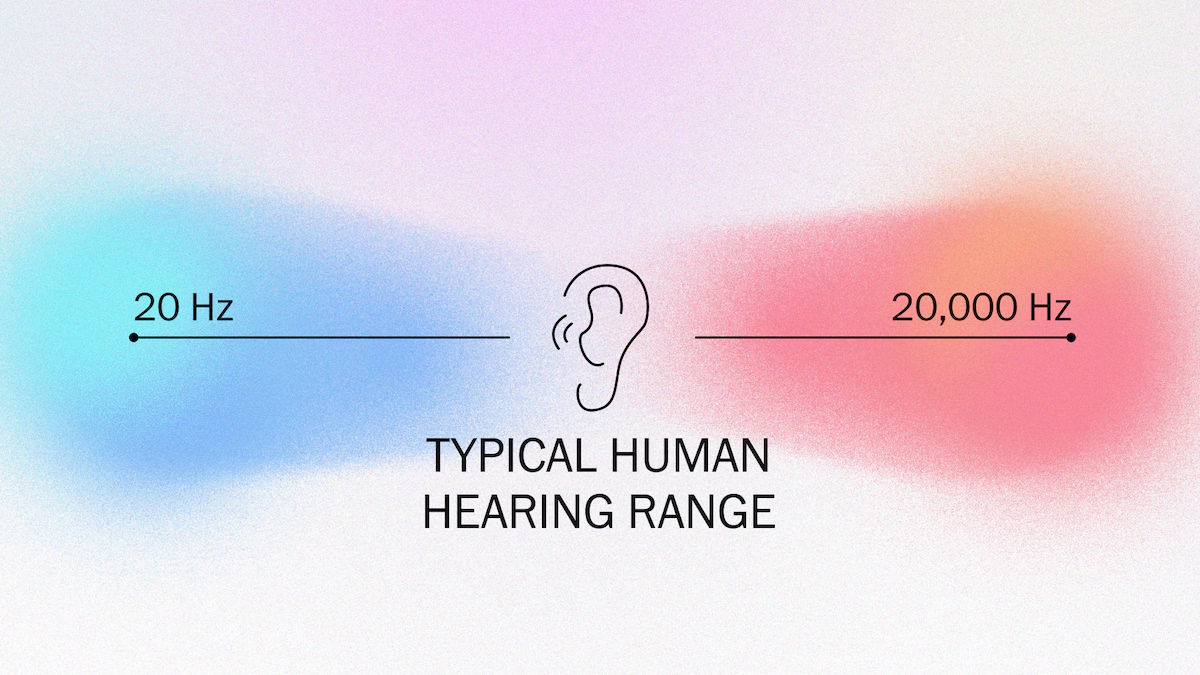
The human ear on its own can decipher sounds with frequencies as low as about 20 hertz up to an outer limit of about 20,000 hertz, or 20 kilohertz. Infrasound is anything below that range. Ultrasound — such as the choruses of rats and the pulses of bats — is above it. Yet another category of sound, which most of the world’s insects use to communicate, travels inaudibly through solids.
Knowledge of these sounds isn’t new. Humans first detected infrasound in the late 19th century, for example, and monitored it to track nuclear tests during the Cold War. But recent advances in artificial intelligence, signal-processing software and the miniaturization of sensors make it relatively cheap and easy to remove the noise and isolate these sounds.
“There is no Silence in the Earth,” wrote Emily Dickinson, who lived not far from these woods.
Now, science is proving her correct.
“We’re evolved to have a narrow perceptual range of what we need to know,” House says, “and we’re just oblivious to the rest.” But when you realize you’re bathed in soundwaves from far away, “your sense of the local expands.” You feel that you are part of something larger.
We lose our human-centric view of the world as we realize that even the smallest of creatures are “talking” to each other. We feel insignificant when we hear an ocean storm hundreds of miles away.
House, with his $2,000-setup in the woods, has made an album, “Everyday Infrasound in an Uncertain World,” featuring the incoming sounds on a single day. He has also captured natural and human-made sounds in isolation. With his permission, I’m sharing some here.
“The planet is speaking to us,” he says. And this is what it is saying.
A symphony of sounds
House’s album is haunting and unsettling. (When I played it at home, the cats ran away.)
You might pick up on elements that resemble a squeaky gate swinging on its hinges, the footsteps of giants, an empty can rattling down the street, a slide whistle, drumming, wind blowing, a missile falling from the sky.
Listen to an excerpt from Brian House’s album, “Everyday Infrasound in an Uncertain World”
In other places on the album, there is popping and clicking and zooming, what sounds like garbled voices rising and falling, a heartbeat, a seagull, shrieking, rumbling. Browp. Thump. Boom. Crunch. Bowch.
“This is what’s happening all the time,” House says.
Long-waved sounds of nature
When we listen to infrasound, it’s not the sound we typically associate with a thing, such as the crashing of the ocean surf or the thunder of a storm. Common sounds have wavelengths only inches or a few feet long. But infrasound waves are often hundreds of feet long. They can travel great distances without being absorbed by the atmosphere.
The infrasound coming from the ocean is called a “microbarom.” The interaction of wind and surface waves create something reminiscent of a background heartbeat. Sometimes it sounds like ripples of thunder or the echoes of an explosion.
The infrasound from a storm front, caused by clashing air masses, sounds like a fighter jet or a clap of thunder. But the infrasound from actual thunder sounds like a wimpy “bloop.” The jet and thunder sounds are joined by muffled thumps, pops and cracks.
Listen to the infrasound from a storm front
The infrasound from a glacier, which House recorded while in Svalbard, Norway, is made of a series of thuds and knocks, with orchestral tones in the background. None of this comes from the visible calving of ice but rather from the movements deep within. Each “crack,” lasting one second in the sped-up recording, is actually a full minute long.
The volcanic infrasound, which House took from publicly available U.S. Geological Survey data from a 2021 eruption in Tonga, sounds like a wave crashing on a beach. But these are, in fact, the pressure waves, caused by the ejection of rocks and ash, that traveled thousands of miles. Because the frequency was extremely low, House sped it up by 960 times rather than the usual 60 times.
The sounds of human activity
House’s recordings reveal that we are changing the planet in ways we can’t always perceive.
For Earth’s first 4.5 billion years, give or take, only nature could produce infrasound. But human industrial activity has altered the soundscape of the planet as surely as it has altered the climate. Studies suggest that intense levels of human-generated infrasound can cause symptoms such as nausea and dizziness, and could even be used as weapons.
A train’s infrasound resembles a jet approaching and then screaming past, with its Doppler effect. (Actual jets don’t generate noticeable infrasound at all.) A helicopter sounds like a slide whistle — generated by the air currents, not the engine. A data center, with its massive power and cooling systems, produces an almost soothing hum, while industrial HVAC systems combine to form a discordant droning.
High-frequency nature
At the other end of the spectrum, animals communicate at frequencies too high for us to hear naturally. House recorded rats in the New York subway and then slowed down the recording by 24 times, to bring it into our hearing range. The result, in his telling: “There are cries of joy and excitement, and there are shouts of warning, admonishment and displeasure. Percussive chatter mixes with plaintive questioning, and most relatable of all are the occasional bouts of laughter.”
I am less sure about what the animals are saying, but they are definitely singing and squawking, solo and in groups, and variously sounding like they are barking, howling and sounding a foghorn.
The technology is relatively accessible. For $179 you can get the Echo Meter Touch 2 from Wildlife Acoustics. Plug it into your phone and it allows you to hear bats calling in short pulses of about 10 per second. When the sound is played at 1/20th speed, you can hear big brown bats chirping and clicking rhythmically, in different tones.
Communicating through solids
The more science advances, the more it seems that everything is talking. Plants emit airborne sounds when under stress. Coral larvae navigate toward the sound of healthy reefs. Fish and turtles vocalize. A nonprofit called the Earth Species Project is using artificial intelligence to decode the language of animals so we can understand what they are saying to each other.
One of the group’s projects involves trying to learn the language of jumping spiders. Like 90 percent of insects, they communicate through solids, in the spiders’ case by drumming. Using a miniaturized version of a technology that measures vibrations in planes and cars, the researchers record the little critters doing what sounds a lot like beatboxing: pounding, purring, blowing raspberries and scratching.
“When I listen to this, it’s just like looking at a completely new world,” says Damian Elias, an entomologist at the University of California at Berkeley who leads the project. His team is identifying which sounds the spiders use for mating, shows of aggression and communicating hunger. “It’s just mind-blowing, because it matches the things that we feel and care about. … We’re so locked into how we perceive the world that we didn’t have any idea that all these things were happening in front of us.”
Mystery infrasounds
Even as we learn to understand more of the sounds of the Earth, we’re sometimes reminded how little we know. In the five recordings below, the sounds remain unidentified. To my ear, they are a cosmic rattling, something plunging into deep water, a haunting, weak whistle. Natural or anthropogenic? A meteor? Something terrestrial? “The unknowns are much more interesting,” House says, and “listening to these samples, I think, bears that out.”
House is an artist, not a scientist. He’s recording the sounds not to explain and interpret them but to experience them for their beauty and mystery. He thinks scientists, too, should immerse themselves in the “aesthetic experience” of what they study, so they “know what questions to ask.”
It was long thought that considerations of beauty and wonder would inject bias into the scientific process, with its reliance on data and empiricism. But no more. In a 2022 survey of more than 22,000 scientists, Catholic University of America sociologist Brandon Vaidyanathan found that majorities reported experiencing awe and wonder in their work and said that encountering beauty improves their scientific understanding.
“A lot of scientists are motivated by beauty, drawn into science through a feeling of overwhelming awe, of the beauty of some process, whether biological, geological, physics, math,” argues Ben Holtzman, an MIT geologist who has collaborated with House. “When you’ve landed on something that feels right, it feels right because it’s beautiful.”
I’m no scientist. But hearing the inaudible sounds of the planet coming to me through a bunch of milk crates in the forest, I share their sense of awe.
About this story
Audio recordings and processing (except bats and spiders) by Brian House, Amherst College. Reporting by Dana Milbank. Design by Hailey Haymond. Illustrations by Katty Huertas. Development and topper animation by Junne Joaquin Alcantara. Editing by Betty Chavarria and Marisa Bellack. Copy editing by Jordan Dowd.
First Appeared on
Source link






Leave feedback about this