


At the International Earth Rotation and Reference Systems Service in Paris, a quiet calculation takes place several times a year. Technicians compare the world’s atomic clocks, which measure time with unerring precision, against the actual rotation of the planet. The two never quite match. Every so often, the clocks pull ahead, and a decision is made: a single second is added to the global timekeeping system.
The first such adjustment occurred in 1972. Since then, 27 seconds have been inserted. For most of that history, the reason was predictable. The Moon’s gravity has been gently tugging at Earth’s oceans for billions of years, acting as a slow, steady brake on the planet’s spin. But in the past decade, the pattern has become less predictable. The gap between atomic time and rotational time no longer follows the smooth curve that astronomers once expected.
Something else is now interfering with Earth’s spin. It is not a force from space. It is the movement of water across the planet’s own surface.
A Planetary Figure Skater Extending Its Arms
The physics is simple. When a figure skater pulls her arms in, she spins faster. When she extends them outward, she slows down. Earth behaves the same way. Water that was once locked at the poles now flows into the oceans, increasing the bulge around the equator. That redistribution of mass increases the planet’s moment of inertia, forcing its rotation to slow.
Mostafa Kiani Shahvandi, a researcher at the University of Vienna, described the effect directly: “Never before or after that has the planetary ‘figure skater’ raised her arms and sea levels so quickly as in 2000 to 2020.”
The change is tiny. Days are currently lengthening by about 1.33 milliseconds per century due to climate-related factors alone. But over decades of accumulated drift, those fractions of a second disrupt the precise synchronization that modern technology depends on.
An Unprecedented Rate Hidden in Ancient Fossils
To understand whether this slowdown was unusual, researchers from ETH Zurich and the University of Vienna reconstructed Earth’s rotation history going back 3.6 million years. They turned to benthic foraminifera, single-celled marine organisms whose fossilized shells preserve chemical signatures of past sea levels. By analyzing those signatures, the team could calculate how historical sea-level changes affected the planet’s spin.
“From the chemical composition of the foraminifera fossils, we can infer sea-level fluctuations and then mathematically derive the corresponding changes in day length,” Kiani Shahvandi said.
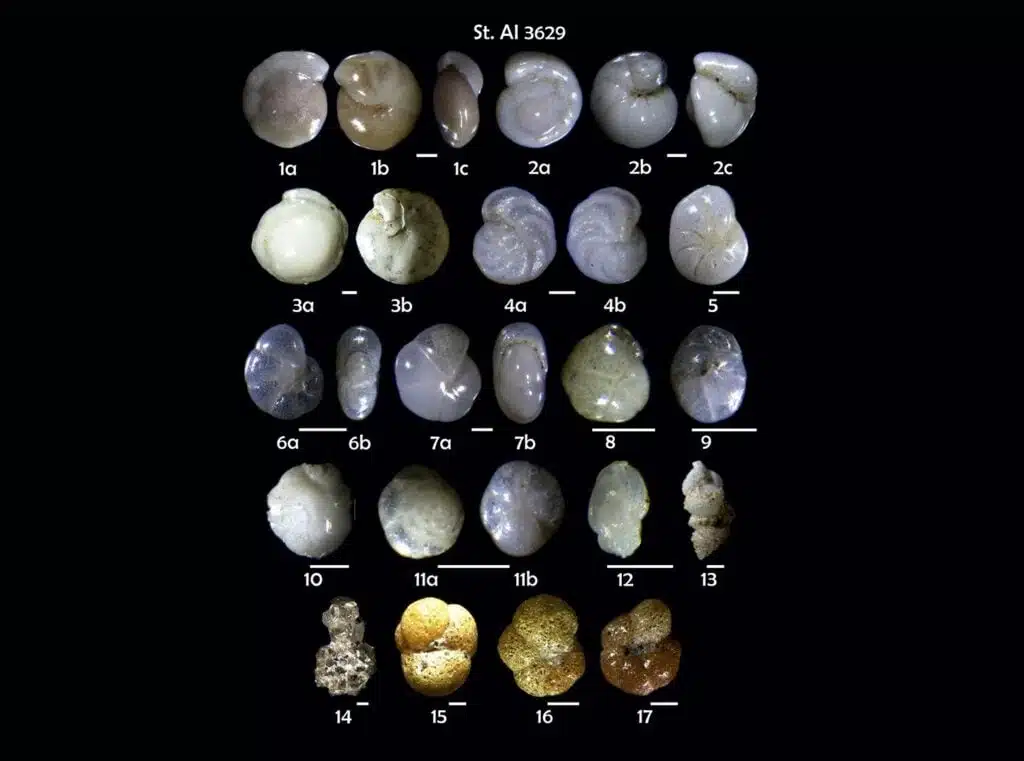
The results, published in the Journal of Geophysical Research, showed that the current rate of day-length increase stands out sharply in the geological record. No natural deglaciation period in the past 3.6 million years produced a slowdown this rapid.
Benedikt Soja, a geodesist at ETH Zurich, noted that the finding places modern climate change in an unmistakable context. “This rapid increase in day length implies that the rate of modern climate change has been unprecedented at least since the late Pliocene, 3.6 million years ago,” he said.
When Climate Change Outpaces the Moon
For most of Earth’s history, the Moon’s gravitational pull has been the dominant force slowing the planet’s rotation. Tidal friction gradually transfers rotational energy from Earth to the Moon, lengthening days by about 1.8 milliseconds per century over the long term. That process is steady and predictable.
Climate-driven slowdown is neither. It is accelerating. The same research team projects that by the end of this century, the effect of melting ice on day length could surpass the effect of the Moon’s tides. Soja added: “By the end of the 21st century, climate change is expected to affect day length even more strongly than the Moon. Even though the changes are only milliseconds, they can cause problems in many areas, for example in precise space navigation, which requires accurate information on Earth’s rotation.”
That shift matters for more than scientific curiosity. Satellite navigation systems such as GPS rely on atomic clocks synchronized to Earth’s rotation. A mismatch of even a few milliseconds introduces positioning errors that grow over time. Space agencies already factor the slowdown into orbital calculations. The irregularity of the new pattern, driven by unpredictable ice melt, makes those corrections more difficult than the steady deceleration caused by lunar tides.
What the Microfossils Revealed
The team’s method combined paleoclimate data with deep-learning algorithms designed to account for uncertainty in ancient records. By examining the chemical composition of foraminifera fossils, researchers inferred past sea-level fluctuations and calculated how those shifts altered Earth’s spin. “This model captures the physics of sea-level change, while remaining robust to the large uncertainties inherent in paleoclimate data,” Kiani Shahvandi said.
The result was a timeline of day-length variation stretching back through the Quaternary period, when large continental ice sheets expanded and contracted repeatedly. Those natural cycles caused Earth’s rotation to speed up and slow down at different times. But none of them produced a change as rapid as what has been observed between 2000 and 2020.
Only one period, roughly two million years ago, came close. Even that episode was slightly slower than the modern rate.
A Slowdown That Requires Constant Correction
Since 1972, international timekeepers have inserted leap seconds to align atomic clocks with Earth’s slowing rotation. But those adjustments were designed for a predictable deceleration. A rotation rate that changes irregularly, and increasingly under human influence, makes the leap-second system harder to manage. Satellites face similar challenges. Precise orbit determination requires knowing Earth’s orientation and rotation rate to within fractions of a millisecond.
Kiani Shahvandi and his colleagues are continuing to track the trend. Their work has already shown that climate change now plays a larger role in day-length variations than previously understood. In a 2024 paper published in Nature Geoscience, the same research group demonstrated that climate effects, including melting ice sheets, glacier loss, and shifts in terrestrial water storage, are also the main driver of long-period polar motion, the drift of Earth’s rotational axis. The two phenomena are linked. Both trace back to the same redistribution of mass.
The numbers remain small. A millisecond per century does not alter daily life. But the direction is clear. For the first time in millions of years, the planet’s rotation is being shaped not by orbital mechanics or natural ice cycles, but by the movement of water that humans have set in motion.
Kiani Shahvandi M, Adhikari S, Dumberry M, Mishra S, Soja B: The increasingly dominant role of climate change on length of day variations. In: Proceedings of the National Academy of Sciences, PNAS 2024, Vol. 121, No. 30, e2406930121.
DOI: external pagehttps://doi.org/10.1073/pnas.2406930121
First Appeared on
Source link






Leave feedback about this