

Sign up for Executive Dysfunction, a weekly newsletter that surfaces under-the-radar stories about what Trump is doing to the law—and how the law is pushing back.
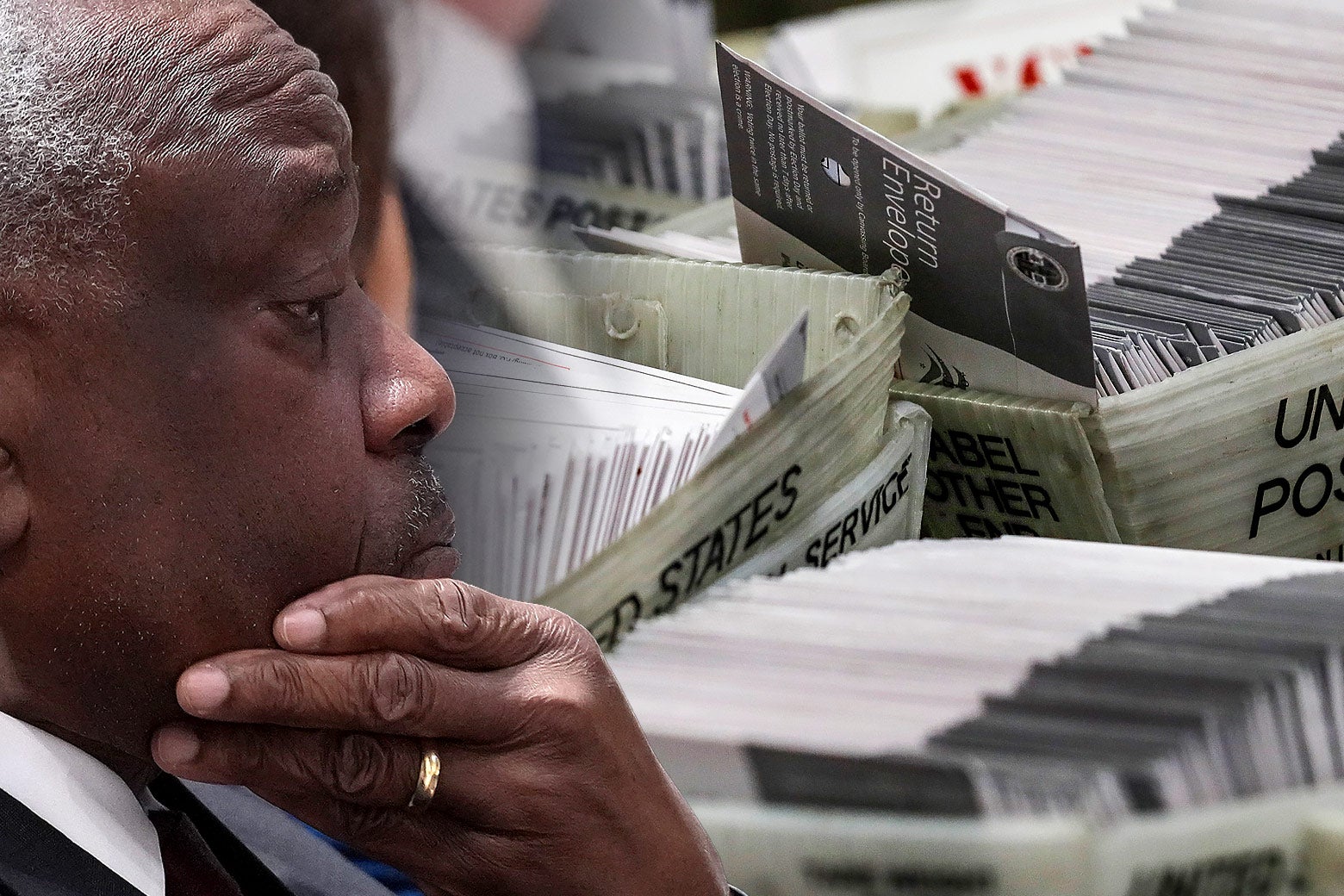
The Supreme Court handed down an alarming decision on Tuesday prohibiting Americans from suing the Postal Service for damages in federal court when carriers intentionally destroy or refuse to deliver their mail. Justice Clarence Thomas’ 5–4 decision in USPS v. Konan is bad enough on its own—a distortion of the law that will deprive individuals of their rightful remedy when postal workers withhold mail on purpose. But it is even more disturbing in light of the upcoming midterms, when millions of Americans will cast their ballots by mail. Konan effectively repeals a major deterrent against postal workers who might try to manipulate the election by targeting mail ballots, a threat that’s not hypothetical. In a moment when American democracy depends on the integrity of mail delivery, the Supreme Court has handed the Postal Service new immunity in cases of deliberate sabotage.
Konan’s facts illustrate exactly why Congress authorized civil suits against postal workers’ intentional misconduct in the first place. For two years, USPS did not deliver mail addressed to tenants of Lebene Konan, a landlord in Euless, Texas. Konan alleges that local carriers objected to the fact that she, a Black woman, leased rooms to white people. So she sued under the Federal Tort Claims Act, which waives the U.S. government’s immunity from certain lawsuits. The FTCA allows certain actions against USPS while forbidding others. As relevant here, the statute prohibits lawsuits against the Postal Service “arising out of the loss, miscarriage, or negligent transmission of letters or postal matter.”
Congress enacted this bar to prevent people from demanding damages in federal court every time their mail was inadvertently delayed. Konan argued that it shields only negligent conduct—like accidentally leaving a letter on the truck—and does not encompass intentional theft or destruction of the mail. A cross-ideological panel of the U.S. Court of Appeals for the 5th Circuit agreed. It reasoned that the willful withholding of the mail goes far beyond “loss” and “miscarriage” and may therefore serve as grounds for a lawsuit. The word “loss” implies an “unintentional action,” the 5th Circuit explained, while “miscarriage” implies a failed attempt at delivery. So a lawsuit for the intentional action of refusing to deliver is still permitted under the FTCA.
The Trump administration appealed to SCOTUS, and prevailed in Tuesday’s 5–4 ruling, winning every Republican-appointed justice except Neil Gorsuch, who joined Justice Sonia Sotomayor’s dissent in a striking defection. Thomas’ majority opinion seems to begin from the premise that victims of mail theft should not be able to collect damages from the government, then work backward to justify that conclusion. Citing favorable definitions from several dictionaries, Thomas wrote that “loss” covers any “deprivation of mail.” And “one can, of course, suffer a deprivation of something when another intentionally keeps that thing for himself.” Note the parlor trick at work here: By replacing the actual language of the statute (“loss”) with his preferred alternative (“deprivation”), the justice was able to insist that stolen mail has merely been “lost,” allowing the government to claim immunity.
As Justice Sonia Sotomayor explained in dissent, this reasoning contorts the English language beyond recognition. “Loss,” as even the government admitted, “is ordinarily understood to capture unintentional conduct,” the justice wrote. After all, “no one intentionally loses something.” People lose their mail when it “gets stuck behind a drawer, not when they intentionally throw it away.” If someone says they “lost” their car, “no one would think it was stolen, only that the person forgot where they had parked it.” The same, Sotomayor wrote, “is true when the Postal Service loses someone’s mail. The reason is an error, not deliberate wrongdoing.”
Thomas’ redefinition of “miscarriage” was even more absurd. Once again, Thomas substituted the word’s most natural meaning for an alternative that loads the dice: Miscarriage, he wrote, is what happens any time mail fails “to arrive properly,” no matter the reason. So mail that is never even transported from the post office to the mailbox is still “miscarried.” To support his claim that “ordinary speakers” use the term this way, Thomas cited two sources: an 1893 article in the Carbondale Leader and a 1911 article in the Kansas City Star, both of which described stolen or destroyed mail as “miscarried.” These obscure reports were his strongest evidence that English speakers describe the intentional withholding of mail as “miscarriage.”
As Sotomayor pointed out, Thomas appears to have uncovered these examples on his own. The government, she wrote, “failed to identify a single example of ‘miscarriage’ ” being used to mean intentional withholding of mail. So Thomas had to do his own research. And this was the best he could find: “Two cherry-picked newspaper references almost 20 years apart, and at least 30 years before the enactment of the FTCA.” If “miscarriage” actually carried this definition, Sotomayor quipped, “one might expect that actual examples of the usage would be easier to come by.” It is far more likely that Congress understood this term as it was used in the Postal Laws and Regulations when the FTCA was enacted: mail that is misdelivered by accident.
But Thomas’ opinion is now the law. And it could not have arrived at a worse time. This fall, millions of Americans will submit their ballots through the mail, and some states will conduct their elections entirely by mail. These citizens rely upon USPS to deliver and return their ballots without delay or interference. (The agency processed nearly 100 million mail ballots in the 2024 general election.) Unfortunately, President Donald Trump has installed an ally as the head of the Postal Service and seized total control over the Justice Department. In the past, Americans have relied upon USPS and DOJ to identify and investigate destruction of mail ballots, which is a federal crime. They have done so in the past when carriers tried to influence elections this way.
Can we trust the Trump administration to do so in 2026? Particularly when the president has telegraphed his desire to undermine the upcoming elections? Konan’s allegations demonstrate the danger of a government that turns a blind eye toward such misconduct. What if, instead of refusing to deliver mail because of race, a post office declines to distribute or collect ballots because of political affiliation? What if a carrier destroys mail ballots from a Democratic enclave, and the Republican candidate wins by a hair? Before Tuesday, the FTCA created a strong deterrent against such intentional interference with mail voting: Victims could sue in court and collect damages—money paid out by the government to make them whole. Although individual carriers would not have to pay up, these lawsuits could uncover and publicize their misconduct, leading to other professional and personal consequences. Now if someone files suit because they think their mail ballot got stolen by a postal worker, a court won’t open the door to an investigation. It will simply toss the suit.
Last year, Margaret Schaack laid out these risks in the University of Chicago Law Review. A ruling for the Trump administration in Konan, Shaack wrote, would deny “direct recourse to potential litigants whose ballots are stolen and delayed.” Without this safeguard, “postal workers might feel emboldened to intentionally withhold mail-in ballots for elections,” and “the government would be immune from any attempts to seek” individual redress. At a bare minimum, shielding mail theft or destruction from FTCA suits “may disincentivize the USPS from expending resources to institute policies that better prevent intentional impediments to mail delivery.” The Supreme Court’s decision in Konan means we’ll find out the hard way whether these fears come to pass.
Ironically, Thomas himself has in the past expressed his apprehension that mail voting poses a massive “risk of fraud.” That’s broadly untrue, but he did cite one legitimate concern about theft of an election through “stealing absentee ballots.” If the justice were genuinely worried about this possibility, one would not expect him to erase a key safeguard against it by judicial fiat. Yet his indefensible opinion in Konan invites precisely that risk.
First Appeared on
Source link




Leave feedback about this