


Researchers from China have created the elusive and incredibly rare hexagonal diamond, a material that could outshine natural diamond in hardness and resilience. Published in Nature on March 4, 2026, their study reveals that this hexagonal form of carbon, once only theorized, is not only real but also possesses superior qualities that could revolutionize industries dependent on materials’ strength and heat resistance.
Unveiling the Elusive Hexagonal Diamond
For decades, scientists have speculated about the existence of a diamond variant that could surpass the strength of natural diamonds. Diamond, with its crystal lattice of carbon atoms arranged in a cubic pattern, has been considered the hardest known natural material on Earth. But what if another form of diamond could be even tougher? Enter hexagonal diamond, or lonsdaleite, a mysterious material theorized to exist in meteorites but never before confirmed in pure form. That is, until now.
The study, published in Nature earlier this month, marks a historic step in material science, with researchers at Zhengzhou University in China creating the first pure hexagonal diamond samples. This breakthrough not only confirms the material’s existence but also provides compelling evidence of its extraordinary properties. For the first time, scientists have successfully synthesized hexagonal diamond in a laboratory and tested its hardness, revealing that it’s more durable and resistant to wear than the cubic form.
The Journey to Discover Hexagonal Diamond
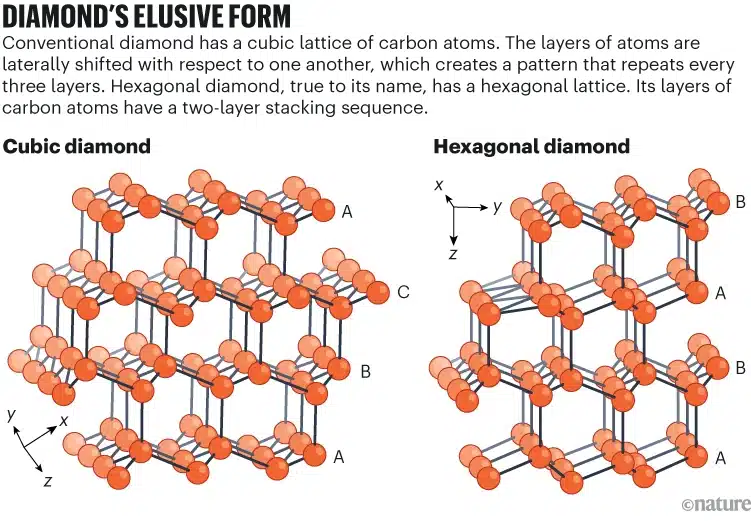
The story of hexagonal diamond begins over half a century ago when researchers first theorized that carbon atoms could arrange themselves in a hexagonal lattice, rather than the familiar cubic one. This idea was first proposed in 1962 at the Pittsburgh Coal Research Center, suggesting that such a structure could result in a material with unique properties, potentially even superior to natural diamond.
(Nature (2026))
While researchers had previously detected traces of hexagonal diamond in meteorites, proving its pure existence remained a challenge. Most of these findings were based on meteorite fragments, with hexagonal diamond often mixed with cubic diamond, graphite, and other minerals. These complex mixtures made it difficult, if not impossible, to isolate and study the material in detail. The breakthrough study now provides concrete proof of the material’s distinct properties by producing small, pure samples and subjecting them to rigorous tests.
The Discovery: What Makes Hexagonal Diamond Superior?
Hexagonal diamond differs from the cubic variety in the way its carbon atoms bond. While cubic diamonds have carbon atoms arranged in a three-dimensional cubic structure, hexagonal diamonds arrange themselves in a two-dimensional honeycomb pattern. This structural difference results in distinct material properties that are only now being fully understood.
According to the study, “structural and spectroscopic analyses, supported by large-scale molecular dynamical simulations, unambiguously confirm the identity of HD (hexagonal diamond).” The research team’s innovative approach involved compressing highly organized graphite under extreme pressure and heat, creating the necessary conditions for the formation of pure hexagonal diamond.
The result was a material that was not only more rigid and harder than its cubic counterpart but also far more resistant to oxidation. This means that hexagonal diamonds can endure significantly higher temperatures without succumbing to degradation, a feature that opens up potential uses in extreme environments.
Potential Applications in Industry
The discovery of hexagonal diamond has enormous implications for a wide range of industries. For years, industries reliant on the hardness of diamonds, such as mining, drilling, and cutting, have utilized cubic diamonds to create the toughest tools. However, the new properties of hexagonal diamond could revolutionize these industries.
With superior heat tolerance and resistance to wear, hexagonal diamond could vastly improve the efficiency and longevity of cutting tools, abrasives, and even electronics that require high heat dissipation.
In fact, researchers are already speculating about its potential in quantum sensing and thermal management.
First Appeared on
Source link





Leave feedback about this