

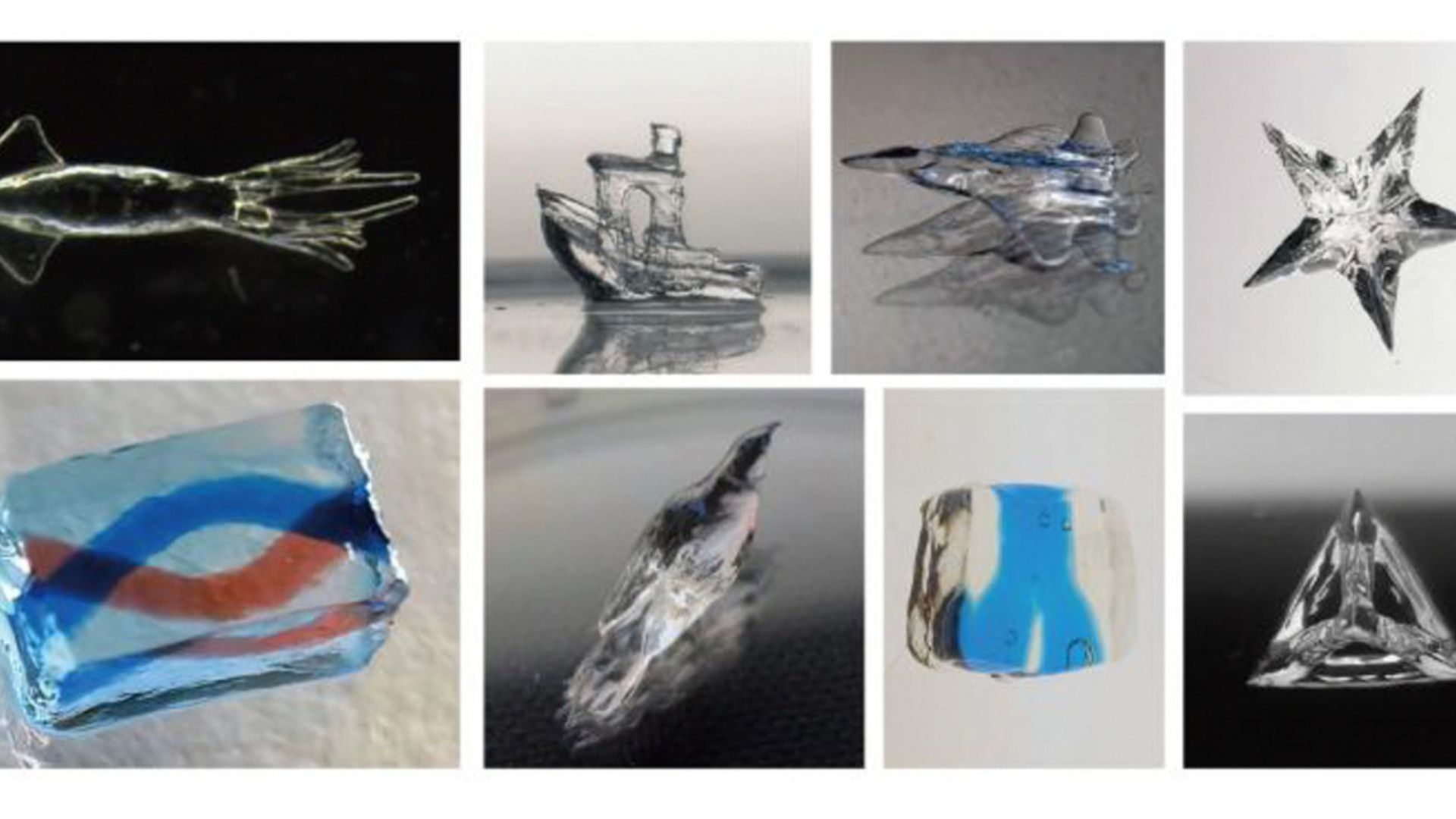
In recent years, 3D printing has advanced rapidly. However, the technology has been trapped in a frustrating tug-of-war. If you wanted something precise, you had to wait hours. If you wanted something fast, you sacrificed the details.
But these challenges have been solved by a research team at Tsinghua University, China.
Unlike point-by-point or layer-by-layer printing, the new technique uses high-dimensional holographic light fields to create a 3D solid structure almost instantaneously.
Interestingly, it can print complex, millimeter-scale objects in just 0.6 seconds. Moreover, 3D printing maintains great detail, with feature sizes as small as 12 micrometers.
The technology offers a transformative solution for fields like biomedicine and nanotechnology by overcoming the trade-off between speed and precision.
It could pave the way for advanced applications in flexible electronics, micro-robotics, and the creation of highly detailed biological tissue models.
“We achieved mass production of complex and diverse 3D structures within low-viscosity materials, demonstrating its potential for broad applications in diverse fields,” the researchers wrote in the study paper.
Ultra-fast 3D printing
A research team has introduced Digital Incoherent Synthesis of Holographic light fields (DISH), an advancement in Volumetric Additive Manufacturing (VAM).
Regular 3D printers work like a patient mason, laying down one thin layer of plastic at a time. It’s a slow, mechanical crawl.
However, DISH functions more like a high-tech projector. It manipulates “holographic light fields” to sculpt an entire three-dimensional object within a resin container simultaneously. There are no moving arms, no clicking nozzles, and no waiting for layers to dry.
The DISH method advances volumetric 3D printing by using a high-speed rotating periscope to project light from multiple angles, eliminating the need to physically rotate the resin container.
It employs iterative optimization of holograms. The system maintains a sharp 19 μm resolution over a 1 cm range — far exceeding the typical depth-of-field limits of standard lenses.
This allows the technology to sculpt entire millimeter-scale objects with extreme precision in a fraction of a second, regardless of whether the material is stationary or moving through a fluid channel.
“ The iterative optimization of the holograms for different angles in DISH maintains 19-μm printing resolution across the 1-cm range that is far beyond the depth of field of the objective and enables high-resolution in situ 3D printing of millimetre-scale objects within only 0.6 s,” the study noted.
Beneficial for various sectors
The team successfully tested with acrylate materials across a wide range of viscosities.
Reportedly, the system achieves a printing rate of 333 cubic millimeters per second while maintaining a resolution of 12 micrometers — roughly one-fifth the thickness of a human hair.
This advancement could boost the high-tech sector by enabling the mass production of intricate hardware, such as smartphone camera modules and photonic computing components.
In the medical field, it enables rapid creation of high-resolution biological tissue models, while in robotics, it facilitates the development of micro-robots and flexible electronics with complex, curved geometries.
The findings were published in the journal Nature on February 12.
First Appeared on
Source link






Leave feedback about this