

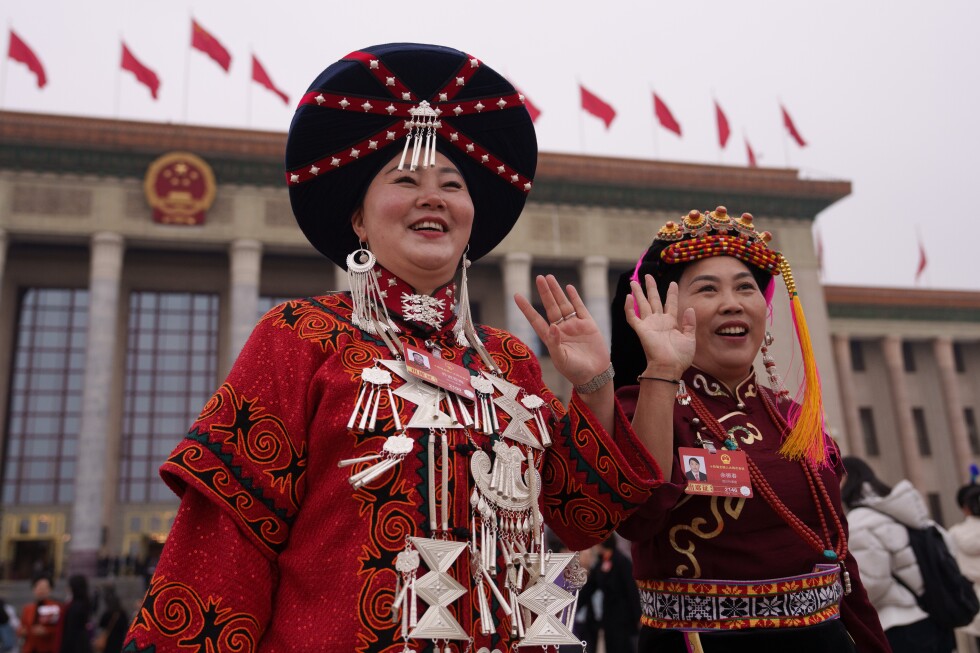
BEIJING (AP) — China adopted a sweeping law Thursday to promote what it calls “ethnic unity,” a measure that critics say would further erode the rights of some minority groups as authorities cement a push toward assimilation.
The law, approved by the country’s ceremonial legislature, is designed to foster “a stronger sense of community among all ethnic groups in the Chinese nation,” said Lou Qinjian, a delegate to the National People’s Congress who introduced the proposal to the whole body.
The proposed law lays out the need to promote ethnic unity by all government bodies and private enterprises, including local governments and state-affiliated groups like the All-China Women’s Federation.
“The people of each ethnic group, all organizations and groups of the country, armed forces, every Party and social organization, every company, must forge a common consciousness of the Chinese nation according to law and the constitution, and take the responsibility of building this consciousness,” it reads.
Academics and observers say the new provision represents a setback for the identity of ethnic minorities because it mandates the use of Mandarin Chinese in compulsory education, among other things.
The majority of China’s population is Han Chinese and the official language is Mandarin. The country has 55 ethnic groups, making up 8.9% of the 1.4 billion population.
The constitution states that “each ethnicity has the right to use and develop their own language” and “have the right to self-rule,” while the Law on Regional Ethnic Autonomy promises limited autonomy to those groups, including allowing them to create flexible measures to develop their economy.
Experts say that despite those provisions, the new law is likely to take priority in practice.
“It puts a death nail in the party’s original promise of meaningful autonomy,” said James Leibold, a professor at Australia’s LaTrobe University who has studied China’s changing policies toward its ethnic minorities. Leibold called the measure a capstone of Chinese President Xi Jinping’s “major rethink” of ethnic policies.
China’s United Front, which oversees ethnic minority policy, did not respond to a request for comment.
Meaningful autonomy once existed in teaching native tongues
According to Article 15 in the new law, Mandarin Chinese is mandated to be taught to all children before kindergarten and throughout the rest of compulsory education up to the end of high school.
Mandarin is already the primary language of instruction in Inner Mongolia, Tibet and Xinjiang — Chinese regions with large ethnic minority populations — but the new law essentially states that minority languages cannot be the primary language of instruction nationwide.
Until recent years, ethnic minorities had some autonomy in what language could be used for teaching in schools.
In the past, students in Inner Mongolia, a Chinese autonomous region bordering Mongolia, could study large parts of the entire curriculum in Mongolian.
That changed in 2020, when new students found out their Mongolian language textbooks could no longer be used and they could only use Chinese textbooks. The policy change led to massive protests and an immediate crackdown, as well as later re-education campaigns, according to an essay co-written by Leibold and a Mongolian former journalist.
Students in the region can currently only study Mongolian as a foreign language class inside schools, one hour a day.
Push for assimilation
Scholars also note the mention of pushing for “mutually embedded community environments” in the law, which they say may result in the break up of minority-heavy neighborhoods.
“The intention is to encourage Han and other minorities to migrate into each other’s communities,” said Minglang Zhou, a professor at the University of Maryland who studied China’s bilingual policies.
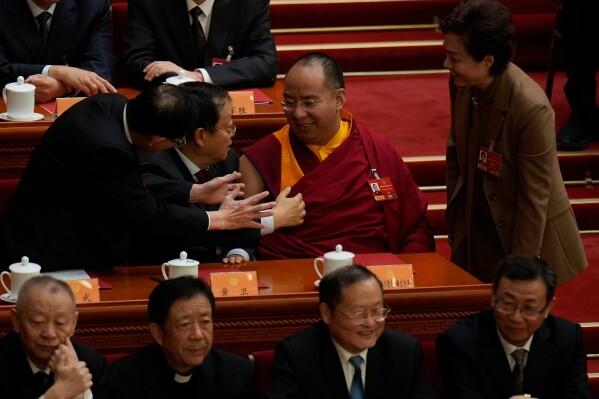
Many countries, including the U.S., pursue similar assimilation policies. China has said its approach is to bring development to ethnic minorities areas. But Maya Wang, deputy Asia director at Human Rights Watch, said the law isn’t really about ensuring equality.
“The question was never so much about ensuring their participation in the economy in an equitable manner, more inclusive manner,” because the policies are being forced on Tibetans, Wang said. “And a truly inclusive model does not preclude the ability of children to speak two languages.”
Law lays out legal penalties related to ethnic policy
The law also creates a legal base for the Chinese government to prosecute people or organizations outside China if their actions harm the progress of “ethnic unity.”
The legal penalties for people abroad echo the clause in the National Security Law which China imposed on Hong Kong in 2020, which states that authorities can prosecute people based outside China over actions that Beijing perceives as secession or subversion. Hong Kong’s government later issued bounties for 34 overseas activists on suspicion of violating the security law.
Rayhan Asat, a legal scholar at Harvard University, said “the law serves as a strategic tool and gives the pretext to government to commit all sorts of human rights violations.”
Asat said her younger brother, Ekpar Asat, is serving a 15-year prison sentence in Xinjiang on charges of inciting ethnic discrimination and ethnic hatred. Asat said her family never got any formal notice from the government about his arrest or a trial.
Asat’s brother was an entrepreneur who built a social media platform for Uyghurs. She said he was taken shortly after he visited the U.S. as part of the State Department’s International Visitor Leadership Program in 2016.
Ethnic Uyghurs, a Muslim minority group, have been the target of a long-term campaign of detention, and later incarceration by China. While the short-term interment camps were said to be closed in 2019, thousands ended up in prison, where experts have said they were targeted for their identity and not for actual crimes.
Asat said she hopes that U.S. President Donald Trump will raise his case in his upcoming summit with Xi.
She said she worries about how the new generation will define being Uyghur.
“I think preserving any sort of Uyghur identity would be impossible,” she said.
First Appeared on
Source link



Leave feedback about this