

When Richard Feynman first conceived of quantum computers in the 1980s, he believed they should primarily investigate quantum phenomena. So that’s what a group of chemists did: they used quantum hardware to explore a near-impossible molecule in the quantum realm.
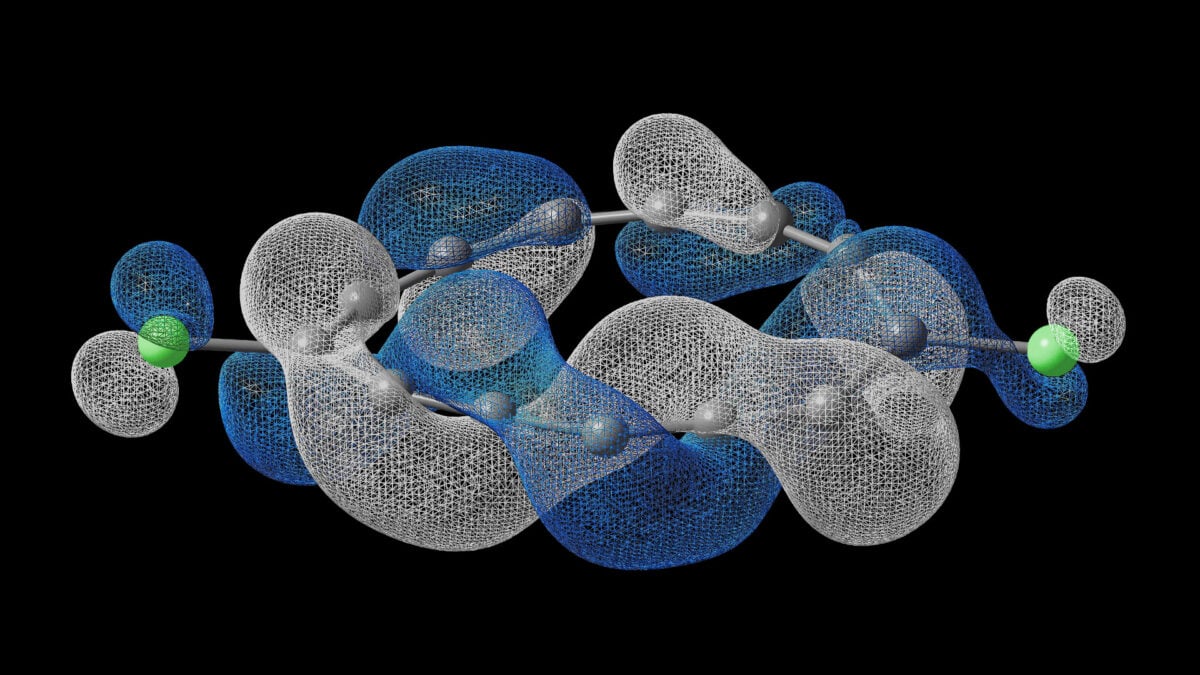
In a paper published today in Science, researchers report building a new type of molecule featuring what they call a “half-Möbius” configuration, or topology. The team created the molecule through conventional means, but it took the computational power of a quantum computer to confirm that the seemingly wacky molecule was a legitimate configuration in the quantum realm and later conceptualize what kind of structure it represented.
The findings highlight the growing power of quantum hardware in scientific research, in which researchers are increasingly gaining access to a different set of tools to probe difficult problems—especially those previously believed impossible to solve.
A chemist’s unrealized fantasy
You can easily create a Möbius strip of your own: Take a long strip of paper, give it a twist, and connect the ends—done! Things aren’t so simple in advanced chemistry, however. At the smallest scales, a molecule’s atomic connections don’t resemble the neat, organized ball-and-stick models typically presented in chemistry textbooks.
Instead, electrons interact via orbitals—probabilistic functions denoting the wave-like quantum behavior of electrons in an atom. Now, for researchers, this is a huge hassle, since classical computers aren’t that great at “explicitly describing interactions between electrons,” Igor Rončević, the study’s lead author and a chemist at the University of Manchester, told Gizmodo.
“About 10 years ago, we could model 16 or so electrons using classical computers, and now we can go up to 18,” he added. “Even if we doubled computing power, this would not get us much further, as the scaling is exponential. This is because we are using classical objects—bits—to simulate quantum objects—electrons.”
In chemistry, topology influences how electrons move through a molecule and subsequently influences the molecule’s chemical behavior. Since understanding these interactions is critical to realizing complex molecular structures, these methodological challenges have been a huge obstacle thus far, he said.
Taking a step further
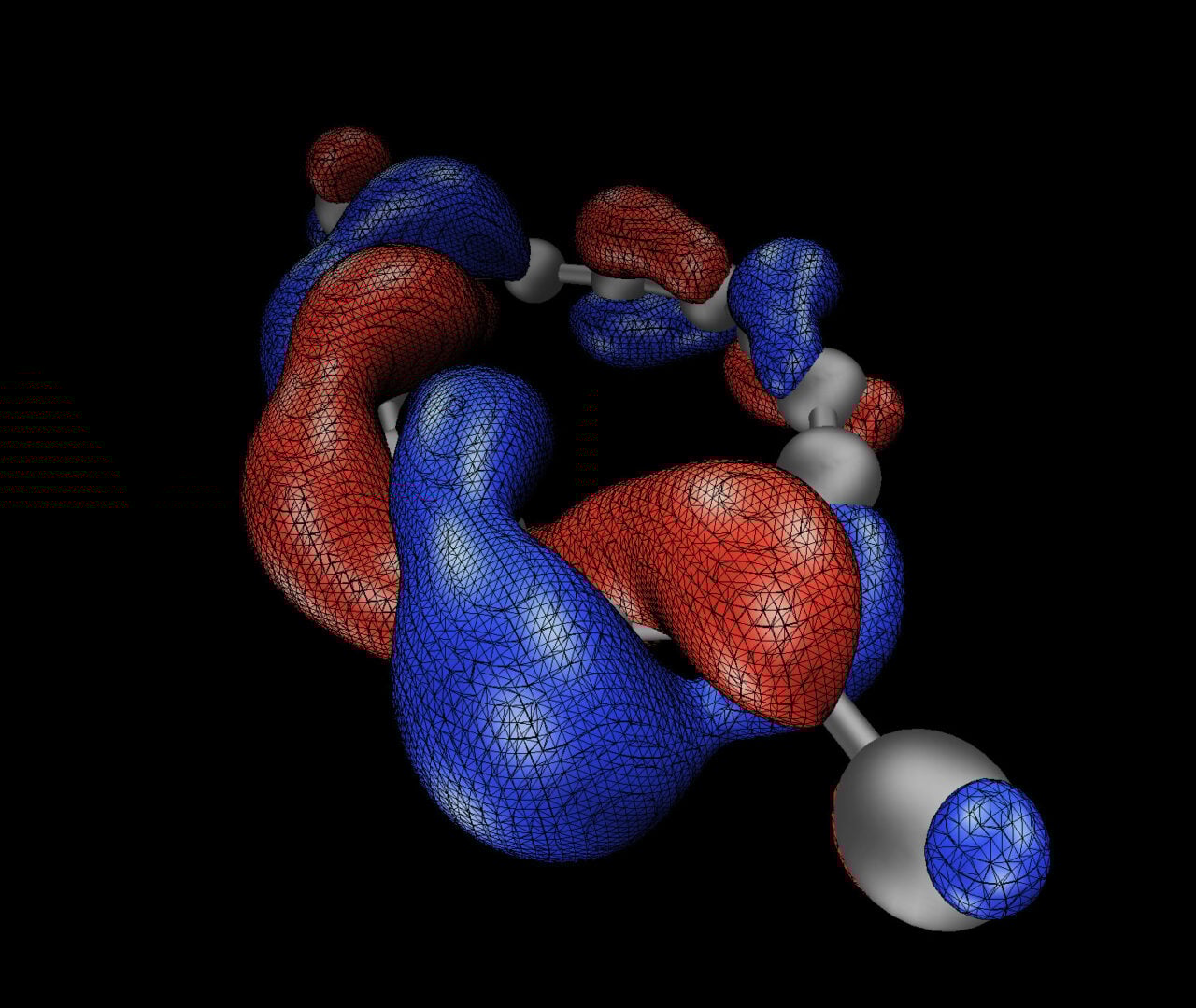
But the computing power of a quantum computer enabled the team to model and describe up to 32 electrons. Remarkably, the “half” Möbius molecule’s orbital structure requires four loops to fully trace and can switch back and forth between multiple twisted states—a never-before-seen molecular topology.
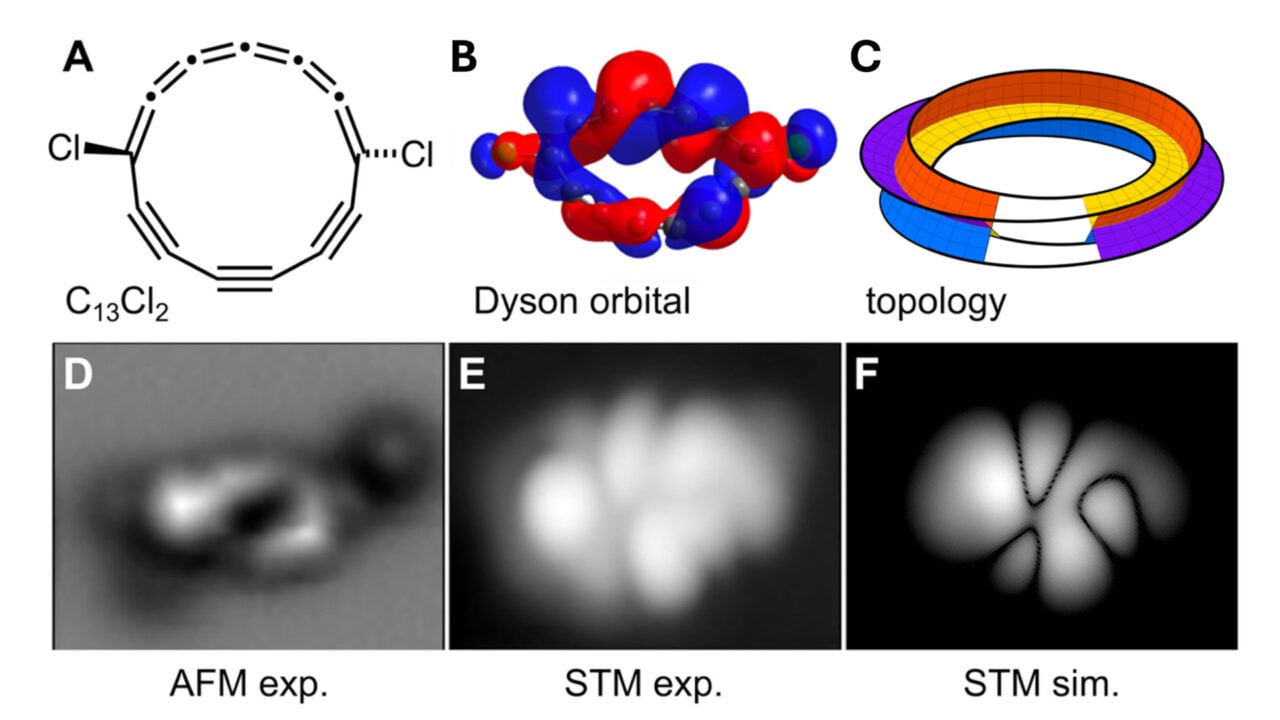
Initially, the team was investigating carbon ring-like structures but, in the process, also ended up creating a carbon-based molecule with two chlorines. When they revisited the molecule with a microscope at atomic resolution, they realized it had an unusual orbital structure. It was only after the team reproduced the image using a quantum computer that they knew they weren’t “hallucinating,” Rončević recalled.
Still, it took another return to older theoretical work—all the way back to 1964—to really understand the topology, he added, noting that “the main challenge was actually realizing what we have and then figuring out the theory of how to describe it. When it all finally clicked, we were exhausted but very happy.”
Is this the revolution?
Now, to address the elephant in the room: Does this experiment demonstrate quantum advantage—that quantum hardware undoubtedly outperforms its classical counterparts for specific tasks? And importantly, is any of this even useful?
Scott Aaronson, a computer scientist at the University of Texas at Austin who wasn’t involved in the new work, told Gizmodo that, at the very least, the paper on its own treats the quantum hardware more as an afterthought, he said.
“They do say that they surpassed what exact classical simulation can do, but that isn’t the relevant question,” Aaronson explained. “The relevant question is, did they get any benefit compared to approximate classical simulation?”
To be fair, Aaronson added, “This seems like an indication of how the use of quantum computers for chemistry, materials science, etc., will become increasingly routine, to the point that it’s barely even worth remarking on.”
“That’s great—that’s the whole point,” Jerry Chow, director of IBM Quantum, told Gizmodo in response to Aaronson’s comments. Chow was not directly involved in the new study but oversees the use of IBM’s quantum hardware.
“It may become more and more mundane that these pieces are coming together, but it shows the maturity of the capabilities to be leveraged as a tool by domain experts,” Chow said. “It’s what Feynman talked about—quantum computers have the ability to study quantum effects, which are natural in chemistry.”
A quantum era in chemistry
All that said, Rončević is just happy to have some cool new tools. The team isn’t sure yet where the new molecule could come in handy, but the findings confirm it’s possible to engineer and manipulate tiny electron states, then use quantum hardware to validate quantum mechanical behavior.
For instance, disk drives emerged as a product of scientists realizing that the spin of an electron could be used as an additional “degree of freedom” in technological breakthroughs. Likewise, non-trivial topologies could support quantum sensors or allow for more intricate control over powering quantum technologies, Rončević explained.
“Science advances as we figure out new ways to manipulate matter,” he said. “If we are being very optimistic, we could conjecture that topologically non-trivial molecules will find applications in quantum technologies.”
First Appeared on
Source link






Leave feedback about this