

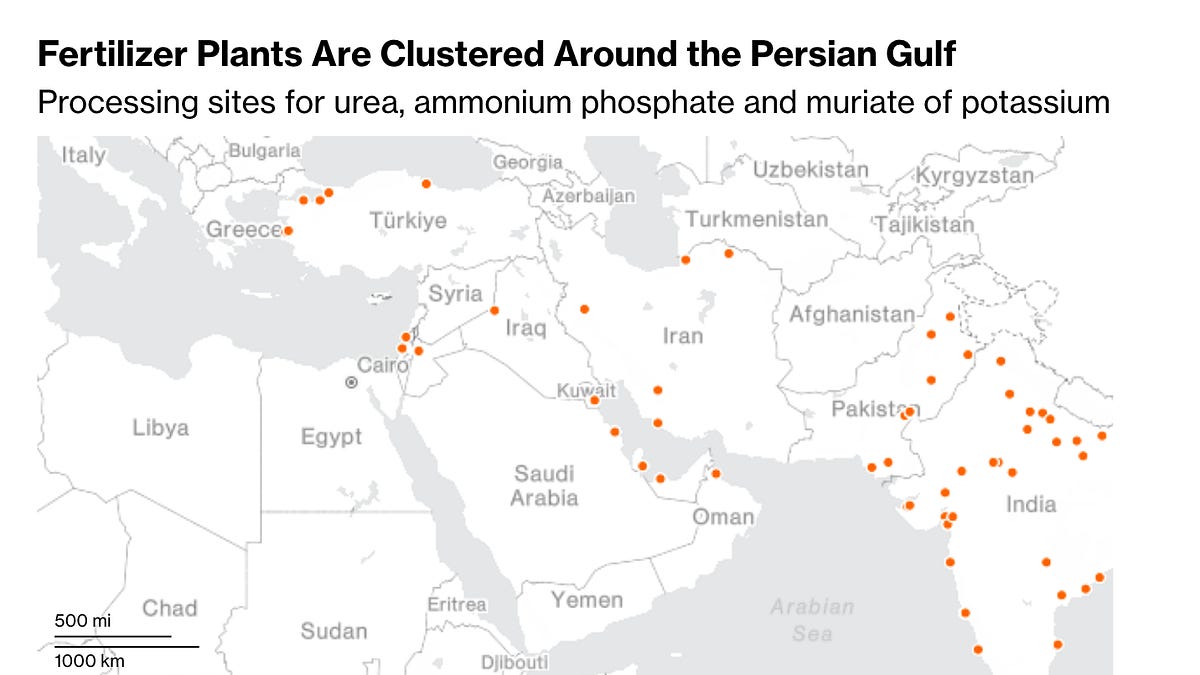
One impact of the war being waged by the US and Israel against Iran that is not getting as much attention as it deserves, is the impact on the global supply of fertilizer.
Prices for key fertilizer inputs like Urea are surging.
For most of history it was obvious that one should schedule conflict so as to avoid clashing with the agricultural cycle. Autumn, when the harvest was in, was the ideal moment for big battles. That was why major military maneuvers were generally held at that time of year. Even as late as 1914 the harvest timetable may have played some role in the war planning of combatants.
The current war is disastrous from the point of view of the modern agricultural cycle.
The gulf region handles about one third of the global trade in inorganic nutrients and in terms of the agricultural cycle this is the key moment for shipments to be steaming out from the Gulf towards the major agricultural zones of the world.
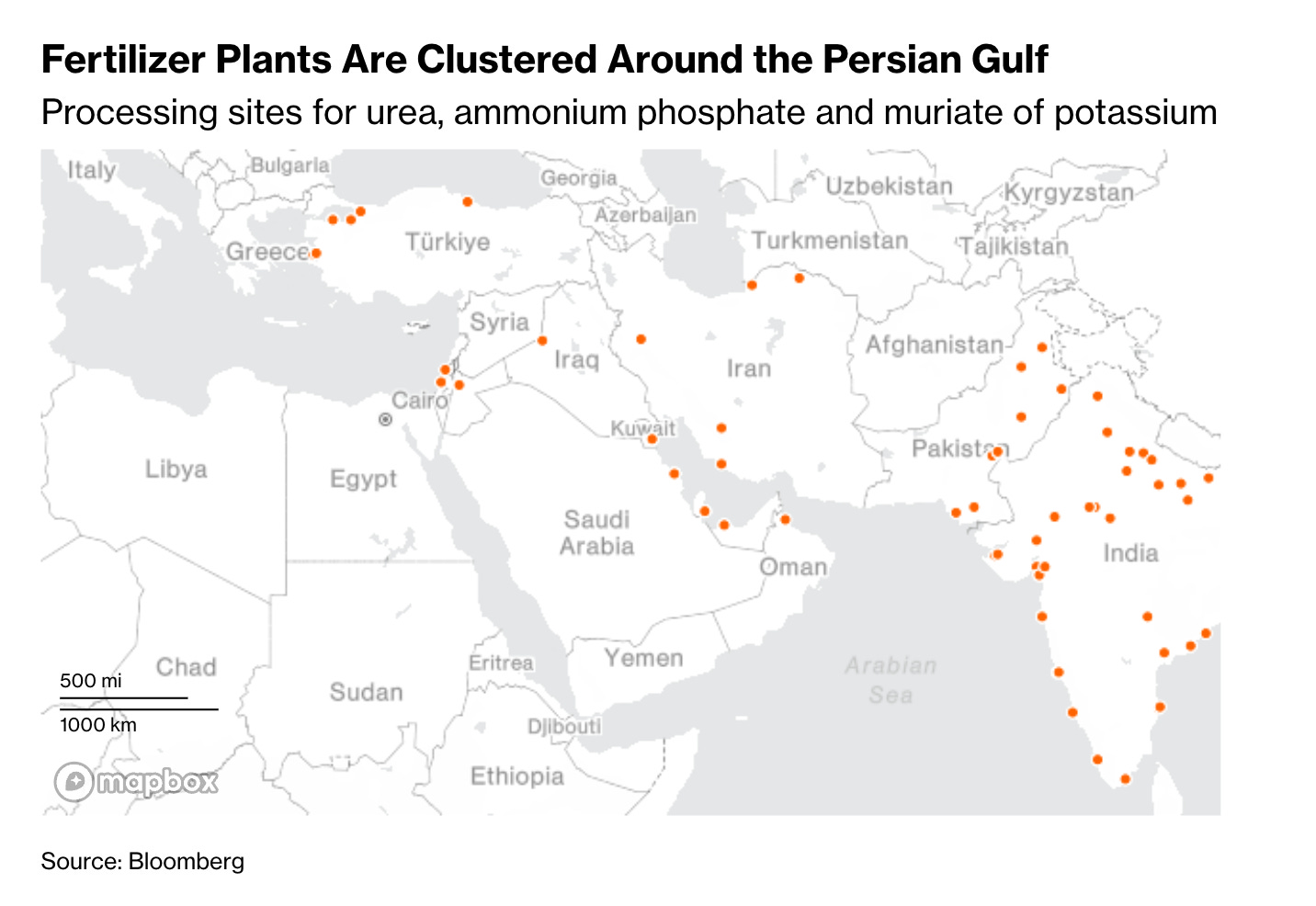
Earlier this week, Qatar shut down LNG production at the world’s largest export facility after an Iranian drone attack. As Bloomberg reports: “Qatar is a source of some 11% of global urea exports, and nearly 45% of those shipments come from Persian Gulf facilities more broadly, according to Alexis Maxwell, an analyst at Bloomberg Intelligence. Prices for granular urea in Egypt have surged by $60 a metric ton since the effective closure of the Strait of Hormuz, and buyers are already looking for other suppliers in North Africa and Southeast Asia, Bloomberg Green Markets reported.”
To make matters worse: “Iran controls 10% to 12% of the global urea trade, while Israel’s declaration of a state of emergency could interrupt gas deliveries to Egypt and therefore fertilizer production”
In New Orleans the price of urea barges shot up by “$50 and $80 dollars per short ton to between $520 to $550 on Monday.
As one observer said to Nikkei: “The politicians are saying this is a war that’s going to last for weeks, not days, and when you look around at the world within four weeks, we’re in the middle of [the Northern Hemisphere’s] spring season applications and if these ships don’t go through the Strait of Hormuz today, they’re not going to arrive in time. … You’re talking about either having to switch your planting to a crop that is much less intensive for nitrogen use,” he said, or see yields fall. In Australia, while much of the fertilizer needed for sowing has already been bought, farmers around this time start looking to buy urea for dressing cereal crops beginning in September, said Stephen Annells, chief executive of Fertilizer Australia, a group representing the industry.”
Synchronizing wars and the agricultural cycle may still matter!
Beneficiaries of the shock are major fertilizer producers like Yara International ASA and CF Industries Holdings Inc., the world’s largest ammonia producer.
Meanwhile in India, fertilizer production is shutting down for lack of Qatari LNG. “Some manufacturers, like Indian Farmers Fertiliser Cooperative Ltd., have started reductions at certain urea plants, according to people familiar with the matter, who asked not to be identified. Any prolonged disruption may compel companies to shut facilities, the people added, without providing details.”
In Pakistan as well, “Sui Northern Gas Pipelines Ltd. has also informed customers it will be unable to supply regasified LNG to their fertilizer plants due to the Middle East conflict, according to a company notice seen by Bloomberg. The country receives most of its LNG from Qatar and the suspension takes effect from midnight Wednesday.”
The Fertiliser Association of India reassures its customers that there are ample supplies. But they are hoping for a short war.
As Bloomberg explains: “Expensive fertilizer imports would complicate New Delhi’s efforts to rein in spending on nutrient subsidies for farmers, potentially derailing reductions planned in the annual budget. The government is seeking to trim its fiscal deficit target to 4.3% of gross domestic product next fiscal year, from a goal of 4.4% in 2025-26.”
Talk about a polycrisis linkage: Netanyahu persuades Trump to attack Iran, which responds by attacking Qatar, which responds by shutting down LNG, which spikes fertilizer prices in India which upsets the Indian fiscal consolidation effort!
To see who will really pay the price however, look not to the developed world or big emerging markets like India, but to the weakest links in the chain – the poor, agrarian, smallholder economies of Africa.
Look at the impact on fertilizer usage in Cote d’Ivoire, Kenya, Nigeria and South Africa, during the last great gas-price crisis at the start of the Ukraine war.
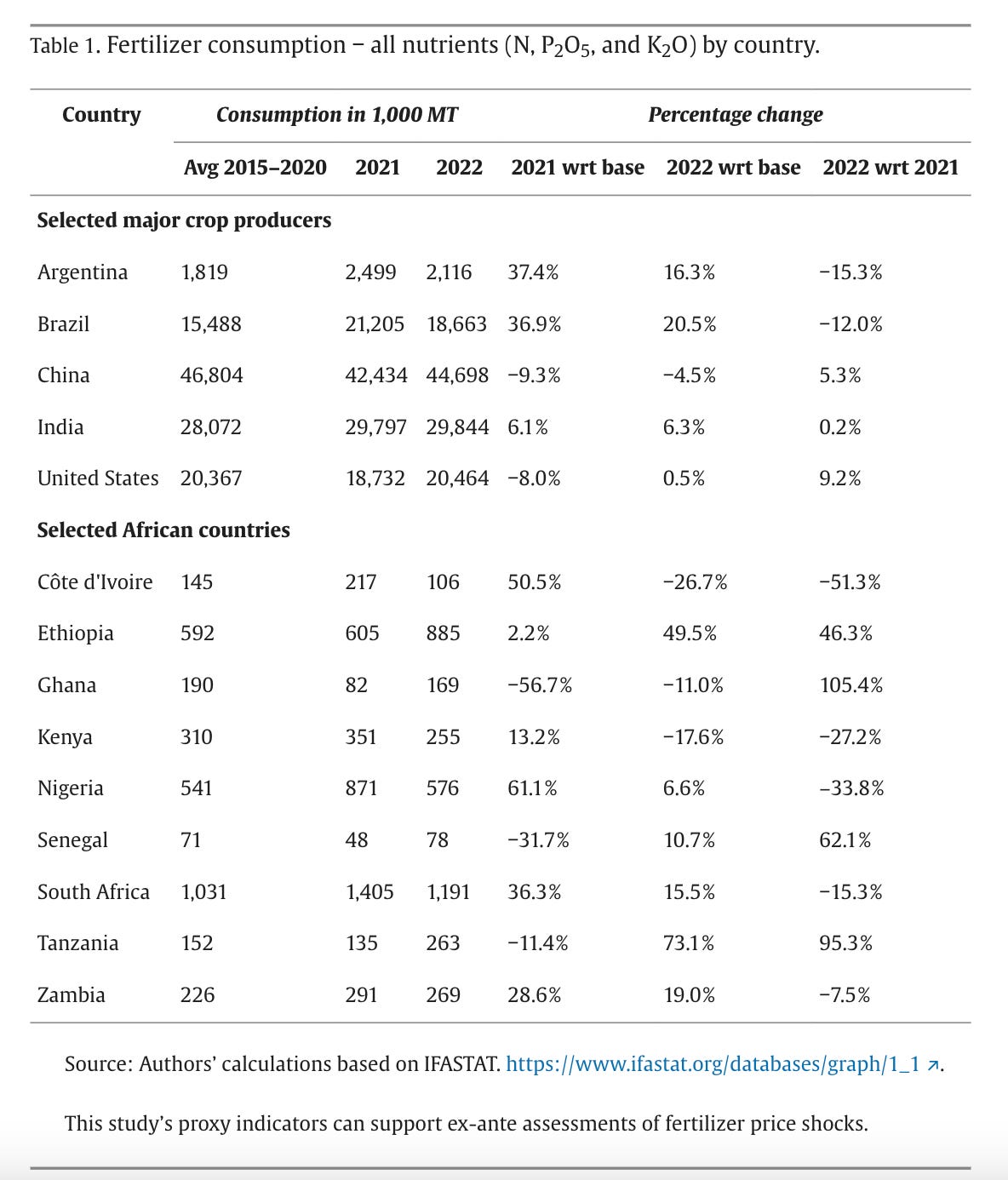
Source: Vos et al (2015)
I love writing the newsletter. If you fancy buying me a coffee once a month, you know what to do. Chartbook will keep on coming to your mailbox in any case.
First Appeared on
Source link





Leave feedback about this