

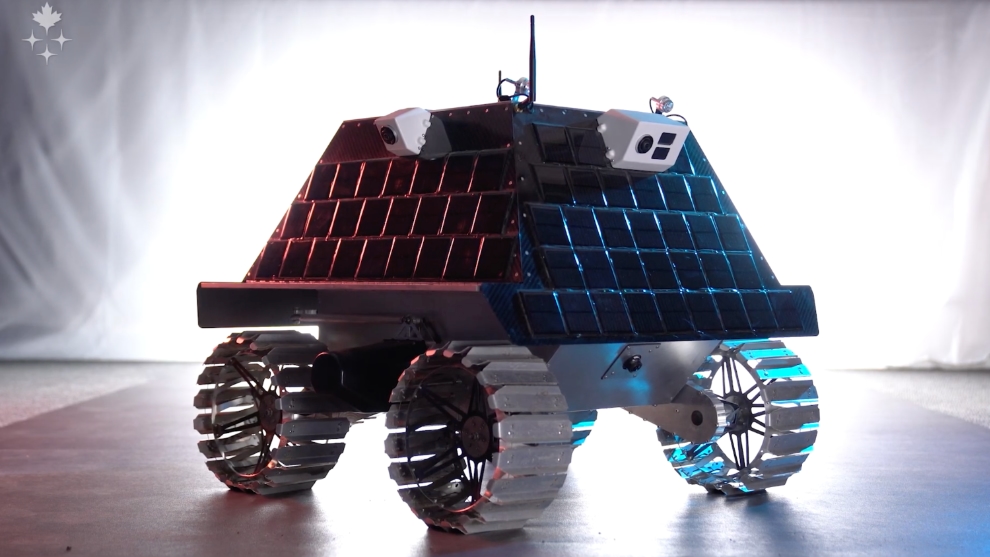
Even as the federal government boosts defence spending to historic levels—including significant investments in the space sector—it is simultaneously beginning to deliver on its promise to rein in overall spending. With the release of the 2026–27 Departmental Plan, we now know exactly where those cuts will hit the Canadian Space Agency (CSA), most notably with the outright termination of the Lunar Rover Mission.
The loss of the Lunar Rover Mission which was under development by Canadensys Aerospace will come as a significant blow to the community. The mission was approved in 2022 and manifested to launch with Firefly in 2029. Canadensys had assembled a large team of subcontractors and built a Canada wide science team.
SpaceQ reached out to the Canadian Space Agency and Canadensys with our questions and will update the story as needed.
2026-27 Planned spending of $913.9M
While the agency’s top-line budget remains a substantial $913.9 million for the upcoming fiscal year, the mandate to find internal savings is forcing hard choices. Beginning with a $6.66 million cut in 2026–27, the financial scale-back will reach $14.36 million by 2028–29. To hit these targets and shed an estimated 45 full-time roles, the CSA is streamlining its operations and along with the previously mentioned termination of the Lunar Rover Mission—freeing up capital to prioritize other lunar initiatives such as the Lunar Utility Vehicle and Earth-observation.
The CSA budget planned spending for fiscal year 2026-27 for its core responsibilities which are lumped into the name “Canada in Space,” is $857,063,421. Supporting the core responsibilities are 666.2 FTE’s (full-time equivalents) human resources. Internal services will see spending see planned spending of $56,874,897 and 366.3 FTE’s.
Of note, the CSA increased what it spent in FY2025-26 to $1,361,460,647 mainly as a result of Canada’s investments to the European Space Agency (ESA) programs by an additional $528.5 million.
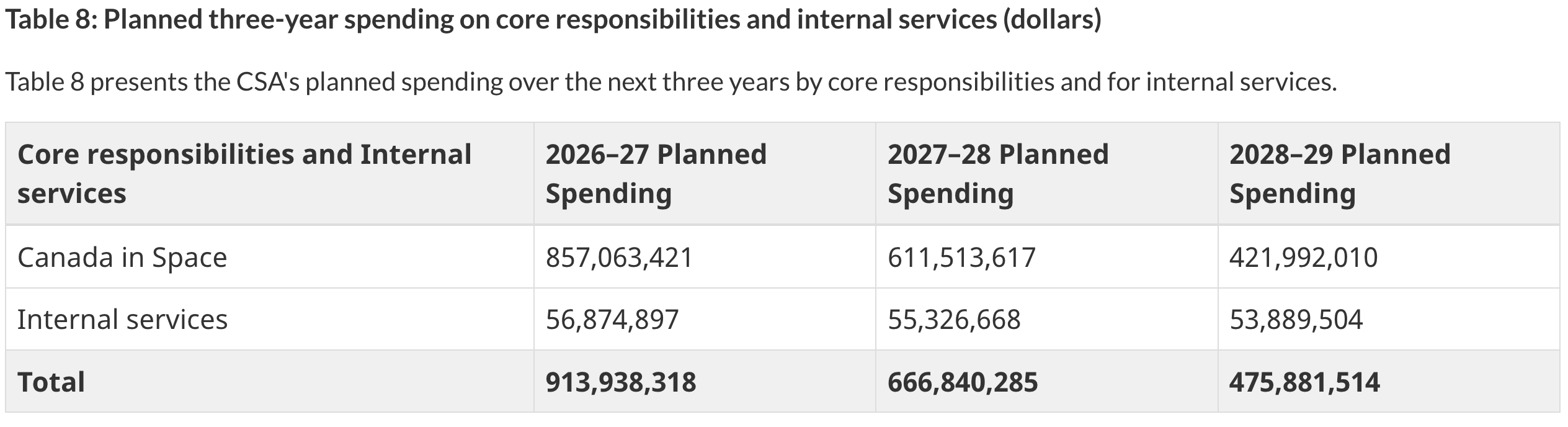
The CSA added these notes on variances between 2026–27 and 2028–29.
- Planned reductions as announced in the 2025 Budget as per the Government of Canada’s Comprehensive Expenditure Review initiative.
- Net decrease in Canadarm3 investments as originally announced in Budget 2019.
- Net decrease in Lunar Exploration Accelerator Program investments in Budget 2023 for the lunar utility vehicle (LEAP2.0-LUV), with additional funding expected in future years.
- Net decrease in investments in the RADARSAT+ initiative to support immediate and future satellite Earth observation, with additional funding expected in future years.
- Net decrease in WildFireSat investments as originally announced in Budget 2022.
- Net decrease in funding for the NASA-led Atmosphere Observing System (AOS) through the development of the Thin Ice Cloud in InfraRed Emissions (TICFIRE) instrument, as announced in Budget 2022, with additional funding expected in future years.
- Net decrease in Gateway External Robotics Interfaces (GERI) investments.
Core responsibilities – Canada in Space
In aiming to achieve its planned results in the coming fiscal year the CSA outlined the following:
Result 1: Canada Remains a Leading Space-Faring Nation
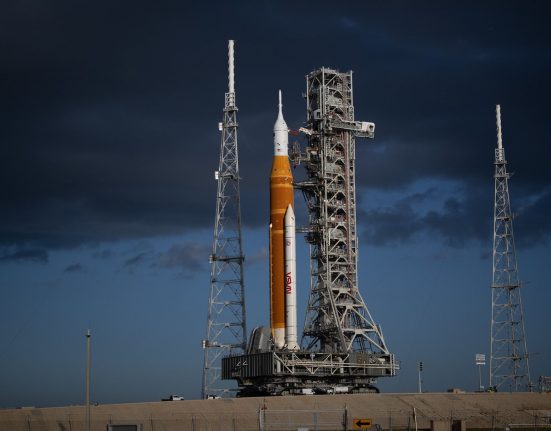
- Lunar Exploration & Infrastructure: Astronaut Jeremy Hansen will fly on the historic Artemis 2 mission. On the hardware side, Canadarm3 will hit a critical design milestone in early 2027, with flight hardware for the Gateway External Robotic Interface (GERI) expected the same year. The CSA is also continuing early preparatory studies for a future lunar utility rover and a LEAP CubeSat.
- ISS & Commercial LEO: Astronaut Joshua Kutryk will launch on Canada’s fourth long-duration mission (CAN4) to the ISS. With the ISS retiring in 2030, the CSA is actively studying commercial Low Earth Orbit (LEO) destinations to ensure uninterrupted access for Canadian science and robotics.
- Quantum Communications: 2026–27 will see the launch of QEYSSat, a mission demonstrating quantum key distribution (QKD) to lay the groundwork for a secure, quantum-resistant global communications network.
- Deep Space Science: The CSA will complete its OSIRIS-REx curation facility in Longueuil to receive Canada’s Bennu asteroid sample. The agency also continues its support of the James Webb Space Telescope (funding up to 38 Canadian research projects) and will deliver cryoharness qualification models for the ESA-led Ariel space telescope.
Result 2: Space Information and Technologies Improve Quality of Life
- SAR Data Continuity & Sovereignty: To protect critical Synthetic Aperture Radar (SAR) infrastructure—which handles roughly 300,000 imagery requests annually for the government and military—the CSA is advancing the addition of a new satellite to the RADARSAT Constellation Mission (RCM), while actively designing the next-generation RADARSAT+ system.
- High-ROI Climate Missions: Development is pushing forward on WildFireSat (targeting a 2029 launch with an estimated economic ROI of up to $5 billion over five years) and the High-altitude Aerosols, Water vapour and Clouds (HAWC) mission.
- Arctic & Atmospheric Monitoring: Planning is advancing for the Highly Elliptical Orbit-based Arctic Observing Mission (AOM). Meanwhile, following the decommissioning of the MOPITT instrument in 2025, the CSA is focusing on archiving its 25-year data record to maintain a global reference for air quality forecasting.
Result 3: Investments in Space Benefit the Canadian Economy
- $664.6 Million ESA Commitment: Leveraging the massive €407.71 million funding injection announced in late 2025, the CSA expects at least 45 Canadian organizations to secure contracts through the Canada-ESA Cooperation Agreement, explicitly tying these investments to Canada’s defence industrial base and state-of-the-art tech development.
- Commercial EO Procurement: Following an RFI in 2025–26, the CSA will complete an options analysis in early 2026–27 to define how the government will procure commercial satellite imagery moving forward.
- SME & Ecosystem Funding: The Space Technology Development Program (STDP) will roll out up to 25 funding opportunities to de-risk and commercialize Canadian space tech. Additionally, the $2.65 million smartEarth initiative will fund capacity development, including the SaMBA biodiversity project.
- Workforce Pipeline: To build the highly qualified personnel of tomorrow, the CSA is funding at least 40 university projects through the FAST program and supporting student-built satellites via CUBICS, with at least one CubeSat slated for launch in 2026.
Related
First Appeared on
Source link



Leave feedback about this