

To predict how an outbreak will progress, epidemiologists often use stock-and-flow diagrams: illustrations featuring stocks of people (susceptible, infected, recovered, dead) and arrows showing flows between them based on factors such as exposure or virulence. Stocks and flows are just objects and morphisms of a category. The arrangement of boxes and arrows in the diagrams translates into equations describing the system’s evolution.
Over the last few years, Osgood, Baez, and their team have developed a software package called StockFlow that formalizes this kind of modeling. Specialists can model different aspects of an outbreak, such as how health disparities affect the infection rates of susceptible people, and these categories can be composed into larger ones. “Category theory is able to handle those fancier forms of composition,” Baez said.
StockFlow has yet to spread among epidemiologists, but Osgood teaches it to his students in hopes of inoculating the next generation of modelers. “This is genuinely something that could be used,” said Leinster. “It’s serious stuff.”
Meanwhile, Hadzihasanovic and Capucci are both part of Safeguarded AI, a project funded by ARIA, a U.K. government–funded advanced research agency, that’s applying category theory to the problem of AI safety. How, the program asks, can unpredictable and error-prone AI systems be trusted to operate essential real-world systems, such as nuclear plants or power grids?
I can see the need here, and the team’s answer is clever: Build formal models of complex systems for the AI to practice on. These models must have the same logical structure as the real system, correctly representing the morphisms between many different types of objects.
“Category theory gives you a modular and compositional way of doing this,” Capucci said. “We are developing fundamental technology that we can deploy in so many situations.”

There’s a sense among applied category theorists that their approach will pay off in the long run, as systems grow ever more complex and interconnected, and as AI gets more involved. Winging it won’t cut it. “This is going to be, eventually, very important work,” Hadzihasanovic said.
Many practitioners got into the field because they share Baez’s environmental ethos and hope to take on greener problems in time. Baez still has high hopes. A cousin of Joan Baez, the folk singer and activist, he was heavily influenced by his uncle (her father), a physicist who was also a socially active Quaker. It’s “infused in me,” he said, to help the world and “not just enjoy myself.”
I asked what it is about the biosphere that he thinks category theory can help us understand.
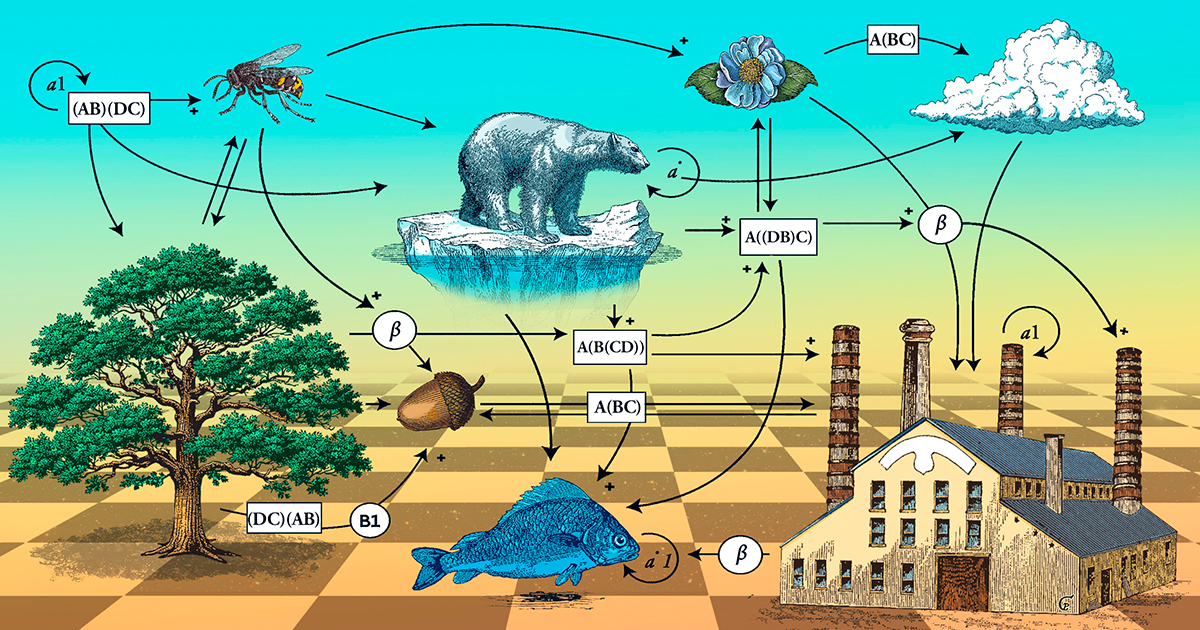
In his view, we improperly categorize biological systems. We mistake them for machines, objects that perform specific tasks by taking in matter and energy and producing desired outputs and waste. “We focus on the part we care about and ignore the waste and where is the energy coming from,” Baez said. “Our whole technology and indeed our whole mathematics is based on that attitude.”
Living systems are a different category, though. They’re not built to perform tasks. Evolution has made life “incredibly subtle and complicated in ways we can’t fully fathom,” he said. Genes aren’t discrete parts of a machine with their own purposes, for instance; they all have numerous roles and impacts. In an ecosystem, there’s no waste; one creature’s poop is another’s feast.
“I don’t think we have the math to understand such systems yet,” said Baez, who thinks modeling these systems will involve new categories with previously unstudied logical structures. “That’s the kind of mathematics I would like to develop, because I have this hope that it will help us be kinder to the world if we understand the world a bit better and not think of the natural world as raw materials for our machines to take advantage of to do what we want to do. That attitude that we have right now is running into a wall. That attitude winds up destroying the whole planet.”
Indeed, we might value nonhumans, ecosystems, and the climate more by conceiving of them and ourselves as objects in a shared category.
Like these mathematicians, I yearn to make the world a better place while doing what I love. (Don’t we all?) Philosophically, I see the promise in applied category theory. Time will tell whether the approach will genuinely help humanity or the planet. But for those who feel called to do good and to do math, it’s worth a try.
First Appeared on
Source link




Leave feedback about this