

Buried deep under the Pacific Ocean, the Tamu Massif has been identified as the largest single volcano ever discovered on Earth. First described by a team led by Dr. William Sager of the University of Houston, the discovery reveals a structure so vast and flat that it long escaped clear identification. Its existence, confirmed through detailed analysis, places it among the most significant geological findings of recent decades.
The massif is located in the Shatsky Rise, a remote underwater plateau about 1,000 miles east of Japan. According to the researchers, what had been mapped as three separate mounds is in fact one continuous volcanic system, unified by its structure and origin.
This matters because it challenges previous interpretations of oceanic plateaus. According to the study published in Nature Geoscience, recognizing the Tamu Massif as a single volcano opens new paths for understanding how massive eruptions from Earth’s interior can shape the seafloor.
A Colossal Structure Mistaken for Many
For years, scientists studying the region treated its features as distinct formations, though they never gave them official names. Instead, they relied on informal labels, or as Dr. Sager put it, they simply got tired of referring to them as: “the one on the left, the one on the right and the big one.”
That changed when seismic-reflection data revealed continuous lava flows linking the entire structure. According to findings, avaliable on Nature Geoscience journal, the massif spans roughly 120,000 square miles.
“ It’s about the size of the state of New Mexico, making it by far the largest ever discovered on Earth,” he said.
The scale alone sets it apart. No other volcano on Earth rivals this footprint, operating as one cohesive, interconnected system rather than a cluster of separate features.
An Unusually Flat and Expansive Volcano
The Tamu Massif does not resemble the steep volcanoes most people imagine. Instead, it is extremely broad, with slopes so gradual they are nearly imperceptible.
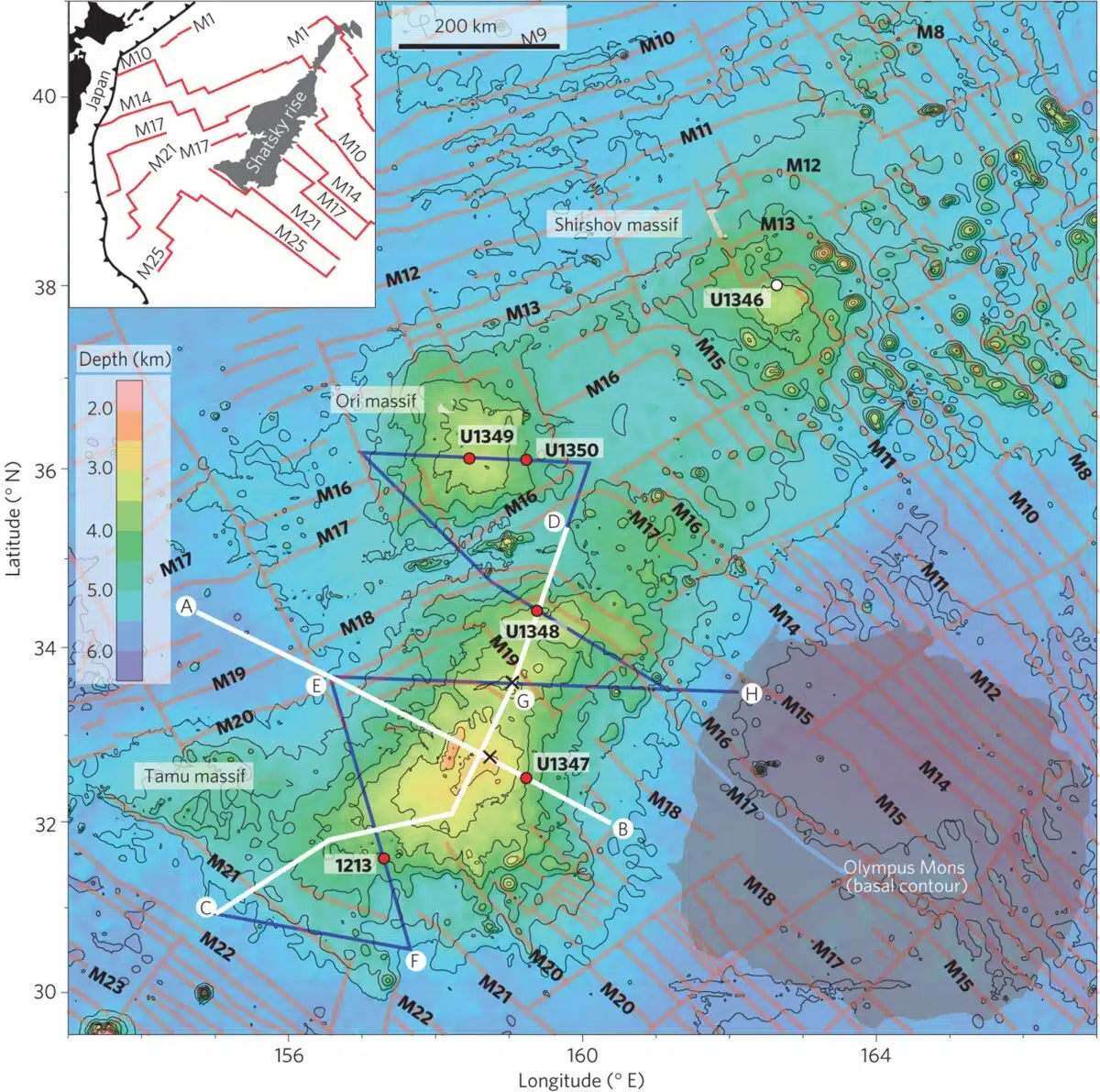
According to Dr. Sager, someone standing on its flank would struggle to determine the direction of descent. The volcano’s summit lies about 6,500 feet below the ocean surface, while its base reaches depths close to 4 miles.
Researchers explained that this shape was formed by massive lava flows spreading outward from a central source, creating a wide, shield-like structure unlike any other submarine volcano identified to date.
A Giant Comparable to Martian Volcanoes
The Tamu Massif is so vast that it belongs to a category of its own. As the research team noted only Olympus Mons on Mars, the solar system’s largest volcano, can match its scale.
This comparison underscores the structure’s exceptional size. By contrast, Mauna Loa in Hawaii, the largest active volcano on Earth, covers only about 2,000 square miles.
As Dr. Sager explained, the formation of such a structure required a huge volume of magma rising from deep within the Earth’s mantle. The massif formed around 145 million years ago and became inactive shortly afterward.
” So this is important information for geologists trying to understand how the Earth’s interior works,” he added.
.
First Appeared on
Source link






Leave feedback about this