

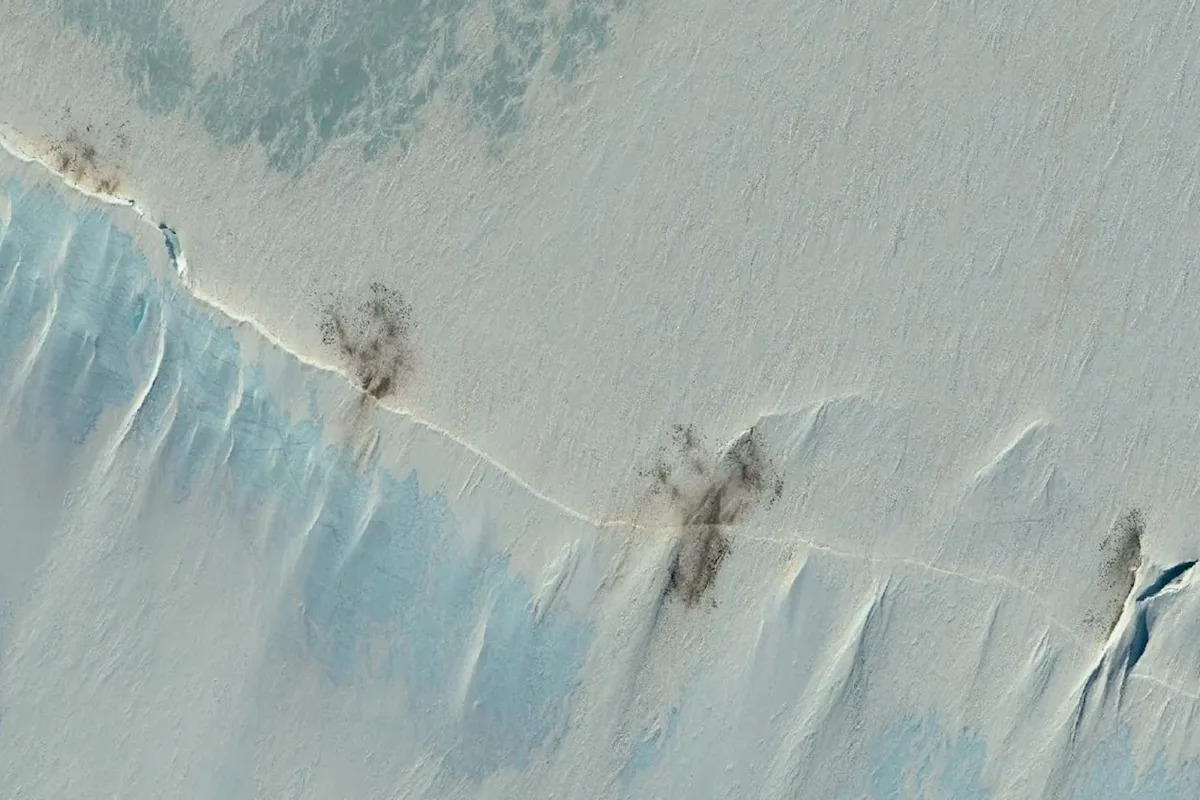
Scientists have discovered a “catastrophic” new threat to Antarctica’s fragile ecosystem after studying blotches on satellite images of sea ice. Emperor penguins can grow to 1.2 metres tall and weigh 45kg, but from high above the Earth, their colonies appear as tiny brown specks.
Researchers from the British Antarctic Survey (BAS) stumbled upon these clusters at Marie Byrd Land, in the west of the icy continent.
But as they studied them over seven years, they realised the number of colonies in the region appeared to be shrinking.
It had already been estimated that emperor penguins could be functionally extinct in 75 years. And the impact of sea ice loss was already understood to be killing thousands of chicks.
The penguins are an important piece of the continent’s ecosystem, and widespread losses would likely impact the entire food chain.
Fear ‘huge numbers’ of emperor penguins died
Before 2022, there were over 100 groups along the coast at Marie Byrd Land, but in 2025, just 25 were visible.
The penguins are congregating in bigger groups because they have less territory as sea ice melts due to climate change. But importantly, there also appears to be fewer penguins overall.
The region is important because it historically maintained stable ice through the summer.
So every year, thousands of penguins would migrate there from up to 1,000km away.
The decline in sea ice has been rapid, and it hit record lows between 2022 and 2024.
Coverage dropped in the region from a 50-year average of 500,000 square km to just 100,000 in 2023.
BAS mapping expert Dr Peter Fretwell said it’s possible that some penguins relocated to new areas when the ice melted.
“But also, it’s possible that huge numbers of penguins perished after entering the Southern Ocean before they had replaced their waterproof feathers,” he said.
“If this has happened, the situation for emperors as a species is even worse than we thought.”
It’s predicted emperor penguins could be functionally extinct by the end of the century. Source: Peter Fretwell/BAS
Emperor penguins migrate to Marie Byrd Land during the summer, so they can moult.
The process of replacing their feathers is slow, and they need somewhere stable to undergo the change during the hotter period.
During the moult, they face an increased risk of exhaustion and death.
Not only can they not feed for several weeks, if they’re forced into the freezing ocean, they can die of hypothermia, or because they’re weaker, they can easily be eaten by predators.
BAS said the melting of ice that surrounds large groups of penguins could have “catastrophic consequences” for their survival.
It noted the Marie Byrd Land population is made up of seven colonies that account for 40 per cent of the population.
And so a decline in this group would be a significant blow to the species.
Do you have a story tip? Email: [email protected].
You can also follow us on Facebook, Instagram, TikTok, Twitter and YouTube.
First Appeared on
Source link






Leave feedback about this