

Summary and Key Points: Brandon J. Weichert, a veteran national security editor and geopolitical consultant, evaluates the “Great Missile Burn” of the Purim War. As of March 2026, the Trump administration could reportedly drain INDOPACOM interceptor and missile stockpiles to sustain operations against Iran.
-This report analyzes the U.S. defense industrial base’s failure to scale production, creating a “logistics crisis” across multiple theaters.
-Weichert concludes that by depleting Pacific reserves to crush Iranian resistance, the U.S. is signaling strategic vulnerability to China, potentially inviting an attack on Taiwan while American magazines are empty.
INDOPACOM at Risk: Analyzing the Possible Dangerous Shift of Pacific Weapon Stockpiles to the Middle East
President Donald Trump is deeply committed to what some are calling the “Purim War,” the current conflict between the United States, its Israeli allies, and the Islamic Republic of Iran.
We’ve reached several days of the high-intensity conflict, which has been defined by a seemingly endless barrage of missiles and anti-missile interceptor fire stretching across the arc of the greater Middle East.
The Purim War’s Brutal Opening Salvo
Already, panic is setting in among U.S. defense planners, as the operational tempo over the first four days of the Purim War is far greater than expected.
There is now a mad dash of logistics planes flying to and from the Middle East, as the military attempts to secure whatever weapon sources it can to maintain its current operational tempo. Trump argues that the U.S. arsenals are so vast, particularly in terms of what he describes as “high-end systems” (so, nuclear weapons?), that he can fight a “forever war” and win!
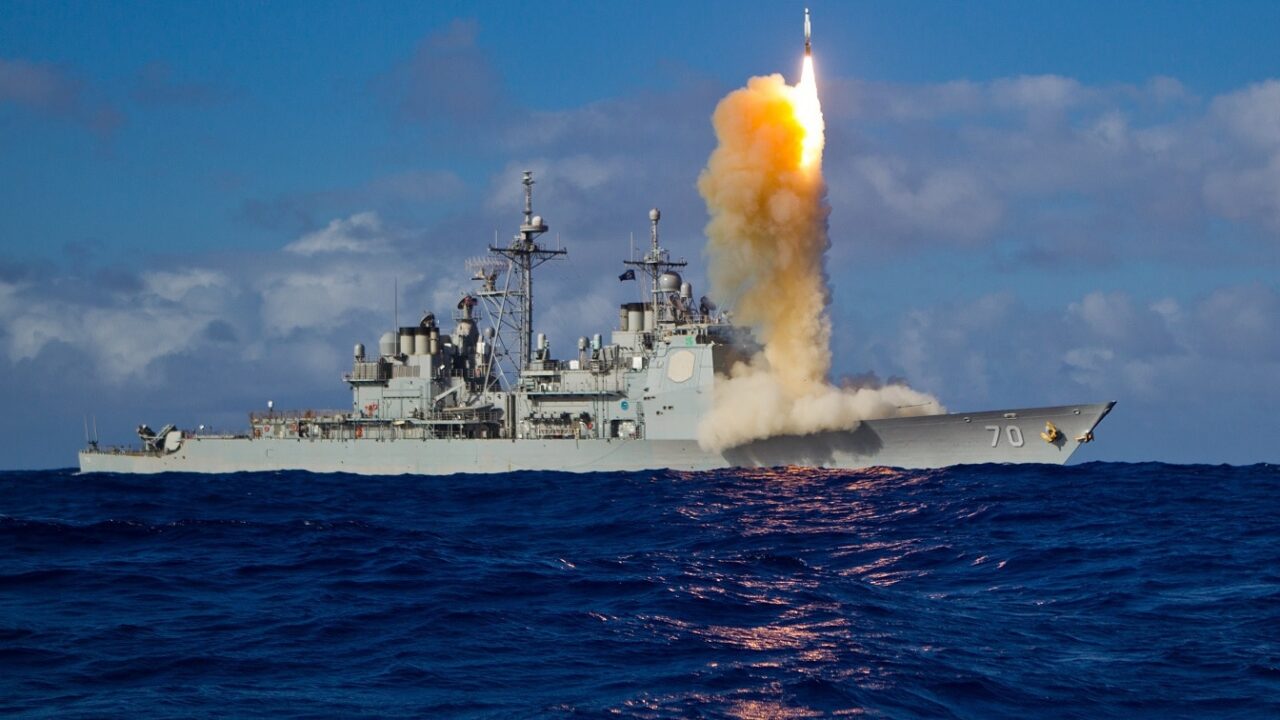
PACIFIC OCEAN (April 26, 2007) – A Standard Missile-3 (SM-3) is launched from the Aegis-class guided missile cruiser USS Lake Erie (CG 70), during a joint Missile Defense Agency, U.S. Navy ballistic missile flight test. Approximately three minutes later, the SM-3 intercepted a unitary (non-separating) ballistic missile threat target, launched from the Pacific Missile Range Facility, Barking Sands, Kauai, Hawaii. Within moments of this launch, the USS Lake Erie also launched a Standard Missile-2 (SM-2) against a hostile air target in order to defend herself. The test was the eighth intercept, in 10 program flight tests. The test was designed to show the capability of the ship and its crew to conduct ballistic missile defense and at the same time defend herself. This test also marks the 27th successful hit-to-kill intercept in tests since 2001. U.S. Navy photo (RELEASED)
Of course, anyone who has ever worked logistics at the Pentagon understands the absurdity of this claim. Going back to 2023, barely a year into the Ukraine War, multiple logistics experts both inside the Pentagon and in think tanks were warning the public that America’s critical defense stockpiles were at crisis levels. No one listened. America tried to build more systems.
That was a failure because the American defense industrial base simply cannot scale worth a darn anymore.
So, since 2023, the United States has spasmodically shifted weapons out of one of its global combatant commands that is not believed to be engaged in significant military operations and transferred those stockpiles to the area of responsibility (AOR) that is experiencing serious conflict.
That bought the U.S. logisticians some time. Ultimately, though, there’s only so much to go around—and the greater the operational demand, the higher demand for weapons, the more likely that depletion becomes a real risk.
This is the poorly understood story of 2026.
Because now, both Europe and the Middle East are burning (with side conflicts boiling in Latin America and a potential flashpoint in the Indo-Pacific between China and Taiwan). And with these conflicts raging on multiple continents, pulling finite armaments from depleting stockpiles, with few replacements coming online in a reliable manner, a true logistics crisis is about to explode onto the front pages of the world.
The Great Missile Burn
As the U.S. military blasts through its stockpiles for the CENTCOM AOR, it must now pivot and begin drawing weapons and platforms from the last remaining large stockpile of available weapons, INDOPACOM.
This is really what Trump means when he says that the United States military can wage a “forever war” with virtually limitless supplies. Well, it’s not forever. It’s for maybe five weeks or more. And that conflict will not enjoy limitless supplies. It will be limited to however many weapons and platforms INDOPACOM can hand over.
The rumor mill suggests that the Trump administration is planning for one major military operation that it believes will crush the Islamic Republic’s most obnoxious resistance. Yet, that resistance has proven incredibly resilient, and it has been far more destructive than what the Americans or Israelis believed Iran was capable of.
Within the month, though, it is probable that we will have a much better grasp on the situation in Iran—and it will require whatever remaining stockpiles of missiles and air defense interceptors are available in the INDOPACOM.
INDOPACOM: The Last Reserve
But what happens once those stockpiles in the INDOPACOM AOR are depleted? Will China, which I can assure you is closely monitoring the status of America’s critical stockpiles in the region, simply sit back and behave as a normal power in that part of the world?
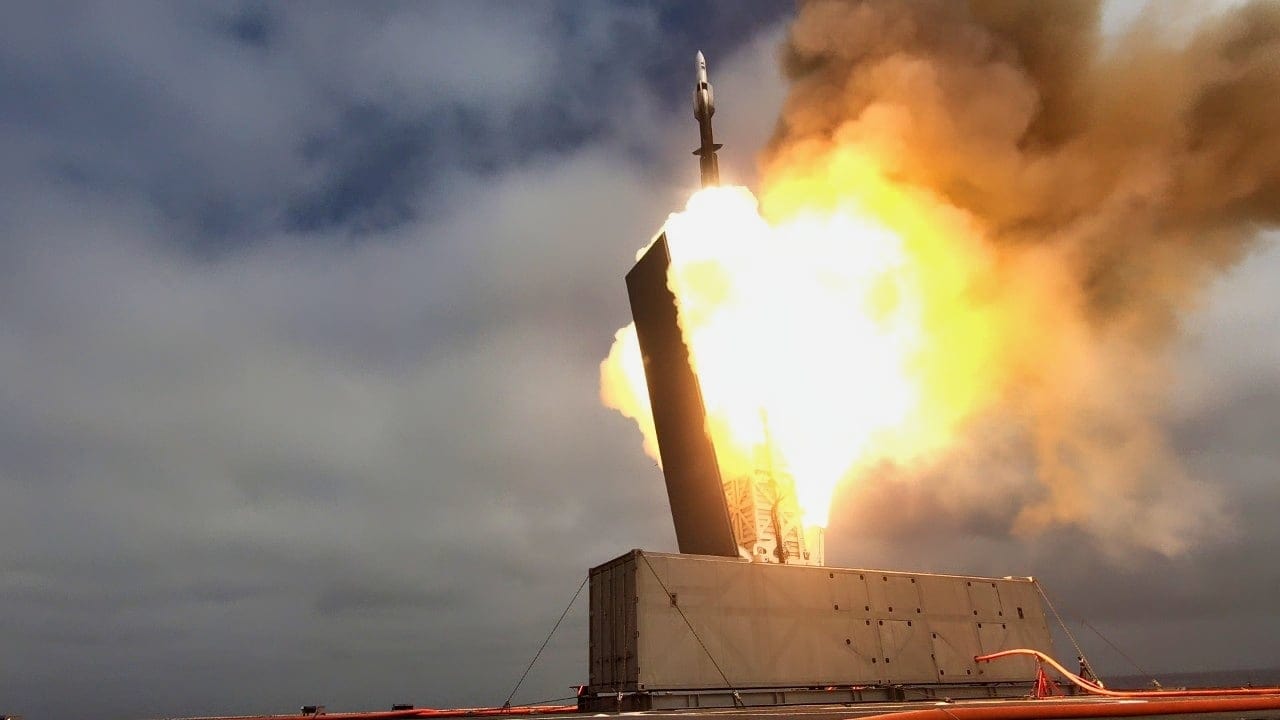
USS Savannah (LCS 28) conducts a live-fire demonstration in the Eastern Pacific Ocean utilizing a containerized launching system that fired an SM-6 missile from the ship at a designated target. The exercise demonstrated the modularity and lethality of Littoral Combat Ships and the ability to successfully integrate a containerized weapons system to engage a surface target. The exercise will inform continued testing, evaluation and integration of containerized weapons systems on afloat platforms.
Or will Beijing sense that the moment those stockpiles in the INDOPACOM AOR are depleted, it would be presented with a fait accompli in terms of threatening to attack its neighbors, like Taiwan?
Trump believes he will defeat the Islamic Republic of Iran. It’s just a matter of time. For the sake of this essay, I’ll withhold my judgement on that assumption.
If, however, this war lasts longer than what his rosiest assumptions were, even if Trump manages to win, it could set the conditions for a major strategic defeat at the hands of the Chinese in the INDOPACOM AOR, considering that America’s primary defensive systems and weapons there would have been drained to fight the Iranians—with no real replacements coming in from the United States’ defense industrial base.
In fact, I am certain that the ongoing Purim War will ensure that the Americans cannot effectively defend their interests in the Indo-Pacific from the Chinese, if this conflict in the Middle East lasts more than a few weeks and the Americans are forced to move the stockpile in the Indo-Pacific to the Middle East.
About the Author: Brandon J. Weichert
Brandon J. Weichert is the Senior National Security Editor at 19FortyFive.com. He was previously the senior national security editor at The National Interest. Weichert is the host of The National Security Hour on iHeartRadio, where he discusses national security policy every Wednesday at 8pm Eastern. He hosts a companion show on Rumble entitled “National Security Talk.” Weichert consults regularly with various government institutions and private organizations on geopolitical issues. His writings have appeared in numerous publications, among them Popular Mechanics, National Review, MSN, and The American Spectator. And his books include Winning Space: How America Remains a Superpower, Biohacked: China’s Race to Control Life, and The Shadow War: Iran’s Quest for Supremacy. Weichert’s newest book, A Disaster of Our Own Making: How the West Lost Ukraine, is available for purchase wherever books are sold. He can be followed via Twitter/X @WeTheBrandon.
First Appeared on
Source link





Leave feedback about this