

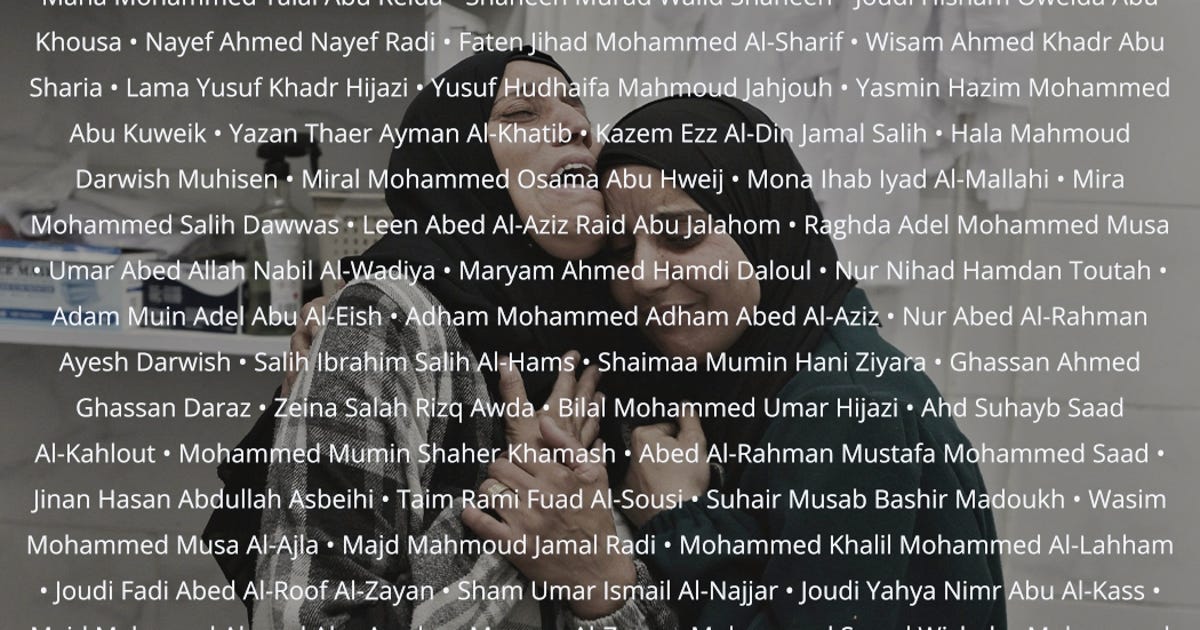
Gaza’s fatalities list is an explosive and controversial document. Critics claim the Hamas-run Gaza Health Ministry duplicates names, counts Hamas militants as civilians and inflates the number of women and minors. Haaretz took a deep dive into how the list of nearly 70,000 names was compiled to test those claims
The name Hind Rajab, possibly the most famous Palestinian victim of the war, appears on row 5,918 of the Hamas-run Gaza Health Ministry’s list of fatalities. In January 2024, she was the sole survivor among seven people in her family’s car as they tried to flee Gaza City at the orders of the IDF. For over two hours, she remained on the phone with her family and the Red Crescent, which dispatched paramedics to rescue her.
Eleven days later, her body, riddled with hundreds of bullets, was found in the car. The bodies of the paramedics, Yousef al-Zeino and Ahmed al-Madhoun, were discovered in the bullet-riddled ambulance nearby. Their deaths are recorded later in the table, in rows 46,722 and 49,661.
Hind Rajab was 5 years and 8 months old when she died. Her position in row 5,918 means that 5,917 children younger than her were killed in the war. The first name in the table is Waad Sabbah, who was killed six weeks after Hind. He and 17 other newborns died within their first 24 hours. One hundred and fifteen children died before reaching one month. A total of 1,054 children died before their first birthday.
The Gaza Health Ministry’s list of the dead, which Haaretz translated from Arabic with the help of AI and which spans more than 2,000 pages, is a document whose significance is rivaled only by the controversy it has generated. Governments worldwide, along with researchers and human rights organizations, have treated it as the closest thing to an official estimate of the death toll. Israel and conservative researchers, on the other hand, have raised doubts. They have criticized the list, attempted to undermine its credibility and pointed to errors, though these appear negligible.
Over time, however, a consensus has taken shape: even if the list has weaknesses, including the fact that it does not differentiate between combatants and civilians, it reflects the scale of the disaster inflicted on Gaza and its people. It also forms the basis for allegations that Israel committed war crimes, crimes against humanity and even genocide.
“It’s clear that the list isn’t 100 percent accurate and that it has errors, but I think they’re around one percent,” says Dr. Lee Mordechai, a historian at the Hebrew University of Jerusalem who leads a war documentation project based on tens of thousands of open sources.
He also points to the test of time. In previous rounds of fighting, when Israel eventually published its own figures for civilian deaths, they were close to those of the Gaza Health Ministry. “The Health Ministry’s count is actually an undercount. It does not include unidentified bodies, bodies buried in the rubble or bodies for which there is no information.”
As the months have passed, claims of fabrication and exaggeration have largely remained confined to Israeli television panels. At the end of January, an apparent dispute over the number of dead seemed to end in Israel when a senior army source confirmed that the IDF recognizes that 70,000 people died, precisely the figure cited by Gazan authorities. Even so, politicians have been slow to echo that acknowledgment, and the IDF’s English-language spokesperson quickly issued a denial of the senior officer’s remarks.
Even if the argument over the total number of dead is, for now, largely settled, disagreement in Israel continues over who the dead were: How many were gunmen, how many were affiliated with Hamas, how many were killed under circumstances that meet the conditions of international law?
None of this alters the stark figures in the table. Of the recorded deaths, 20,876, about 30 percent, are young girls, teenage girls and women. Another 3,220 were aged 65 and over, including the final name on the list, Tamam al-Batsh, who was 110 when she died.
68,844
Gazans whose names appear on the list
At least 47%
of those killed were likely noncombatants
20,633 killed under age 18
44,990 killed ages 18-65
3,221 killed age 65 and over
Each dot represents 100 people on the Gaza Health Ministry’s list. The list includes people who died violent deaths in the war – and were identified. About 3,000 additional bodies remain unidentified, and many others are still buried under the rubble. Deaths from hunger or disease are not included.
65% of the dead were ages 18-65; about 30% were minors and 5% were 65 or older.
17,594 were age 16 and under, including 3,150 infants and toddlers (3 and under). 18 were killed within their first 24 hours of life. Among older teenagers (ages 16-18), 3,039 were killed.
Of the older teenagers, 837 were girls and 2,202 were boys, who were more likely to leave shelter. There is no conclusive evidence that teenagers participated in fighting in large numbers.
This age group includes the vast majority of Hamas militants, though they are not identified as such on the list. According to most experts, most of the men killed were not armed militants and, like teenage boys, were more likely to leave shelters. Although 33,793 men were killed – nearly three times the number of women (11,197) – women make up a higher share of the dead than in any other war in recent decades.
32,849 of those killed were age 16 and under, women (including teenage girls), or age 65 and older; in other words, individuals not likely to have participated in combat.
Those not suspected of being combatants – about half of the dead – make up a much higher share than in any other war in the 21st century.
First Appeared on
Source link





Leave feedback about this