

On clear nights, the band of the Milky Way stretches across the sky like a pale river of light. For centuries, that glow defined our sense of where we sit in the cosmos. It looks orderly, even calm, as if our galaxy rests at the center of something balanced. But beyond that familiar strip of stars lies a far more complex gravitational landscape shaped by invisible mass.
Small galaxies drift around us in slow, steady orbits. Others move away, carried by the expansion of the universe. Astronomers track these motions with increasing precision, mapping distances and velocities across millions of light years. The resulting picture reveals a dynamic environment governed largely by dark matter, which outweighs all visible stars combined.
For years, one detail refused to sit comfortably inside standard models. Galaxies just beyond our immediate neighborhood appeared to follow the cosmic expansion with surprising smoothness. Their motion outward did not show the level of gravitational braking many calculations predicted. The discrepancy was subtle, but persistent within measurements of the local Hubble flow.
Now a new reconstruction suggests the answer may lie in how unseen matter is arranged around us rather than how much of it exists.
A Local Group That Is Not Spherical
In a study published in Nature Astronomy, researchers led by Ewoud Wempe and Amina Helmi at the University of Groningen reconstructed the mass distribution around the Local Group, the collection of galaxies that includes the Milky Way and Andromeda. Instead of assuming a smooth, spherical halo, they allowed the data to guide the structure of surrounding matter.
Using constrained cosmological simulations grounded in the Lambda Cold Dark Matter framework, the team fed in observed galaxy positions and velocities. The model adjusted the unseen mass until it reproduced what astronomers actually measure in the nearby universe. This method ties theoretical structure directly to real motion rather than relying on simplified assumptions.
What emerged was a pronounced flattening. Most of the surrounding matter appears concentrated in a vast dark matter plane extending tens of millions of light years. Density increases toward this plane and drops sharply above and below it. In practical terms, the gravitational landscape around our galaxy may resemble a broad sheet rather than a roughly symmetrical cloud.
A summary of the findings published by Phys.org explains that this flattened configuration aligns more closely with the observed velocity field of nearby galaxies than spherical models do. The structure itself remains inferred entirely from gravitational effects rather than direct detection.
Why Geometry Changes Galaxy Motions
Astronomers measure recession speeds through the Hubble flow, the large scale expansion of space. In theory, the gravity of the Local Group should slow nearby galaxies relative to that expansion. If mass were distributed evenly in all directions, the pull would act symmetrically and noticeably alter those outward trajectories.
Yet observations show that many nearby systems follow the same smooth pattern. When the mass distribution is assumed to be spherical, models tend to overpredict how strongly galaxies should be slowed. That mismatch prompted researchers to reconsider the geometry rather than the total amount of matter involved.
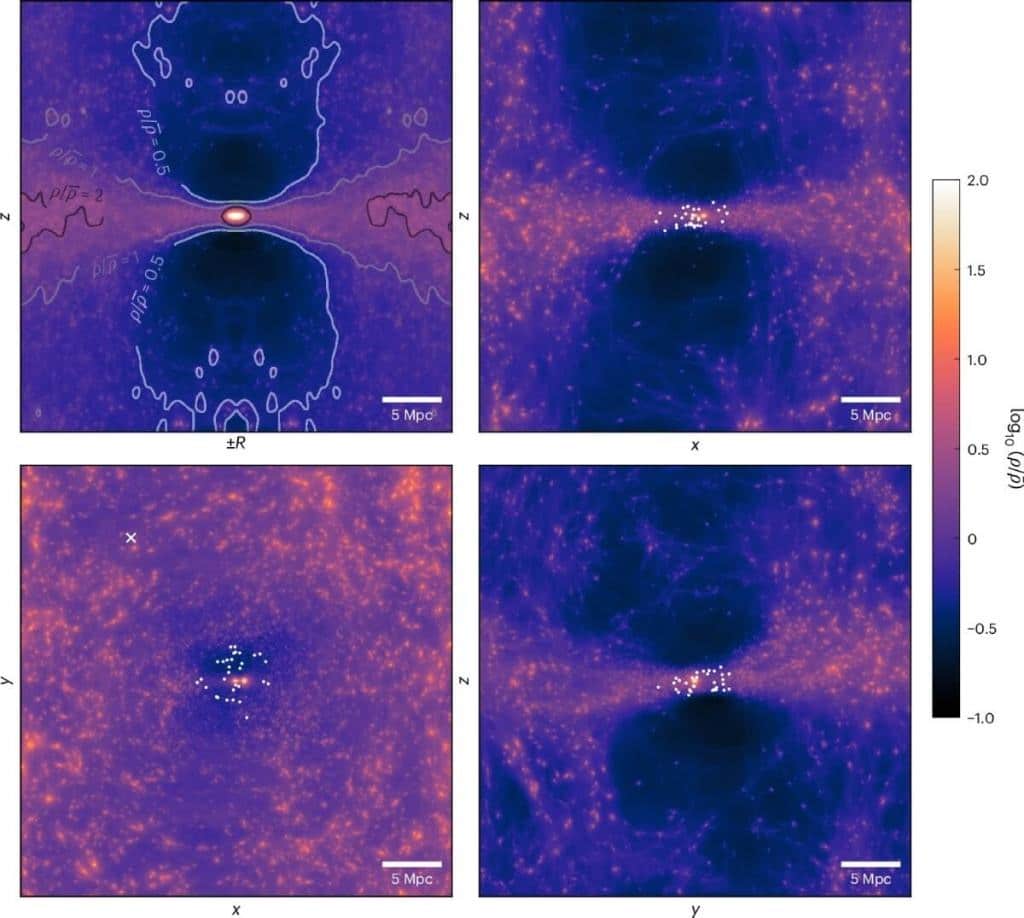
Projections revealing the sheet of dark matter where the Milky Way is located. Credit: Nature Astronomy
When the same total mass is arranged within a flattened structure, galaxies positioned above or below it experience less inward gravitational pull. Their outward motion then matches observed speeds more closely. The difference comes not from reducing dark matter, but from changing how it is spatially organized.
This approach does not replace the broader cosmological framework. It operates within the Lambda Cold Dark Matter model, refining the local structure of matter rather than altering the physics of cosmic expansion.
Echoes from the Cosmic Web
The idea that dark matter organizes into sheets and filaments fits with the broader picture of the cosmic web, the large scale structure of the universe. Simulations show matter collapsing along preferred directions, forming flattened regions and elongated strands over immense distances.
Observations from the Atacama Large Millimeter Array also support this view. In an earlier report, astronomers using ALMA described massive primordial galaxies embedded in extremely dense environments shaped by invisible mass.
While the scales differ dramatically, both cases reflect the same principle. Matter in the universe does not distribute itself evenly. It collapses along preferred planes and filaments under gravity, influencing galaxy formation and long term motion.
The new study remains limited by available data, particularly for faint dwarf galaxies located well above or below the inferred structure. More precise measurements will help refine the thickness and exact orientation of the plane. According to the analysis published in Nature Astronomy, arranging the same total mass within a flattened geometry reproduces the observed motions of nearby galaxies more accurately than spherical models.
First Appeared on
Source link






Leave feedback about this