

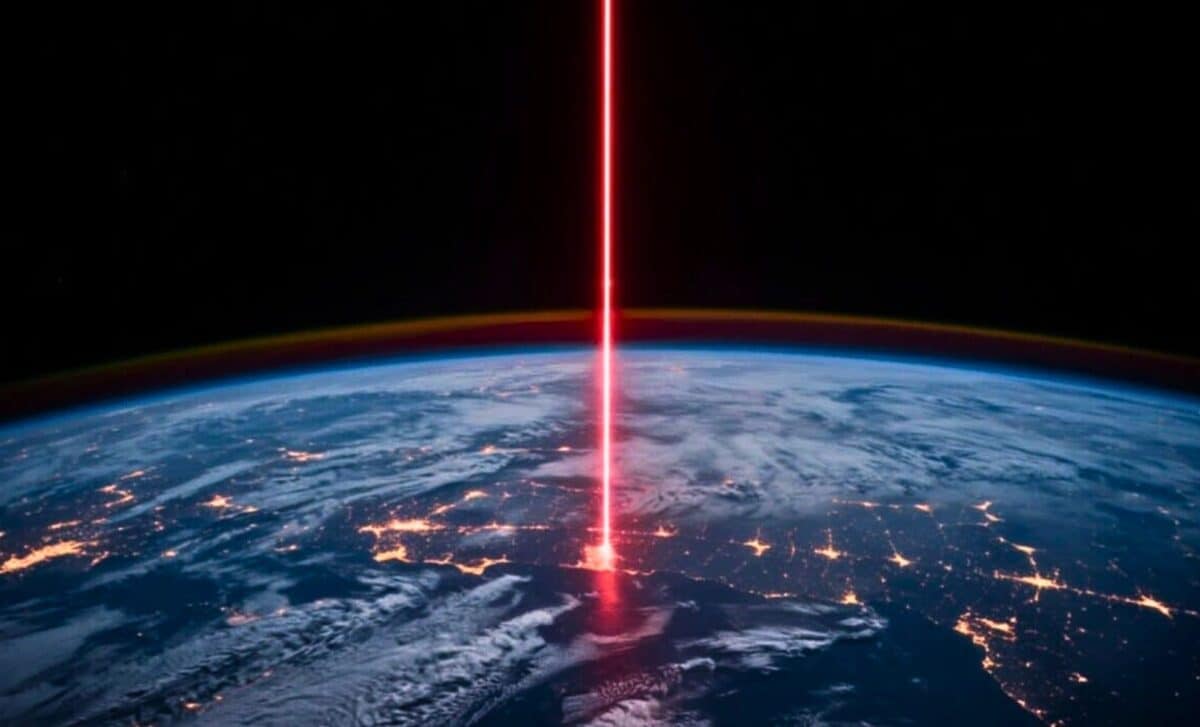
A thin, stubbornly bright line showed up in data from the MeerKAT radio telescope that did not fit the usual rules of distance. The feature sat in a familiar part of the radio spectrum, but it was coming from so far away that signals like it typically fade into the background. Instead of smearing out, it stayed sharp enough to measure. That was the first hint that something was amplifying it.
The source already had a survey name that sounded more like a serial number than a destination: HATLAS J142935.3–002836. Astronomers had seen it before as a distorted, stretched-looking galaxy system, the kind that suggests gravity has bent the view. A report from Live Science described it as a “mega-laser,” but the real curiosity was why the line stayed detectable at all.
When the team calculated the distance, the scale became clearer. The system sits at redshift z = 1.027, placing it more than 8 billion light-years away in light-travel time. That means the radio waves began their journey when the universe was much younger than it is now. The MeerKAT radio telescope was effectively catching a signal that left long before Earth existed.
The 18-Centimeter Fingerprint
The crucial clue was the wavelength: about 18 centimeters. That specific “color” of radio light is strongly associated with the hydroxyl molecule (OH), a simple pairing of oxygen and hydrogen that can exist in vast clouds of gas. Under the right conditions, hydroxyl can behave like an amplifier, strengthening radiation at a very specific frequency.
That amplification works like a laser in principle, but at radio wavelengths. Astronomers call it a maser, short for microwave amplification by stimulated emission of radiation. When a maser is powerful enough to be seen in other galaxies, it becomes a hydroxyl megamaser. In this case, the team argues the signal is bright enough to push beyond that label into a proposed new tier: gigamaser.
The paper, published in arXiv, describes the emission as coming from the two main hydroxyl lines near 1667 MHz and 1665 MHz, which are the standard signatures astronomers look for. What mattered most was not just the presence of those lines, but how strong they appeared at this distance. That is what set this detection apart from earlier hydroxyl surveys.
A Merger Powering the Natural Amplifier
The host system is described as a violently merging galaxy. That matters because the brightest hydroxyl megamasers are often found where galaxies collide and gas becomes dense and chaotic. Mergers can compress clouds, stir turbulence, and create thick, dusty regions where molecules pile up. Those are exactly the conditions that can “pump” hydroxyl into the right state to amplify radio emission.
“This system is truly extraordinary,” said Dr Thato Manamela of the University of Pretoria. “We are seeing the radio equivalent of a laser halfway across the universe.” The phrasing is dramatic, but the mechanism is straightforward: a merger creates dense, energized gas, and hydroxyl molecules amplify radio emission at the 18-centimeter wavelength.
The researchers from the South African Radio Astronomy Observatory also point to signs of intense activity in the host. Earlier studies of the same system suggest a very high rate of star formation, consistent with a merger that is rapidly converting gas into new stars. That context helps explain why the hydroxyl signal could be so bright in the first place, even before any extra help from gravity along the line of sight.
The Foreground Galaxy Acting like a Lens
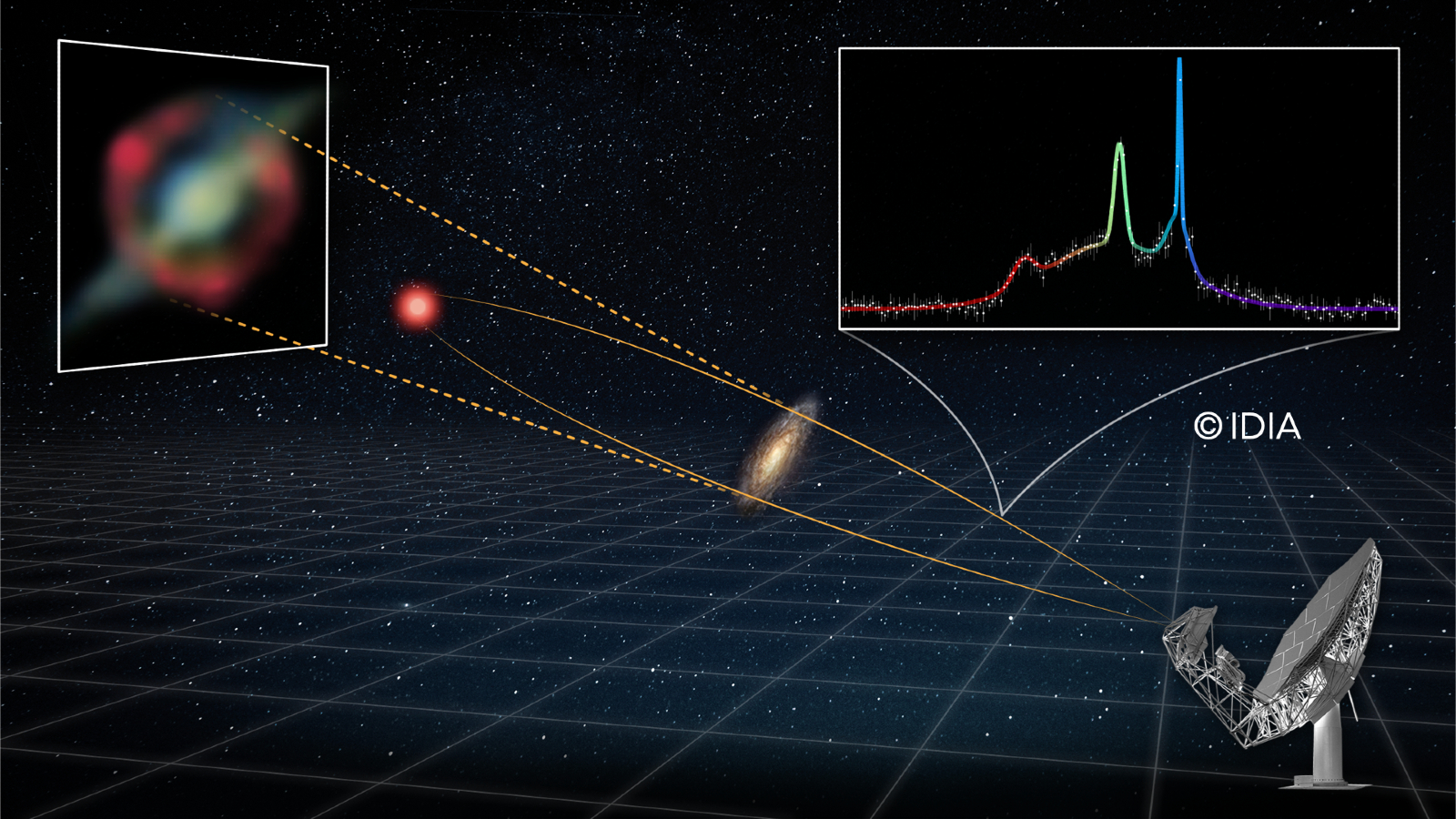
Distance alone still does not explain everything. The signal looks bright because it had help on the way to Earth. Between us and the merger sits an unrelated galaxy positioned almost perfectly along the same line of sight. Its gravity bends space-time and focuses the background emission, boosting what arrives at Earth.
This effect is called strong gravitational lensing. It does not create new light, but it redirects more of the existing light toward us, like a natural magnifying glass. That is why the same system looks distorted in images and unusually intense in radio data. In an explainer, Universe Today described the foreground galaxy as a kind of “cosmic telescope,” which matches how astronomers talk about lensing in practice.
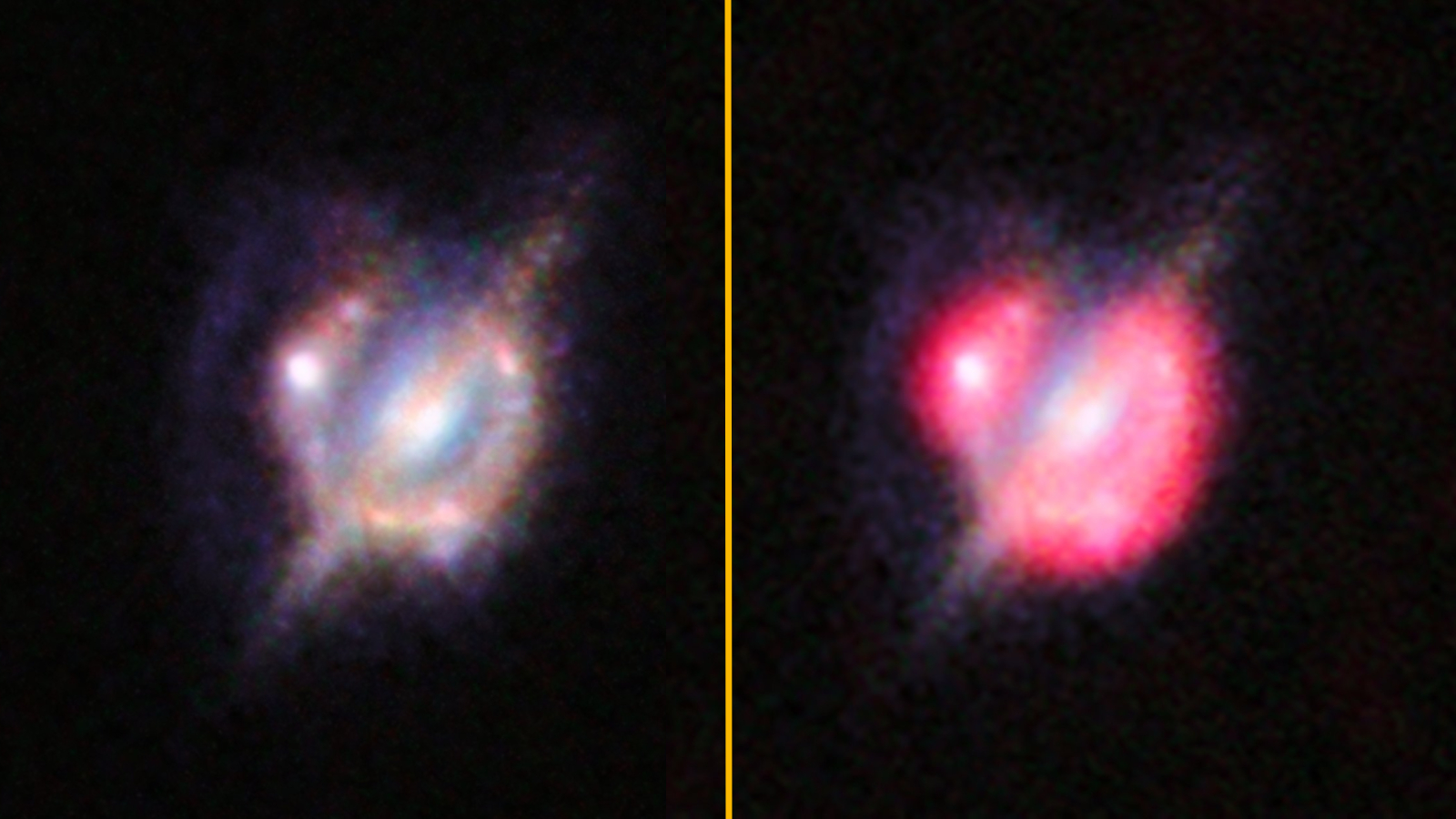
Because lensing boosts the brightness, the team is careful about what “brightest” means. The paper emphasizes how luminous the signal appears to us, not what it would look like without the lens. The proposed gigamaser label is tied to this observed power, combining an extreme environment in the background galaxy with a fortunate alignment in the foreground.
What Meerkat Saw, and What Comes Next
The detection did not require a long campaign. The team reports confirming the signal with only a few hours of observing time, using dozens of dishes working together as the MeerKAT radio telescope array. That short integration is one reason the find is being treated as a proof of capability, not just a one-off curiosity. It shows that wide surveys could uncover more distant hydroxyl systems if the telescope looks in the right way.
The same dataset also contained an additional clue: a separate absorption feature from neutral hydrogen (H I), another common gas tracer. That matters because it suggests the system contains multiple layers of gas, not just the molecular material producing hydroxyl emission. Together, the features help build a more complete picture of what a gas-rich merger looked like at this point in cosmic history.
First Appeared on
Source link






Leave feedback about this