

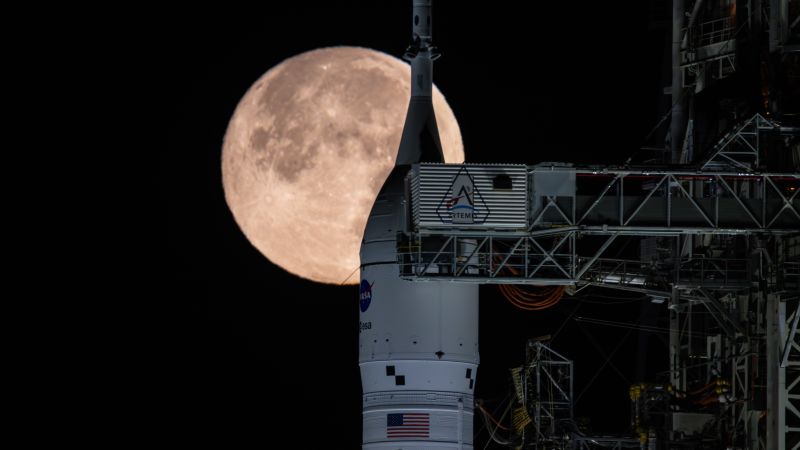
If all had gone according to plan, four astronauts might have been returning just this week from a history-making, 10-day slingshot trip around the moon.
Instead, NASA’s engineers have been grappling with the rocket and fuel meant to propel the mission, called Artemis II, troubleshooting an all-too-familiar problem.
Just a few hours into a pre-launch test called a wet dress rehearsal in early February, launch controllers found that enough super-chilled liquid hydrogen fuel was leaking at the launchpad to prompt safety concerns. The hydrogen leaks kept cropping up, forcing NASA to halt fuel flow to the rocket multiple times.
The issue ultimately left the space agency unable to complete the full test and led to more than a week of investigations and repairs.
If pesky hydrogen leaks and a delayed moon mission evoke a sense of déjà vu, it may be because NASA has been through this before.
Liftoff of an uncrewed test flight around the moon in 2022, called Artemis I, was delayed several times then nearly thwarted by similar hydrogen seepage before a team of jumpsuit-clad NASA workers swept in at the 11th hour and manually fixed a leaky valve. There are also records of engineers struggling with similar issues throughout the Space Shuttle program, which ran from 1981 to 2011.
Leaks are a major concern on the ground: Hydrogen is very easy to ignite and energetic, meaning that too much of it in one area poses the risk of a catastrophic explosion.
So as launch controllers navigate another “wet dress” rehearsal Thursday, the question remains: Why does NASA keep using this notoriously fickle fuel?
Engineers pioneered the use of hydrogen as rocket fuel in the mid-20th Century before it was used for the Apollo moon rockets — and most of the launch vehicles that have opted for the fuel since have also wrestled with leaks.
For example, the Vulcan Centaur rocket, which is produced by US-based military contractor United Launch Alliance and builds on decades of legacy technology, uses hydrogen to power the upper part of its rocket. And in 2023, a fuel leak caused a fireball explosion during Vulcan Centaur testing in Alabama, damaging nearby infrastructure and delaying the rocket’s inaugural launch.
Hydrogen’s leaky tendencies can be attributed to the fact that it’s the lightest element in the universe. It “tends to find its way out of things you want to try to contain it in,” said Adam Swanger, a senior principal investigator and cryogenics research engineer at NASA’s Kennedy Space Center. “And it has very low density.”
To put that in perspective, hydrogen is roughly 14 times lighter than the air on Earth. But the same properties that make hydrogen so difficult to contain also make it an ideal rocket fuel.
“The low density is good for performance,” Swanger told CNN. “So there’s kind of a trade-off there.”
When selecting fuel for a rocket, the most important consideration is a concept called “specific impulse,” often abbreviated as Isp. It’s a measure of how much thrust — or force — a rocket engine can generate with a set amount of fuel.
To calculate the Isp, the predicted thrust of a rocket engine is divided by the rate at which it expels a propellant’s weight. And weight is crucial in spaceflight: The more power a rocket must use to lift its own weight, the less capacity the vehicle has to haul valuable cargo or people to orbit.
Hydrogen is known to have a very favorable specific impulse because it’s so lightweight — and it packs a considerable punch at liftoff. In fact, it’s the best in the business, boasting the highest efficiency of all the rocket fuel options, “which is why we end up using it a lot,” Swanger said.
Still, in the case of Artemis, NASA’s choice of fuel goes beyond just performance.
Hydrogen is sometimes considered more trouble than it’s worth, given its propensity to trigger launch delays.
However, the fuel also offers the best efficiency advantage when it’s used in the vacuum of space. That’s why some rocket builders opt to use hydrogen for the upper stages of launch vehicles, but make use of a more manageable fuel for a rocket’s first stage, which houses all the engines that give the initial burst of power off the launchpad.
Orbital rockets built by Jeff Bezos’ Blue Origin or Elon Musk’s SpaceX, for example, make use of alternative fuels — such as methane or RP-1, a type of kerosene — for their rockets’ first stages.
But NASA’s Artemis moon rocket, called the Space Launch System or SLS, uses hydrogen for both the upper and first-stage portions of the vehicle.
And there is one not-so-obvious reason why: “It was ultimately a congressional decision that came through via law that NASA had to use Shuttle hardware and Shuttle workforces and contractors to do the SLS,” said Casey Dreier, the chief of space policy at the nonprofit Planetary Society.
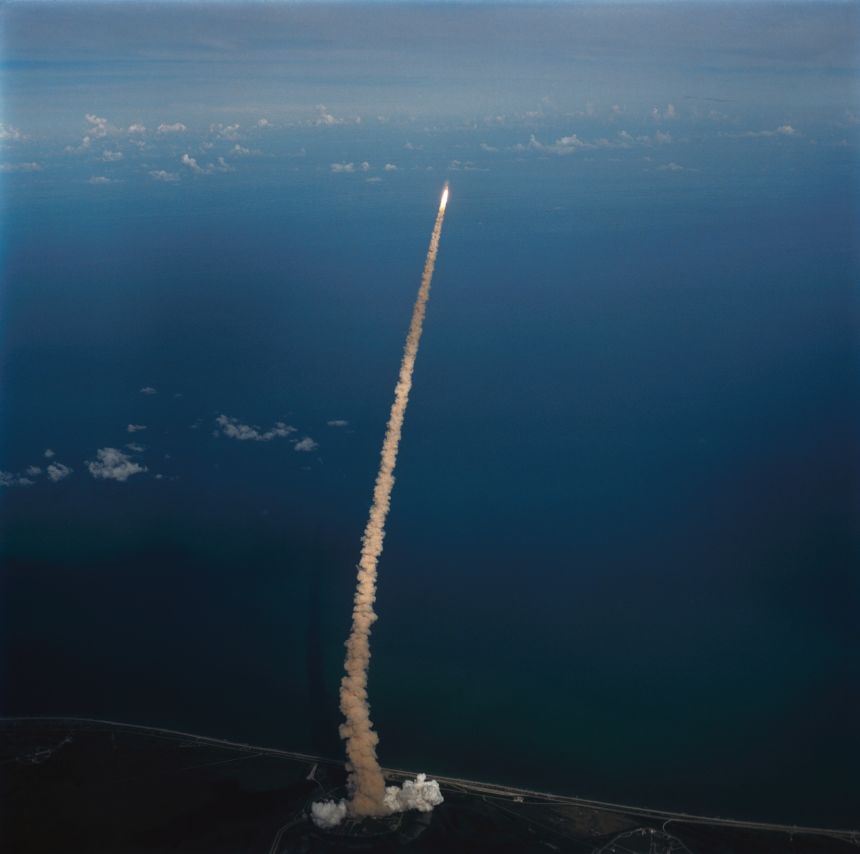
In other words, the SLS uses hydrogen in part because the Space Shuttle also used hydrogen, and lawmakers wanted the SLS program to largely preserve the Shuttle-era workforces and supply chains.
The hydrogen leaks NASA is grappling with today are a symptom of that decision, Dreier added. Opting to attempt to cobble together pieces of an old program for new rockets — rather than starting from scratch — “actually shifted a lot of consequences and cost when it comes to trying to operate the rocket.”
And while all rockets that make use of hydrogen are susceptible to frustrating leaks, NASA’s issues with SLS may be exacerbated by its political quirks.
“It’ll never operate as well as if they designed a new rocket,”
Dreier said. “It’ll have high overhead costs. And you have finicky rockets.”
NASA has acknowledged that SLS can be finicky. But the vehicle is still in the early days of use after two decades of development.
“It’s an experimental vehicle,” said Amit Kshatriya, NASA’s associate administrator, during a February 3 news conference alongside several other agency officials. “Nobody sitting in one of these chairs needs to be calling any of these vehicles operational.”
Notably, NASA does not typically consider a rocket to be fully “operational” until it enters routine service, a milestone it may take quite some time for SLS to achieve considering how infrequently it flies. Space agency officials only considered the Space Shuttle to be operational, for example, after it completed its first four missions, all of which were flown with crew on board.
Kshatriya added that NASA has had a difficult time anticipating the SLS leaks and pinpointing how to prevent them. It’s possible that the process of rolling the rocket out to the launchpad may have contributed to a leaky seal problem engineers are currently troubleshooting, but the agency has not yet confirmed the cause.
“It’s pretty complicated from a stress and strain standpoint. That’s not an excuse,” Kshatriya noted, but engineers have only recently begun hashing out how these issues may develop.
During Artemis I as well as the first Artemis II wet dress rehearsal in early February, leaks were located in the same area: the Tail Service Mast Umbilical (TSMU), a three-story-tall structure that connects the SLS rocket to the ground equipment.
To address the most recent issues found in the TSMU, NASA said technicians recently replaced seals around two of the propellant lines in that area.
To run a successful “wet dress” test and to keep the rocket safe on launch day, NASA must keep the leak rate during fueling to below 16%, according to NASA launch director Charlie Blackwell-Thompson.
And NASA is employing several methods of attempting to stay within the acceptable limits. Apart from working to detect and fix the source of leaks prior to fueling, the agency can also use a technique during the hydrogen loading process that involves briefly warming fuel lines back up, hoping that seals can settle back into a desirable position before they’re plunged back into super-cold temperatures.
Some of the troubleshooting efforts may be paying off, as NASA Administrator Jared Isaacman announced earlier this month that a test in which engineers partially filled SLS’s hydrogen tanks showed improvement. Based on early data reviews, the agency did not observe some of the leaks that troubled the earlier wet dress rehearsal, Isaacman said.
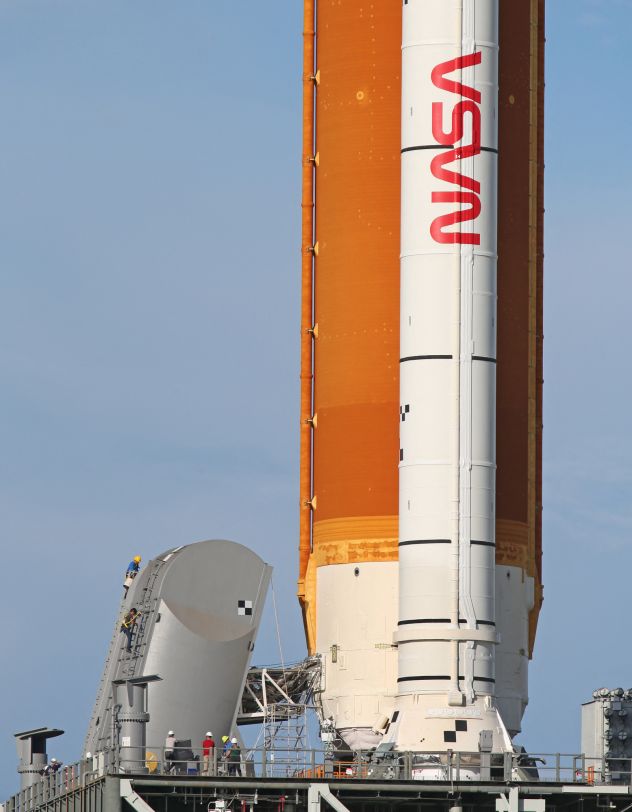
NASA’s chronic struggle to contain its fuel of choice within the rocket raises the question of whether the SLS rocket will always grapple with hydrogen leaks — or if a permanent fix can be found.
Kshatriya noted that while an SLS rocket has flown before, the vehicle is not reusable. That means the SLS on the launchpad today is a brand-new, and it may have its own tics and foibles.
The early February wet dress rehearsal was “the first time this particular machine has borne witness to cryogens,” said Kshatriya, referring to super chilled fuels. “And how it breathes and how it how it vents — and how it wants to leak — is something we have to characterize.”
But avoiding hydrogen leaks completely may require advancements in material sciences.
“Instead of asking why hydrogen is hard to handle, from a material science point of view, you’re asked, ‘Do any existing materials have good enough fracture toughness?’” explained Jihua Gou, a professor for the University of Central Florida’s department of mechanical and aerospace engineering.
Liquid hydrogen must be kept at the unfathomably frigid temperature of minus 423 degrees Fahrenheit. And the infrastructure that contains it needs to be able to withstand frequent chills down to that temperature.
“The biggest problem is the temperature change. And the seals are one thing, but what the seals are attached to also change shape,” noted Swanger, the NASA research engineer.
NASA is currently using Teflon polymers called PTFE, he noted, for those seals.
“Teflon is typically used because that’s historically been the one that works best. There’s just not a lot of options,” Swanger said. And “it becomes a really challenging problem with really large interfaces.”
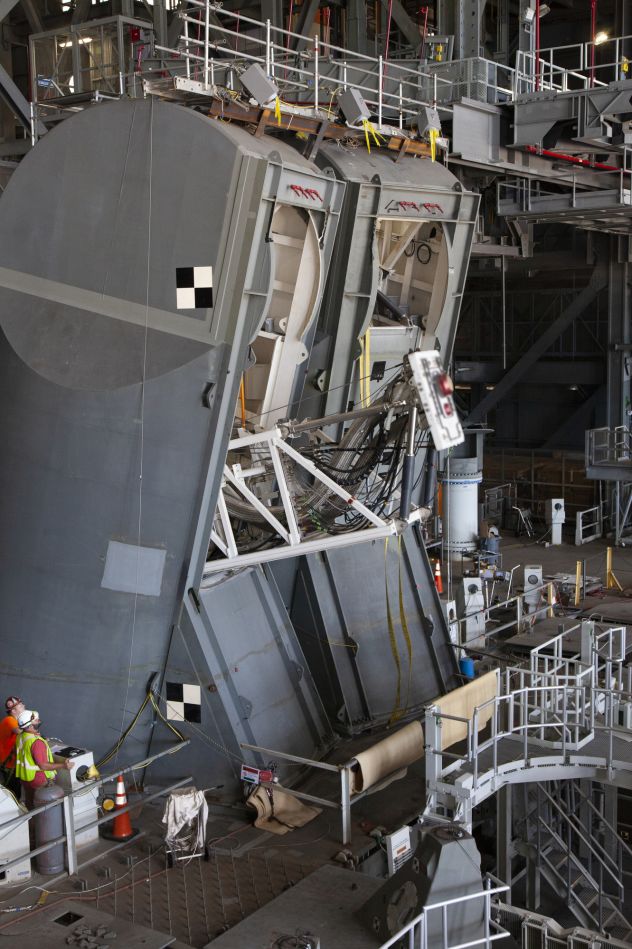
The SLS rocket, he noted, has specific design limitations. Its enormous size, for example, complicates the search for a permanent hydrogen leak fix because a massive rocket requires a large flow rate for the fuel — increasing the risk of seepage.
“When you add up all these very special requirements, you’re really limited in what you can do,” Swanger said. “I think that if there were a different set of requirements, or you’re starting from scratch — figuring out how we make something that absolutely can’t leak — is probably possible.
But there is no going back to the drawing board for SLS, he noted, “and it just isn’t really practical to try to do it.”
If the idea of a hydrogen-propelled vehicle recalls some dangerous incidents, such as the Hindenburg disaster, Swanger also emphasized that NASA at least understands how to safely use the sometimes unruly fuel.
“It can absolutely be safely used without a problem, and even with these leaks that we’ve had,” Swanger said, “we’ve never had an accident.”
First Appeared on
Source link






Leave feedback about this