

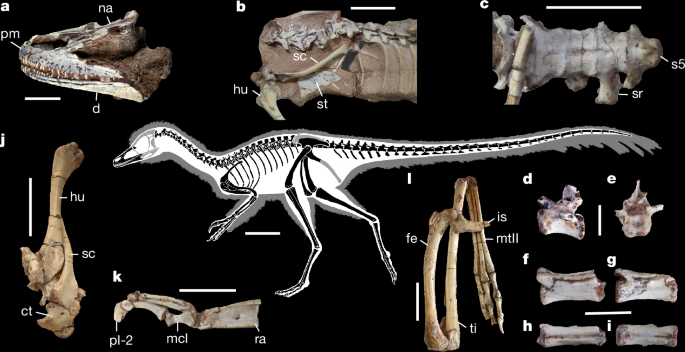
Altangerel, P., Norell, M. A., Chiappe, L. M. & Clark, J. M. Flightless bird from the Cretaceous of Mongolia. Nature 362, 623–626 (1993).
Qin, Z. et al. Growth and miniaturization among alvarezsauroid dinosaurs. Curr. Biol. 31, 3687–3693 (2020).
Meso, J. G. et al. Revised alvarezsaurian phylogeny and body size and evolutionary rate analyses reveal complex evolutionary history dominated by miniaturisation from a much smaller common ancestor. Cladistics 41, 135–155 (2024).
Senter, P. Function in the stunted forelimbs of Mononykus olecranus (Theropoda), a dinosaurian anteater. Paleobiology 31, 373–381 (2005).
Qin, Z., Liao, C. C., Benton, M. J. & Rayfield, E. J. Functional space analyses reveal the function and evolution of the most bizarre theropod manual unguals. Commun. Biol. 6, 181 (2023).
Choiniere, J. N. et al. Evolution of vision and hearing modalities in theropod dinosaurs. Science 372, 610–613 (2021).
Makovicky, P. J., Apesteguía, S. & Gianechini, F. A. A new coelurosaurian theropod from the La Buitrera fossil locality of Río Negro, Argentina. Fieldiana Life Earth Sci. 2012, 90–98 (2012).
Pérez Mayoral, J., Argüello Scotti, A., Apesteguía, S. & Veiga, G. D. High-resolution analysis of an erg-margin system from the Cretaceous Candeleros Formation (La Buitrera Paleontological Area, Río Negro Province, Argentina): an approach to different scales of fluvial-aeolian interactions. Latin Am. J. Sedimentol. Basin Anal. 28, 37–60 (2021).
Chiappe, L. M., Norell, M. A. & Clark, J. M. The skull of a relative of the stem-group bird Mononykus. Nature 392, 275–278 (1998).
Chiappe, L. M., Norell, M. A. & Clark, J. M. in Mesozoic Birds: Above the Heads of Dinosaurs (eds Chiappe, L. M. & Witmer, L. M.) 87–120 (Univ. California Press, 2002).
Xu, X. et al. Two Early Cretaceous fossils document transitional stages in alvarezsaurian dinosaur evolution. Curr. Biol. 28, 2853–2860 (2018).
Agnolín, F. L., Lu, J. C., Kundrát, M. & Xu, L. Alvarezsaurid osteology: new data on cranial anatomy. Hist. Biol. 34, 443–452 (2022).
Kubo, K., Kobayashi, Y., Chinzorig, T. & Tsogtbaatar, K. A new alvarezsaurid dinosaur (Theropoda, Alvarezsauria) from the Upper Cretaceous Baruungoyot Formation of Mongolia provides insights for bird-like sleeping behavior in non-avian dinosaurs. PLoS ONE 18, e0293801 (2023).
Novas, F. E. Anatomy of Patagonykus puertai (Theropoda, Avialae, Alvarezsauridae), from the Late Cretaceous of Patagonia. J. Vertebr. Paleontol. 17, 137–166 (1997).
Averianov, A. O. & Lopatin, A. V. A re-appraisal of Parvicursor remotus from the Late Cretaceous of Mongolia: implications for the phylogeny and taxonomy of alvarezsaurid theropod dinosaurs. J. Syst. Palaeontol. 19, 1097–1128 (2021).
Meso, J. G. et al. Tail anatomy of the Alvarezsauria (Theropoda, Coelurosauria), and its functional and behavioural implications. Cret. Res. 124, 104830 (2021).
Cuesta, E., Vidal, D., Ortega, F., Shibata, M. & Sanz, J. L. Pelecanimimus (Theropoda: Ornithomimosauria) postcranial anatomy and the evolution of the specialized manus in ornithomimosaurs and sternum in maniraptoriforms. Zool. J. Linn. Soc. 194, 553–591 (2022).
Codd, J. R., Manning, P. L., Norell, M. A. & Perry, S. F. Avian-like breathing mechanics in maniraptoran dinosaurs. Proc. R. Soc. B 275, 157–161 (2008).
Agnolin, F. L., Powell, J. E., Novas, F. E. & Kundrát, M. New alvarezsaurid (Dinosauria, Theropoda) from uppermost Cretaceous of north-western Patagonia with associated eggs. Cret. Res. 35, 33–56 (2012).
Xu, X. et al. A monodactyl nonavian dinosaur and the complex evolution of the alvarezsauroid hand. Proc. Natl Acad. Sci. USA 108, 2338–2342 (2011).
Suzuki, S. et al. A new specimen of Shuvuuia deserti from the Mongolian Late Cretaceous and the relationships of alvarezsaurids to other theropod dinosaurs. Contrib. Sci. 494, 1–18 (2002).
Choiniere, J. N., Forster, C. A. & De Klerk, W. J. New information on Nqwebasaurus thwazi, a coelurosaurian theropod from the Early Cretaceous Kirkwood Formation in South Africa. J. Afr. Earth Sci. 71–72, 1–17 (2012).
Novas, F. E. Alvarezsauridae, Cretaceous basal birds from Patagonia and Mongolia. Mem. Qld Mus. 39, 675–702 (1996).
Bonaparte, J. F. Los Vertebrados Fósiles de la Formación Río Colorado, de la Ciudad de Neuquén y Cercanías, Cretácico Superior, Argentina (Museo Argentino de Ciencias Naturales “Bernardino Rivadavia”, 1991).
Nesbitt, S. J., Clarke, J. A., Turner, A. H. & Norell, M. A. A small alvarezsaurid from the eastern Gobi Desert offers insight into evolutionary patterns in the Alvarezsauroidea. J. Vertebr. Paleontol. 31, 144–153 (2011).
Makovicky, P. J. A new small theropod from the Morrison Formation of Como Bluff, Wyoming. J. Vertebr. Paleontol. 17, 755–757 (1997).
Naish, D., Hutt, S. & Martill, D. in Dinosaurs of the Isle of Wight (eds Martill, D. M. & Naish, D.) 242–309 (Wiley-Blackwell, 1991).
Martinelli, A. G. & Vera, E. I. Achillesaurus manazzonei, a new alvarezsaurid theropod (Dinosauria) from the Late Cretaceous Bajo de la Capra Formation, Río Negro Province, Argentina. Zootaxa 1582, 1–17 (2007).
Makovicky, P. J., Apesteguía, S. & Agnolín, F. L. The earliest dromaeosaurid theropod from South America. Nature 437, 1007–1011 (2005).
Ding, A. et al. The biogeography of coelurosaurian theropods and its impact on their evolutionary history. Bull. Am. Mus. Nat. Hist. 440, 117–157 (2020).
Kotevski, J. et al. Evolutionary and paleobiogeographic implications of new carcharodontosaurian, megaraptorid, and unenlagiine theropod remains from the upper Lower Cretaceous of Victoria, southeast Australia. J. Vert. Paleontol. 44, e2441903 (2024).
Pol, D. et al. A new abelisaurid dinosaur from the end Cretaceous of Patagonia and evolutionary rates among the Ceratosauria. Cladistics 40, 307–356 (2024).
Naish, D. & Dyke, G. J. Heptasteornis was no ornithomimid, troodontid, dromaeosaurid or owl: the first alvarezsaurid (Dinosauria: Theropoda) from Europe. N. Jahrb. Geol. Paläontol. Monatsh. 7, 385–401 (2004).
Hartman, S. et al. A new paravian dinosaur from the Late Jurassic of North America supports a late acquisition of avian flight. PeerJ 7, e7247 (2019).
Rougier, G. W., Apesteguía, S. & Gaetano, L. C. Highly specialized mammalian skulls from the Late Cretaceous of South America. Nature 479, 98–102 (2011).
Rougier, G. W., Martinelli, A. M. & Forasiepi, A. M. (eds) in Mesozoic Mammals from South America and Their Forerunners 201–260 (Springer Earth System Sciences, 2021).
Milewski, A. V., Abensperg-Traun, M. & Dickman, C. R. Why are termite- and ant-eating mammals smaller in Australia than in southern Africa: history or ecology? J. Biogeogr. 21, 529–543 (1994).
Goloboff, P. A., Farris, J. S. & Nixon, K. C. TNT, a free program for phylogenetic analysis. Cladistics 24, 774–786 (2008).
Revell, L. J. Phytools: an R package for phylogenetic comparative biology (and other things). Methods Ecol. Evol. 3, 217–223 (2012).
Ree, R. H. & Smith, S. A. Maximum likelihood inference of geographic range evolution by dispersal, local extinction, and cladogenesis. Syst. Biol. 59, 81–94 (2010).
Matzke, N. J. Model selection in historical biogeography reveals that founder-event speciation is a crucial process in island clades. Syst. Biol. 63, 951–970 (2014).
Gianechini, F. A., Makovicky, P. J., Apesteguía, S. & Cerda, I. Postcranial skeletal anatomy of the holotype and referred specimens of Buitreraptor gonzalezorum Makovicky, Apesteguía and Agnolín 2005 (Theropoda, Dromaeosauridae), from the Late Cretaceous of Patagonia. PeerJ 6, e4558 (2018).
Brusatte, S. L., Lloyd, G. T., Wang, S. C. & Norell, M. A. Gradual assembly of avian body plan culminated in rapid rates of evolution across the dinosaur-bird transition. Curr. Biol. 24, 2386–2392 (2014).
Norell, M. A., Clark, J. M. & Makovicky, P. J. in New Perspectives on the Origin and Evolution of Birds: Proceedings of the International Symposium in Honor of John H. Ostrom (eds Gauthier, J. A. & Gall, L. F.) 49–68 (Peabody Museum of Natural History, Yale Univ., 2001).
Maddison, W. P. & Maddison, D. R. Mesquite: a modular system for evolutionary analysis v.3.70 (Mesquite Project, 2021).
Ezcurra, M. D. Exploring the effects of weighting against homoplasy ingenealogies of palaeontological phylogenetic matrices. Cladistics 40, 242–281 (2024).
Pol, D. & Escapa, I. H. Unstable taxa in cladistic analysis: identification and the assessment of relevant characters. Cladistics 25, 515–527 (2009).
Benson, R. B. J. et al. Rates of dinosaur body mass evolution indicate 170 million years of sustained ecological innovation on the avian stem lineage. PLoS Biol. 12, e1001853 (2014).
Bapst, D. W. A stochastic rate-calibrated method for time-scaling phylogenies of fossil taxa. Methods Ecol. Evol. 4, 724–733 (2013).
R Core Team. R: A Language and Environment for Statistical Computing (R Foundation for Statistical Computing, 2025).
Bell, M. A. & Lloyd, G. T. strap: an R package for plotting phylogenies against stratigraphy and assessing their stratigraphic congruence. Palaeontology 58, 379–389 (2015).
Wills, M. A., Barrett, P. M. & Heathcote, J. F. The modified gap excess ratio (GER*) and the stratigraphic congruence of dinosaur phylogenies. Syst. Biol. 57, 891–904 (2008).
Yu, Y., Blair, C. & He, X. RASP 4: ancestral state reconstruction tool for multiple genes and characters. Mol. Biol. Evol. 37, 604–606 (2020).
Scotese, C. R. An atlas of Phanerozoic paleogeographic maps: the seas come in and the seas go out. Ann. Rev. Earth Planet. Sci. 49, 679–728 (2021).
Xu, X. et al. A new Middle Jurassic diplodocoid suggests an earlier dispersal and diversification of sauropod dinosaurs. Nat. Commun. 9, 2700 (2018).
Pennell, M. W. et al. Geiger v2.0: an expanded suite of methods for fitting macroevolutionary models to phylogenetic trees. Bioinformatics 30, 2216–2218 (2014).
Makovicky, P. J. et al. Data and code for ‘Argentine fossil rewrites evolutionary history of a baffling dinosaur clade’. figshare https://doi.org/10.6084/m9.figshare.30569894 (2026).
Corbella, H., Novas, F., Apesteguía, S. & Leanza, H. First fission-track age for the dinosaur-bearing Neuquén Group (Upper Cretaceous), Neuquén Basin, Argentina. Rev. Mus. Argent. Cienc. Nat. N. Ser. 6, 227–232 (2004).
Garrido, A. C. Estratigrafía del Grupo Neuquén, Cretácico Superior de la Cuenca Neuquina (Argentina): nueva propuesta de ordenamiento litoestratigráfico. Rev. Mus. Argent. Cienc. Nat. N. Ser. 12, 121–177 (2010).
First Appeared on
Source link




Leave feedback about this