

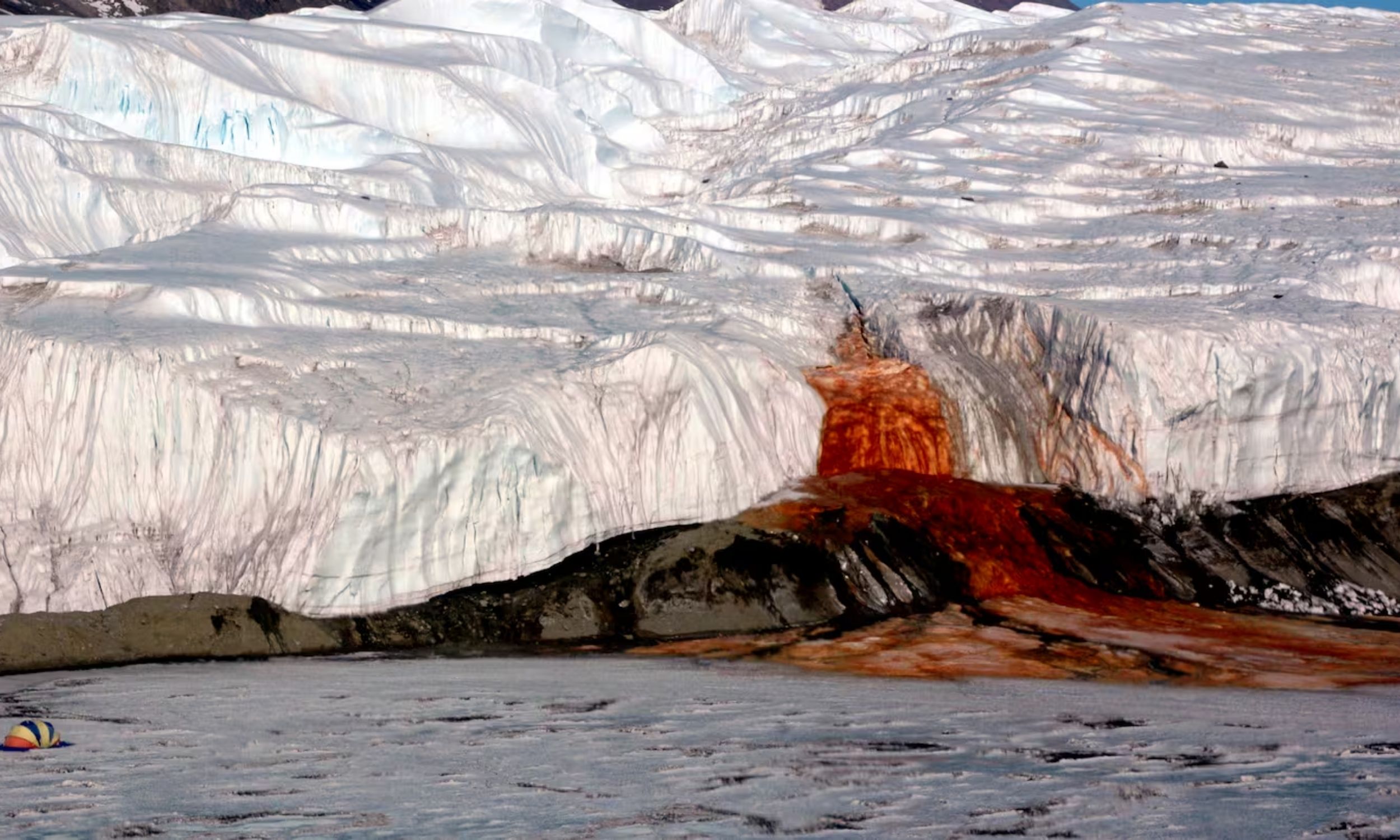
Scientists have linked a sudden burst of rust-red water at Antarctica’s Blood Falls to a measurable drop in the glacier sitting above it.
That connection shows the red flow is not just a surface stain, but a visible signal of pressure changes and hidden water movement deep beneath the ice.
A signal in ice
In September 2018, a tracker on Taylor Glacier, a massive river of ice flowing through Antarctica’s McMurdo Dry Valleys, recorded a drop as a camera caught Blood Falls turning on.
Peter T. Doran, a geoscientist at Louisiana State University (LSU) matched the drop to the outflow and linked it to lower pressure.
Over weeks, his team saw the surface sink, then recover, suggesting a short-lived drainage pulse under the glacier.
Limited coverage left gaps, so future monitoring must track more sites to reveal how often the glacier vents.
Stress beneath the glacier
Pressure builds when heavy ice traps salty water beneath it, and the glacier cannot hold that squeeze forever.
At Blood Falls, the liquid comes from subglacial channels located under a glacier and sealed from air that can open during ice motion.
Weight and slow creep of the ice can push the salty mix toward cracks, where it escapes in sudden pulses.
Those pulses stay hard to predict, since small changes in stress or blockage can delay a release for months.
Salt keeps it flowing
Salt turns ordinary water into a chemical mix that resists freezing, even when air temperatures stay far below freezing.
Researchers call that mix brine, salt-heavy water that stays liquid in deep cold, and Blood Falls carries it to daylight.
Over hundreds and even thousands of years, repeated freezing can concentrate salts, leaving a liquid that keeps moving through the ice.
Those salts likely come from hidden rock and deposits, and their chemistry offers clues about what lies under Taylor Glacier.
Iron turns it red
In 1911, explorers logged the red seep at the glacier face, and an Antarctic protection plan still guards the site.
Once the liquid meets air, oxidation, iron reacting with oxygen and turning rust-red, changes the color within minutes.
Tiny iron particles form in the salty water underground, then stain the ice as the flow spreads downslope.
That fast color change makes each discharge easy to spot, which helps scientists track when the hidden system opens.
Sensors catch the moment
Daily camera frames near Lake Bonney, an ice-covered Antarctic lake, showed fresh staining starting September 19, 2018, and the stain area expanded.
Meanwhile, a lake thermistor, a tiny sensor that measures temperature changes, detected a temperature dip at depth during the same discharge.
In their report, the authors wrote that the serendipitous recording of three different datasets provided a rare, coherent signal of a subglacial brine drainage event.
Only a short window produced this record, yet it captured how fast the system can change once it starts.
Ice slows and sags
A 0.6-inch drop in the glacier surface arrived with nearly a 10% slowdown in its forward motion. Draining water reduces pressure at the base, so the ice presses harder on rock and moves less easily.
“These observations demonstrate that an extended brine discharge event, characterized by episodic pulses of brine sourced from beneath Taylor Glacier over one month, reduces subglacial water pressure, which lowers the surface and reduces ice velocity,” wrote Doran.
Later measurements suggested the ice stayed a bit slower than before, but only longer records can confirm lasting change.
Lake layers get jolted
At roughly 60 feet (18 meters) deep, lake water cooled by as much as 2.7°F (1.5°C) during the same weeks.
Dense brine can slip into the lake at the depth where its weight matches surrounding water, then spreads outward.
That injection disturbed stratification, stable layers that keep lake water from mixing, and it likely moved nutrients sideways.
Life in Antarctica’s Dry Valleys lakes sits in tight bands, so even small jolts can change who gets food and energy.
Mapping hidden brine
From the air, an airborne sensor detected deep salty water below the valley floor, far from any melt.
Signals from that tool pointed to groundwater pathways at least three miles (4.8 kilometers) long, meaning the brine can travel through rock before entering ice.
Later work used ice-penetrating radar to trace brine channels inside the glacier itself, across several miles of ice.
Those maps helped explain why outflow can appear at one crack while other brine slips quietly into the lake.
Life without oxygen
Deep in the brine, microbes survived on iron and sulfur chemistry, even after long isolation under ice.
Instead of breathing oxygen, many of them likely used dissolved minerals as fuel, which keeps the system alive in darkness.
Geologists estimate the reservoir became trapped between three and five million years ago, making it one of the valley’s oldest liquids.
Strict rules limit access and keep most sampling tightly controlled, since outsiders can contaminate such a closed habitat.
Where this leads
Blood Falls now looks less like a strange stain and more like a pressure release point linking ice, rock, and lake.
Future field seasons may add wider sensor networks, and LSU could then test whether warming trends change how often the system vents.
The study is published in Antarctic Science.
—–
Like what you read? Subscribe to our newsletter for engaging articles, exclusive content, and the latest updates.
Check us out on EarthSnap, a free app brought to you by Eric Ralls and Earth.com.
—–
First Appeared on
Source link



Leave feedback about this