

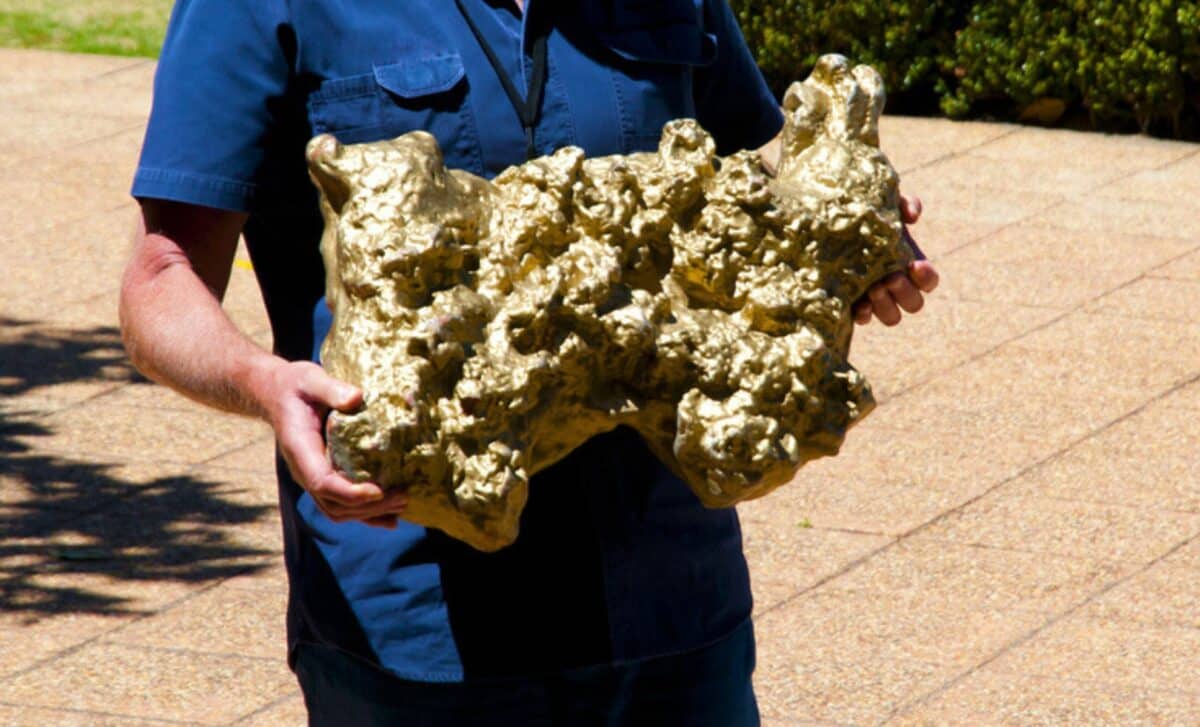
David Hole spends his weekends doing what plenty of men his age do around Maryborough, a small town northwest of Melbourne. He drives out to the regional park, unpacks his metal detector, and walks the yellow clay soils listening for the signal that means he has found gold. The area was at the centre of Victoria’s 19th‑century gold rush. Thousands of men before him have pulled nuggets from this ground. In May 2015, his detector gave a strong reading.
The signal indicated metal, and metal here usually meant one thing. Hole dug through the clay and lifted out a rock the size of a shoebox. It was unusually dense, heavier than any ordinary stone its size. The surface appeared dimpled and sculpted, textured in a way that suggested it had passed through something extreme.
He carried it home certain that inside that reddish crust sat a large gold nugget.
The Rock Resisted Every Attempt to Break It
Hole tried everything he could think of to open it. He used a rock saw. Nothing. He switched to an angle grinder. The blade sparked against the surface and left no visible mark. He drilled into it. He even soaked the rock in acid. Finally he took a sledgehammer and struck it as hard as he could. The hammer bounced back without leaving a fracture. As ScienceAlert detailed in their coverage, the rock’s extraordinary durability was the first clue that it was something far more unusual than a gold nugget.
The rock sat on his property for years after that. Occasionally he would look at it, wonder what it would take to crack it, and leave it where it was. In 2018, still curious, he drove to Melbourne Museum and handed it to the geology department.
Dermot Henry, head of sciences at Museums Victoria, has spent 37 years examining rocks that members of the public bring in believing they have found a meteorite. Almost all of them turn out to be terrestrial rocks with unusual appearances but ordinary compositions. Museum staff call them meteor‑wrongs.
This one was different.
“It had this sculpted, dimpled look to it,” Henry later told reporters. That texture, known as regmaglypts, forms when an object passes through Earth’s atmosphere at high velocity. The exterior melts, and aerodynamic forces sculpt the surface. Henry and his colleague Bill Birch, an emeritus curator in geosciences, weighed the specimen. Seventeen kilograms. They measured its dimensions: 38.5 centimetres long, 14.5 centimetres wide, 14.5 centimetres deep. A media release from Museums Victoria announced the acquisition and described it as the first meteorite found in Victoria since 1995.
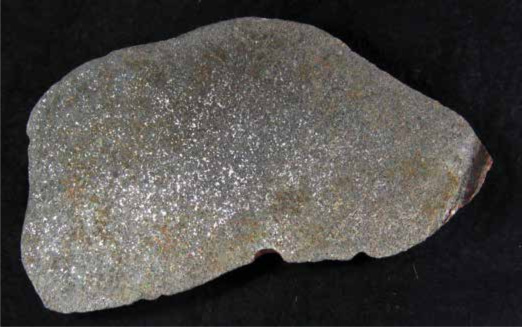
To examine the interior they used a diamond saw, the only tool capable of cutting through the material. Inside they observed features that no terrestrial rock could contain.
Chondrules Reveal the Rock’s Origin in the Early Solar System
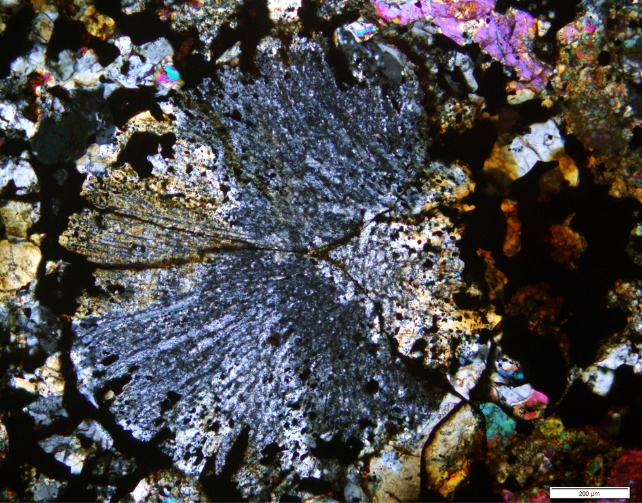
The interior contained small, spherical droplets of metallic minerals. Geologists call them chondrules. They form when dust particles in the protoplanetary disk are rapidly heated and then cool in the microgravity environment of the early solar system. These structures do not occur in rocks that form on Earth. Their presence confirmed the specimen was a chondrite, a class of meteorite that preserves primitive material from the solar system’s formation.
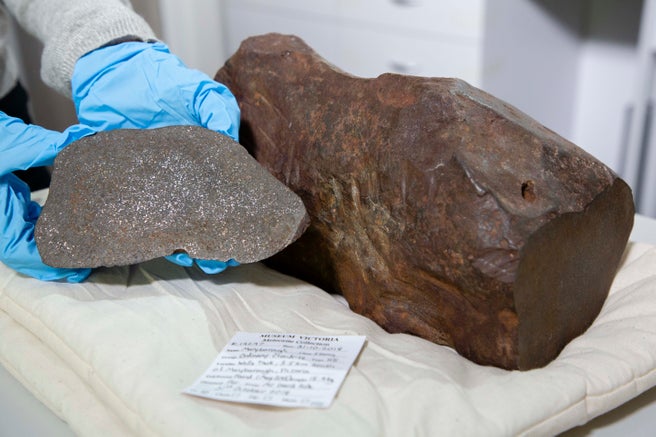
The researchers published their analysis in theProceedings of the Royal Society of Victoria, where they provided the full technical description. The rock, now officially designated the Maryborough meteorite, is classified as an H5 ordinary chondrite. The H refers to high total iron content, approximately 25 to 30 percent by weight. The 5 indicates it has undergone significant thermal metamorphism, with the chondrules partially recrystallized and the minerals homogenized by heat while the rock was still part of its parent asteroid.
Mineral analysis identified kamacite and taenite, two iron‑nickel alloys common in meteorites, along with minor amounts of native copper. The presence of these metals explained why the rock registered so strongly on Hole’s metal detector.
The meteorite formed approximately 4.6 billion years ago, before Earth had fully accreted. It originated in the asteroid belt between Mars and Jupiter. Collisions between asteroids ejected it from that region, and its orbit eventually intersected Earth’s path.
Determining when it landed required different methods. Carbon‑14 dating conducted at the University of Arizona measured terrestrial age by analyzing cosmogenic isotopes that accumulate while the rock is in space and decay after it lands. The results indicate the meteorite arrived on Earth between 100 and 1,000 years ago. Historical records show multiple meteor sightings reported in the Maryborough district between 1889 and 1951. No direct link can be established, but the timing is consistent with the radiometric data.
The Maryborough meteorite is only the 17th meteorite ever documented in Victoria. The state has produced thousands of gold nuggets over the same period. By that measure the specimen is considerably rarer than the precious metal Hole originally sought.
“Meteorites provide the cheapest form of space exploration,” Henry said in the Museums Victoria announcement. “They transport us back in time, providing clues to the age, formation, and chemistry of our solar system.”
The meteorite now resides in the State Collection held by Museums Victoria. It has been displayed publicly, including during National Science Week at Melbourne Museum, where visitors can observe the same specimen that resisted every tool Hole owned and see the chondrules that identify it as a fragment of the early solar system.
First Appeared on
Source link




Leave feedback about this