

For years, the Silverpit Crater sat under the North Sea as one of geology’s most awkward arguments. It had the circular shape, the uplifted center, and the faulted rings that made it look like an impact crater. But that was not enough. Without physical signs of shock in the rocks themselves, the structure remained a suspicion rather than a settled fact.
That uncertainty lasted more than two decades. The crater was first identified in seismic data in 2002, and by 2009 the dispute had become public enough that a Geological Society of London debate reportedly voted overwhelmingly against an impact origin. Competing explanations pointed instead to salt movement deep underground or volcanic processes.
Now the balance has shifted. A 2025 paper in Nature Communications combines 3D seismic imaging, biostratigraphy, microscopic rock analysis, and numerical modeling to argue that Silverpit was formed by a hypervelocity asteroid impact in the middle Eocene, roughly 43 to 46 million years ago. The study presents what researchers describe as compelling evidence, potentially closing one of the stranger long-running disputes in British geology.
The Clue That Changed the Argument
The most important new evidence did not come from the crater’s shape alone. It came from two tiny grains recovered from reworked ejecta in a nearby well. Those grains showed shock lamellae, microscopic deformation features produced under extreme pressure. In impact geology, that matters because shocked minerals are treated as diagnostic evidence. The Silverpit study argues that shock metamorphism in minerals such as quartz and feldspar cannot be reproduced by ordinary terrestrial processes.
Dr. Uisdean Nicholson of Heriot-Watt University, the study’s lead author, described the find as a rare stroke of luck. He said the grains were a real needle-in-a-haystack discovery and that they prove the impact hypothesis beyond doubt because their internal fabric can only be created by intense shock pressure.
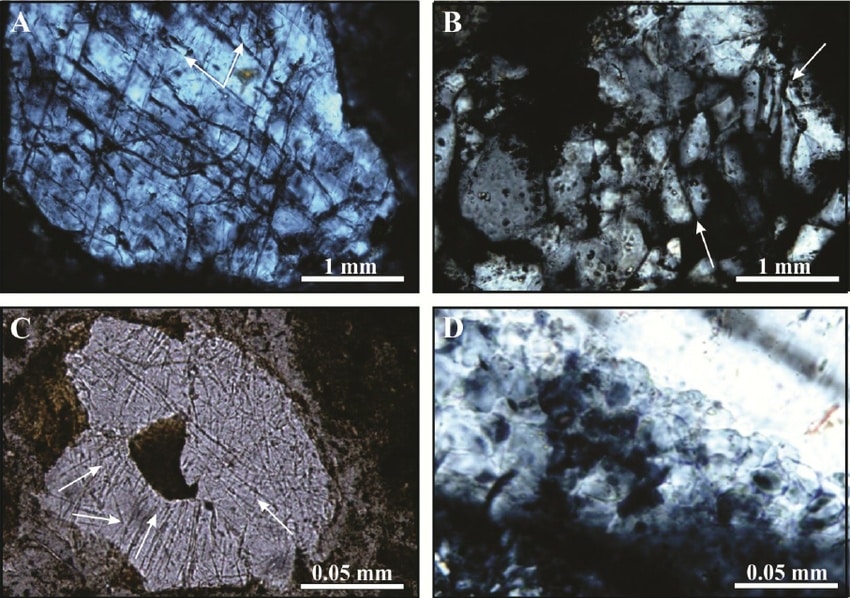
That mineral evidence sits alongside much clearer seismic data than researchers had in the early 2000s. The new imaging shows a 3.2-kilometer circular depression, a central uplift, an annular moat, a surrounding damage zone, and small secondary craters on what was then the seabed. Taken together, those are the kinds of structural features impact specialists expect to see in a marine crater formed at high speed.
A Strike in a Shallow Sea
The study’s age estimate places the event in the middle Eocene, when the area was a shallow marine shelf rather than the colder sea known today. Biostratigraphic work using fossil plankton narrowed the timing to between 43 and 46 million years ago. Co-author Tom Dunkley Jones said the remains of microscopic plankton preserved in sub-sea sediments show that this catastrophic event happened within a narrow geological window.
The modeling points to an asteroid about 160 meters across, striking at about 15 kilometers per second. The seismic patterns suggest a low-angle impact from the west or west-northwest. In the preferred simulation, that was enough to carve the observed crater and deform the surrounding sediments in ways that match the subsurface structure.
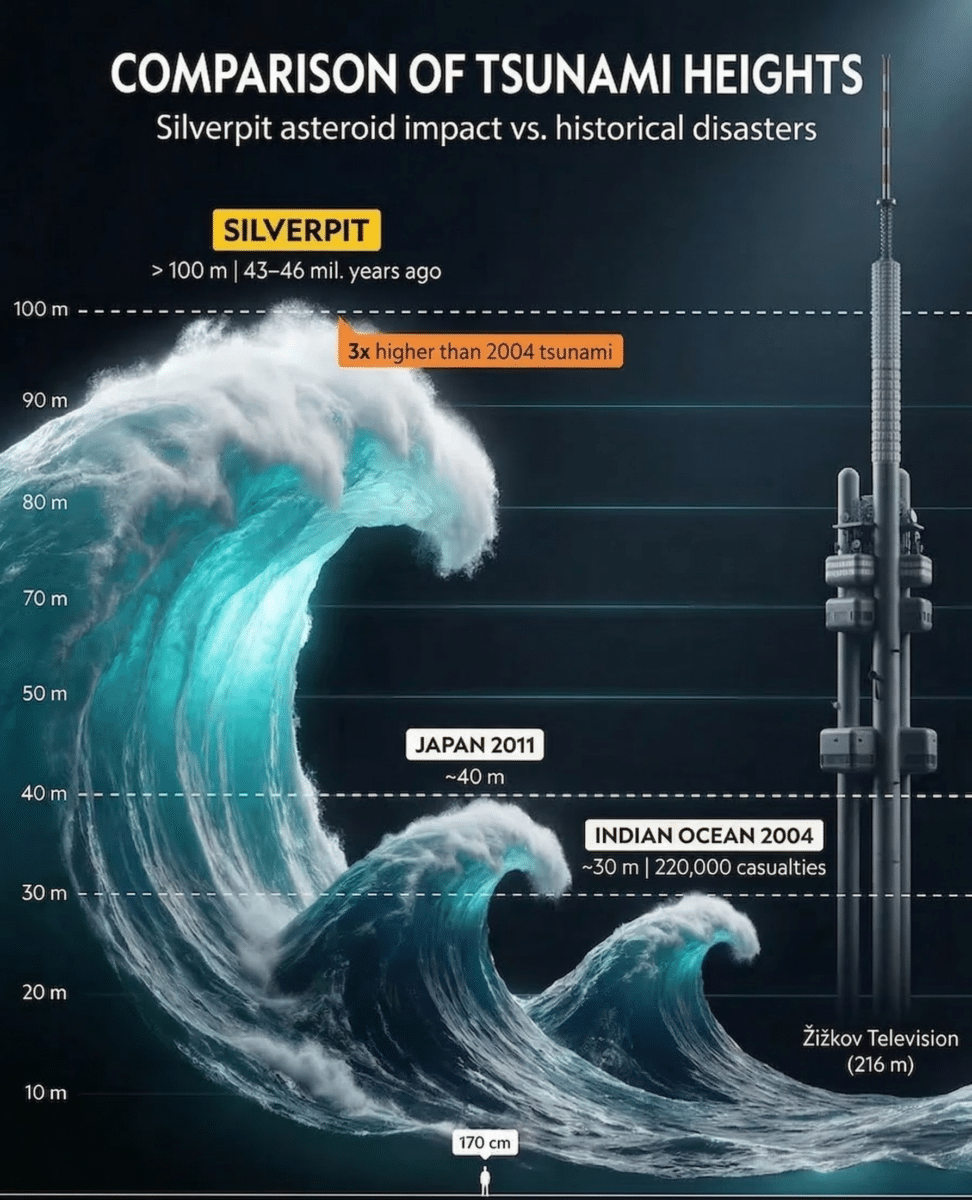
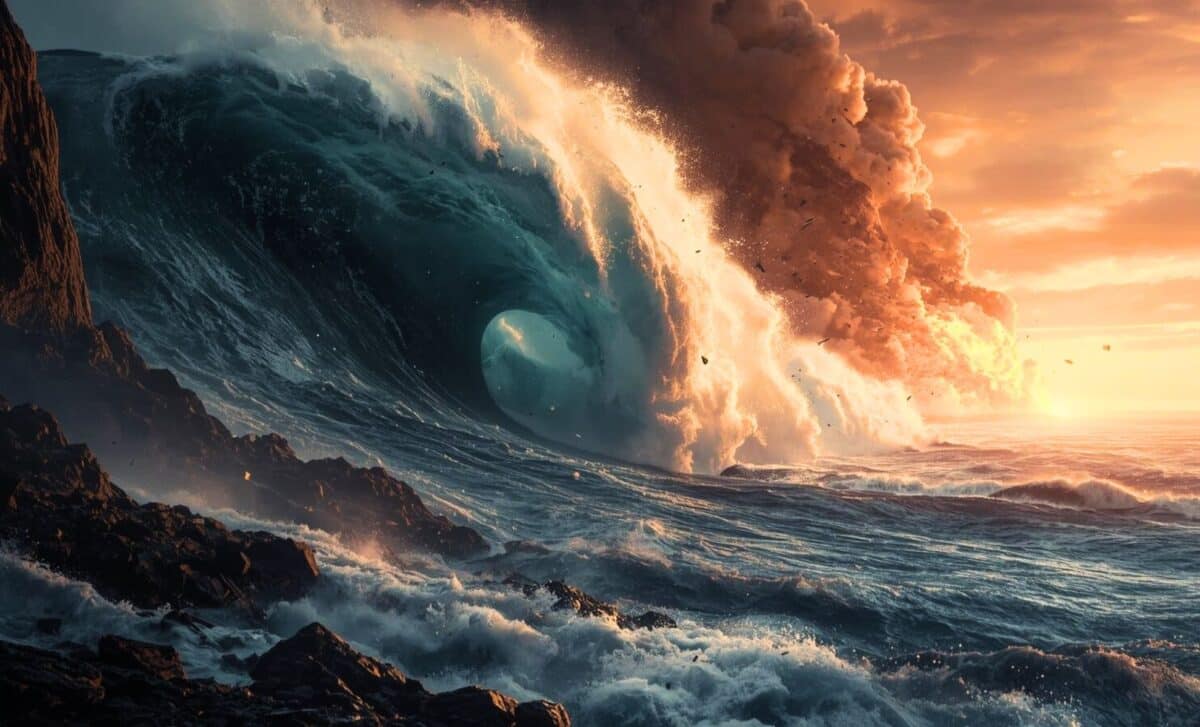
Nicholson said the team’s reconstruction is stark: a 160-meter asteroid hit the seabed at a shallow angle and, within minutes, created a towering curtain of rock and water that collapsed back into the sea, generating a tsunami over 100 meters high. That dramatic wave estimate comes from modeling rather than from a preserved coastal deposit, but it gives a sense of the violence of the event.
Why the Discovery Matters Beyond One Crater
Silverpit is not a dinosaur-killer site, but it does belong to a category that geologists rarely get to study directly. Earth has only around 200 confirmed impact craters, and only a few dozen confirmed or probable marine impact craters. The Earth Impact Database currently lists fewer than 200 confirmed structures worldwide, underlining how limited the record still is compared with the number of impacts Earth must have experienced over geologic time.
Marine craters are especially difficult to preserve and even harder to investigate. Oceans cover more than 70 percent of the planet, yet the seafloor is constantly reworked, buried, and altered. Silverpit survived because it was sealed beneath later sediments and because modern subsurface imaging could finally reveal the structure in enough detail to test the older claims properly.
That combination of burial and technology may explain why Silverpit remained unresolved for so long. It looked like an impact crater before anyone could prove it. Now the missing proof appears to have turned up in the rocks themselves, and the seabed structure once treated as a geological maybe has been drawn into the much smaller club of confirmed impact sites.
First Appeared on
Source link






Leave feedback about this