

This column originally appeared in On The Way, a weekly newsletter covering everything you need to know about NYC-area transportation.
Sign up to get the full version, which includes answers to reader questions, trivia, service changes and more, in your inbox every Thursday.
If only the United States had a functioning high-speed railroad.
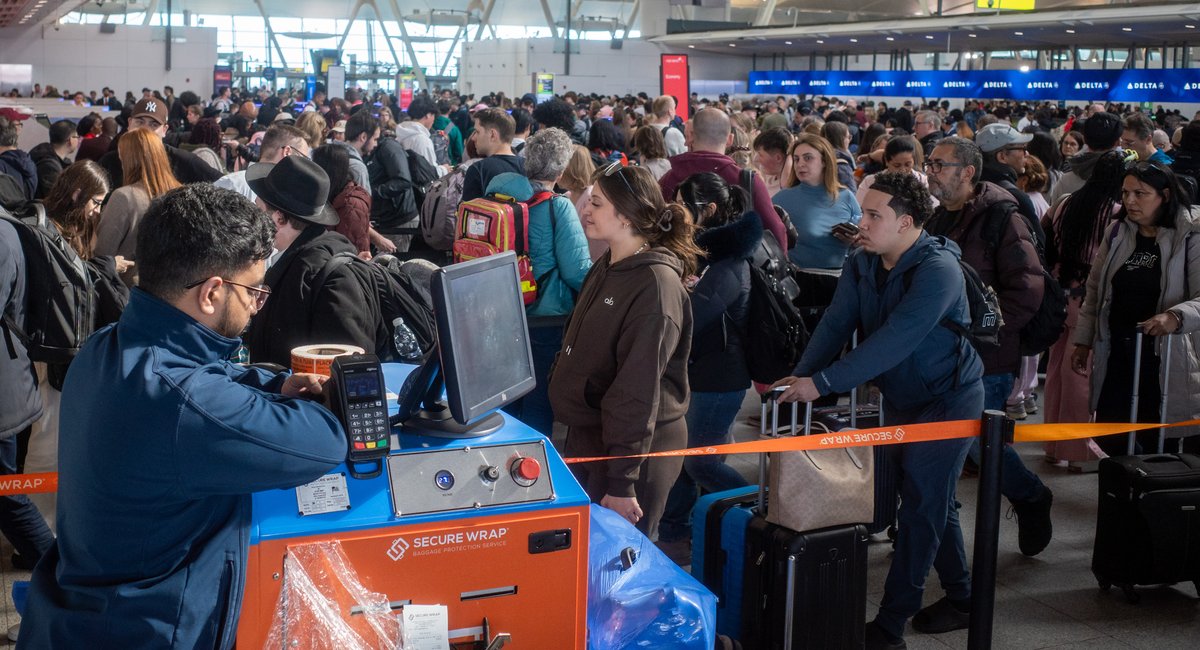
More than a third of the Transportation Security Administration workers at JFK Airport called out of work on Tuesday, according to the Department of Homeland Security. It’s a trend happening across the country as a result of a partial federal government shutdown. TSA workers haven’t been paid for more than a month, and won’t be again until Congress and President Donald Trump resolve a standoff over ICE tactics and new restrictions on voting.
The staff shortage is causing daily lines at the city’s airports so long they’d make the creator of the cronut blush. And because the nation’s passenger railroad is essentially a Toonerville Trolley, travelers have no alternative.
“Every time we have crises like this, and they do pop up from time to time, inevitably people flow to Amtrak,” said Jim Mathews, CEO of the Rail Passengers Association, an advocacy group that pushes for improvements to train infrastructure. “We just, basically, don’t have the resiliency to absorb the extra travelers.”
That isn’t the case in most other major economies, where the construction of high-speed rail has been a priority for decades. Travelers around the world can take fast, reliable trains that are more affordable than flights. China has a high-speed train route from Beijing to Shanghai, nearly the same distance as New York to Chicago, that makes the trip in about 4 hours. In France, a roughly 300-mile train ride from Strasbourg to Paris takes just 1 hour and 45 minutes.
The United States, by comparison, doesn’t have a single inch of high-speed rail, which by modern standards is a train that can exceed 200 mph, Mathews said. The fastest stretch of Amtrak service is on the Northeast Corridor and reaches no more than 160 mph. Most Amtrak trains cruise at about 100 mph. Many of its long-haul routes run slower than they did 60 years ago.
High-speed rail would be a no-brainer for many travelers. A train trip between city centers would be a time saver compared to flying. The experience would be better for riders, who wouldn’t have to deal with TSA security lines or schlep out to Queens and Newark to catch their flights. But the sorry state of the railroads means waiting in an hourslong security line at the airport is still preferable to taking Amtrak.
And even if travelers were willing to take a slow train, riding Amtrak in the Northeast isn’t even cheaper than flying. Mathews said that’s the result of federal policy and congressional decisions that limit subsidies for Amtrak, which forces the agency to charge high prices to cover costs.
“As a result of a policy choice, we are pricing it out of reach,” said Mathews. “We just have to decide as a country that we have to move people in this way [by train], and we’re going to make big investments in this system. Over time, the returns are very much worth it.”
Curious Commuter
Question from Brian in Manhattan
Subway train conductors insist on ordering riders to “use all available doors.” Why? What problem are they trying to solve? And do they think anyone in the history of the transit system has ever gone out of their way to modify their behavior as a result of this order?
Answer
At many stations, riders tend to bunch up on parts of the platforms that are near the entrance. During crowded rush-hour commutes, that can lead to some cars becoming more jammed than others, and lead to trains waiting longer in stations while riders get on and off. This newsletter doesn’t tend to cover behavioral science, but the MTA is working on some new features that tell riders in advance which train cars are sardine cans, and which ones have room to breathe. MTA officials said during an agency board meeting this week they’re looking at adding “dynamic signage,” or digital screens that display a breakdown of capacity in each train’s cars.
First Appeared on
Source link





Leave feedback about this