

President Donald Trump is laying waste to the United States’ long-standing system of alliances. By extorting old friends for short-term gain, threatening to annex allied territory, and applying tariffs indiscriminately, he has squandered decades of cooperation that has served U.S. interests worldwide. When Trump eventually leaves office, the next president will have to decide whether to try to restore these ties. If that successor is a Democrat, the instinct may be to revive the alliance framework that existed during the Cold War. But that would be the wrong approach.
The world has changed since Washington built most of its alliances. After World War II, the United States established an alliance system to contain communism in Asia and Europe. When the Soviet threat collapsed, many analysts assumed Washington would scale back its commitments in favor of greater independence. Instead, the United States maintained its obligations and, in Europe, even expanded them. That was easy to do in a world in which the United States had no peer competitor and the risk of having to fight on behalf of an ally was low.
That world is gone. China now poses the first serious challenge to U.S. economic primacy in a century. In East Asia, its military capabilities rival those of the United States. Russia, meanwhile, has emerged from two decades of weakness to invade its neighbors and harass NATO members. And North Korea now has nuclear weapons that can strike the mainland United States.
Washington therefore needs to reassess its alliances and recalibrate them to suit these new realities. It should judge its partners on whether they strengthen U.S. competitiveness with regard to China and on the low likelihood that they could involve the United States in a war that does not serve its interests. Some current U.S. allies pass this test, but not all of them. As future U.S. leaders try to revive cooperation, they must be hard-nosed. An uncritical reembrace of old allies could weaken the United States and even lead to war.
DON’T SETTLE
The right allies can make up for the fact that the United States’ relative economic and military power has declined since the 1990s. They can help the United States withstand economic coercion from Beijing by diversifying important supply chains, such as for semiconductors and critical minerals. By building their digital economies around U.S. software and hardware, they can help ensure that Washington, not Beijing, sets technological standards across the globe. Allies can also reduce U.S. defense burdens, either by contributing military capabilities directly or by offering the use of their infrastructure and territory to amplify the reach of U.S. power overseas. Diplomatically, the right allies can back U.S. initiatives in multilateral organizations and complement U.S. efforts to sustain influence across the so-called global South.
But such advantages must be weighed against costs. Treaty alliances are not just diplomatic agreements; they also oblige the United States to go to war, and in today’s world, that commitment is more dangerous than ever. China and Russia are much more confident in their ability to deter or defeat U.S. forces than they were 20 years ago, and hence more inclined to clash with U.S. allies, potentially drawing the United States into a conflict. Alliances also require the Pentagon to prepare for major wars in multiple theaters at once, an expensive pursuit.
When it comes to alliances, more is not always better. A tangle of alliances, after all, helped transform what might have been a small conflict between Serbia and the Austro-Hungarian Empire into World War I. Defensive alliances can be misread as offensive ones, triggering the very aggression they were meant to prevent. Or they can embolden minor partners to act more recklessly, potentially ensnaring bigger countries into an unwanted fight. Washington must be particularly careful not to fall into such traps in Asia.
It would also be wise for the United States to limit its commitments to those that the American people are prepared to follow through on. It is, for example, bound by treaty to defend South Korea from external aggression, but in a 2025 poll from the Chicago Council on Global Affairs, only a slim majority of Americans said they would support using U.S. troops to defend their ally from a North Korean attack. If the United States fails to follow through on a defense pledge in a crisis, its credibility will suffer.
TRIM THE FAT
Some alliances require recalibration. Consider the Mutual Defense Treaty between the United States and the Philippines, which was established in 1951. The deal made sense when the United States dominated East Asia militarily, but now that China has become more powerful in its surrounding waters, the pact deserves much more scrutiny. Yet both the Biden and the second Trump administrations rushed to deepen ties with the Philippines by sending it advanced missile systems, deploying U.S. Marine forces there on a rotational basis, and launching a large-scale infrastructure development project near Luzon.
Pentagon planners argue that the Philippines provides an important springboard for attacking mainland China and defending Taiwan, but the utility of Philippine geography and capabilities is overstated. A handful of undefended U.S. equipment sites and rotational Marine deployments are unlikely to deter China from attacking Taiwan. And the marginal military gains offered by Manila must be weighed against the Philippines’ weaknesses: its military is decades behind those of its regional peers, and the country has little to offer the United States economically, technologically, or diplomatically in its long-term competition with China. By recommitting to this lopsided partnership, Washington risks emboldening Manila to take harder lines in the South China Sea, potentially dragging the United States into a conflict over disputed reefs that have limited bearing on core U.S. interests.
The United States should halt the expansion of the Enhanced Defense Cooperation Agreement, a 2014 pact granting U.S. forces access to Philippine military bases, and ensure that U.S. rotational deployments in Luzon do not evolve into permanent military bases that unnecessarily heighten tensions with China. Behind closed doors, Washington should stress to Manila that it does not intend to fight a war over disputed islands in the South China Sea.
Defensive alliances can be misread as offensive ones.
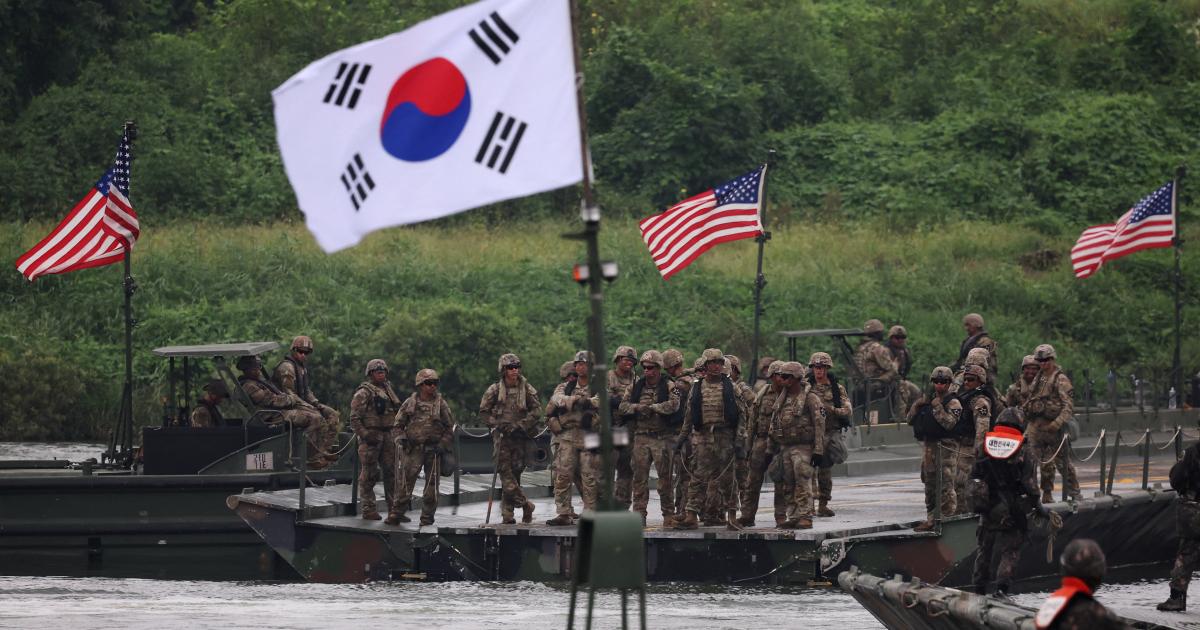
The United States’ relationship with South Korea is more structurally sound than that with the Philippines, but it is still worth reassessing. South Korea is a major economy and a leading producer of advanced microchips, both good reasons for the United States to maintain close ties. Yet the military risks of aligning with South Korea are rising.
When the United States first committed to defending South Korea during the Cold War, North Korea had no way to attack U.S. soil. Now, however, the balance of risk is radically altered: the Kim regime could destroy a U.S. city with nuclear weapons. And although South Korea hosts nearly 30,000 American troops, Seoul has resisted discussing whether U.S. forces based in the country, or South Korea’s own forces, could be used to deter or intervene in a Chinese invasion of Taiwan.
To reduce the risk of a North Korean attack on U.S. soil, Washington should scale back its forces in South Korea, even if doing so might, as some analysts argue, spur Seoul to pursue nuclear weapons. (Washington can try to head off such an outcome by strengthening South Korea’s conventional forces and reminding Seoul of the economic and diplomatic costs of withdrawing from the Nuclear Nonproliferation Treaty.)
BANG FOR YOUR BUCK
Other alliances, such as the one with Japan, have only become more worthwhile in the twenty-first century. With its advanced digital technologies and stakes in companies that extract and process critical minerals abroad, Japan can help the United States compete with China in artificial intelligence. Tokyo is dedicated to its alliance with the United States and has dramatically increased defense spending. It also has major diplomatic weight across the Indo-Pacific and is the world’s fourth-largest economy.
Theoretically, the United States could get caught up in a war with China over the Senkaku Islands (known in China as the Diaoyu Islands) on Japan’s behalf, but Beijing will probably avoid coming to blows with the second most powerful country in East Asia. Japan should therefore remain the central pillar of U.S. power in the Indo-Pacific. Washington should redouble its efforts to cooperate with Tokyo in securing critical supply chains, developing advanced technologies, and reforming global institutions, while also strengthening Japan’s capacity for deterrence and self-defense.
The rationale for the U.S. alliance with Australia also remains strong, in part because the risks are low, even if Canberra brings less to the table than does Tokyo. Australia is a large economy, and it has rich reserves of critical minerals such as lithium, cobalt, and rare-earth elements needed to make electric vehicles and certain advanced weapons. It is a valuable military and intelligence partner, especially because of its location: in the Indo-Pacific but outside the range of most Chinese missiles. Australia has now firmly oriented itself toward the United States and away from China. The AUKUS treaty, a 2021 security pact between the United States, Australia, and the United Kingdom, merits further investment.
Alliances can embolden minor partners to act more recklessly.
The United States’ long-standing alliances in Europe—now under immense strain from the Trump administration—still have high potential, but they are not delivering on it. When it comes to China, European capitals have never fully aligned with Washington. They cooled on China after Beijing supported Russia’s invasion of Ukraine, but the Trump administration’s erratic treatment of European allies has reinforced their tendency to hedge between Washington and Beijing. Over the past few months, leaders of historic U.S. allies, including France and the United Kingdom, have even flocked to China to reset their ties.
Although European countries are unlikely to play much of a military role in the Indo-Pacific, they can take the lead in their own defense against Russia—thus freeing up U.S. resources to balance China. A reformed transatlantic alliance should ensure that Europe steps up to defend itself, while preserving a U.S. commitment to collective defense through NATO. The shift to a NATO led by Europe should be the product of a deliberate transatlantic strategy, not of neglect or coercion.
A renewed transatlantic alliance should also include more diplomatic and industrial cooperation. Combined, the United States and Europe’s economic heft far outstrips China’s. With sustained diplomacy—and flexibility in Brussels—the United States and Europe can cooperate to develop trusted AI infrastructure, coordinate export controls, and jointly process and stockpile critical minerals. This cooperation would go a long way toward preventing China from setting global AI standards or dominating the development of advanced weapons and clean energy.
Europe also retains influence in regions of the world where the United States is comparatively weak, such as Africa. China has been working for well over a decade to develop deep economic and political connections across that continent. U.S. projects such as the Lobito Corridor, an infrastructure project connecting critical minerals mines in Congo and Zambia to a port in Angola on Africa’s western shore, are only beginning to compete. Europe’s relationships can help balance China’s influence.
TIME FOR AN AUDIT
To regularly audit its alliances, Washington will need new bureaucratic mechanisms. Today, it is largely up to regional bureaus at the State Department, the Defense Department, and intelligence agencies to track how allies serve U.S. needs. These regional bureaus bring valuable expertise but can struggle to evaluate the usefulness of the countries in their portfolio through a global lens. Washington should therefore set up a functional office to oversee its partnerships with all foreign capitals, regardless of geography. This office would assess the costs, risks, and domestic political support for alliances. It would also identify opportunities to deepen relationships with key partners, such as India, around shared interests. In addition, it could clarify, publicly or privately, the conditions under which the United States would use force to defend an ally, and what each ally is expected to commit to in return.
The U.S. Congress should play a bigger role, too. Under the Constitution, the Senate has the power to approve or reject treaties. Lawmakers should therefore require the undersecretary of state for political affairs to provide an annual net assessment of the costs, risks, and returns of each major treaty commitment.
Revamping alliances will be controversial, both in Washington and overseas. Depending on how Trump governs throughout the rest of his term, some historic allies may hesitate to renew their bonds with the United States. As Washington adjusts, it owes its partners greater predictability and fairer treatment than Trump has given them. The goal should not be to restore the Cold War–era alliance system out of nostalgia but to build partnerships on a clear-eyed assessment of current realities. The world will be safer if U.S. alliances are tailored to future challenges and the needs of the American people.
Loading…
First Appeared on
Source link






Leave feedback about this