

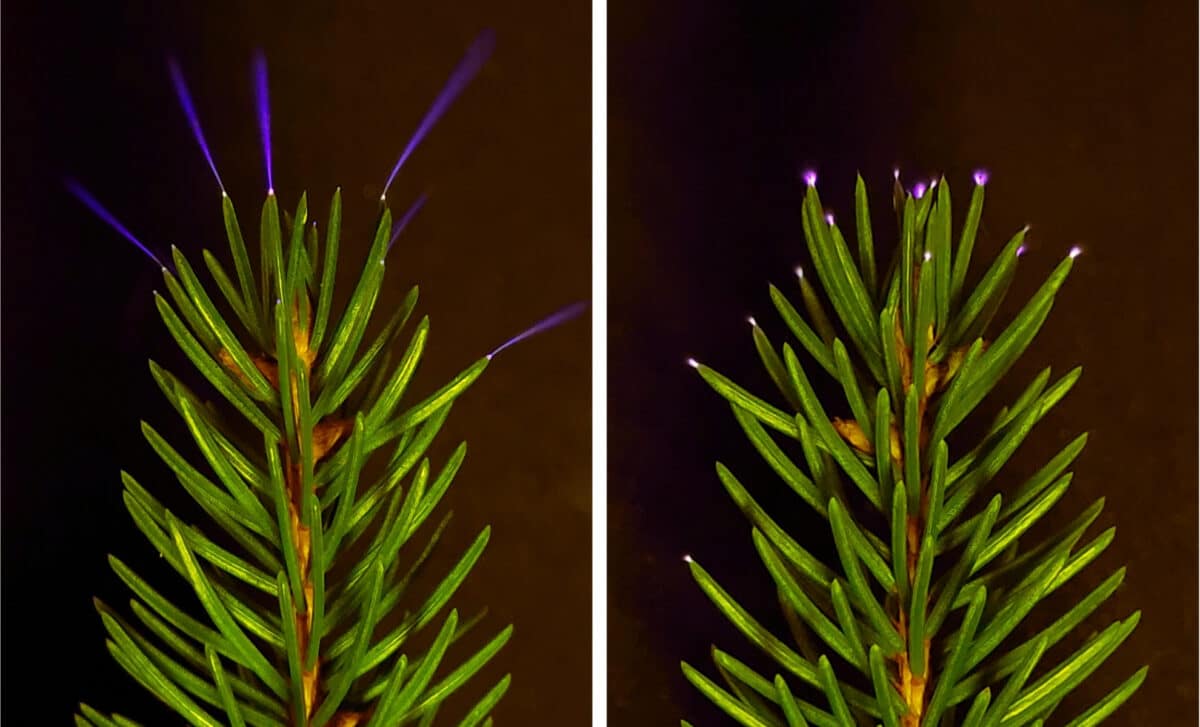
For the first time ever, scientists have captured on camera the ghostly ultraviolet light emitted by trees during thunderstorms. Invisible to the naked eye, this eerie glow is real, it’s measurable, and it’s happening above forests all over the world every time a storm rolls in.
The phenomenon, known as a corona, had long been theorized but never directly observed in nature. That changed when a team of researchers decided to stop hypothesizing and start storm-chasing, literally.
A Century-Old Theory Finally Gets Its Proof
Meteorologists have suspected for decades that trees emit faint bursts of ultraviolet light during electrical storms. The idea, while scientifically grounded, sat comfortably in the realm of “probably real but unconfirmed” for years. According to the research published in Geophysical Research Letters, the mechanism behind the glow is surprisingly elegant: as a thunderstorm passes overhead, its massive electrical charge induces a current inside the trees below, traveling up through moisture-laden trunks and branches until it reaches the tips of leaves, where it has nowhere left to go.
Prevented from dissipating by a thin layer of insulating air, that charge accumulates and radiates faintly outward as a corona of ultraviolet light. Previous lab experiments had recreated the effect, and unusual shifts in the electrical fields of forests had long hinted at its existence. But as Patrick McFarland, the Pennsylvania State University meteorologist who led the study, put it plainly: “These things actually happen; we’ve seen them; we know they exist now.”
A Modified Minivan and a Camera Sensitive Enough to See the Invisible
Getting that proof required a somewhat unconventional setup. McFarland and his team first confirmed the effect indoors by placing small spruce and maple trees in plastic pots beneath charged metal plates designed to simulate the electrical conditions of a passing storm cloud. “In the laboratory, if you turn off all the lights, close the door, and block the windows, you can just barely see the coronae. They look like a blue glow,” McFarland explained in a press release.

Then came the real challenge: catching it outside, mid-storm. The team outfitted a 2013 Toyota Sienna with a weather station, an electric field detector, a laser rangefinder, and a roof-mounted periscope designed to channel light into an ultraviolet camera.
What appeared on screen was, at first glance, unremarkable, just sweetgum leaves, Liquidambar styraciflua, blowing in the wind of a North Carolina storm. But buried in that footage were 41 distinct bursts of ultraviolet light, each lasting anywhere from 0.1 to 3 seconds, hopping sporadically from leaf to leaf and sometimes returning to the same spot. The same effect was later captured in loblolly pine trees, Pinus taeda, at multiple locations spanning the entire US east coast, from Florida to Pennsylvania.
A “Light Show” With Consequences We’re Only Beginning to Understand
The scale of what’s actually happening out there is difficult to wrap your head around. Each corona burst emits roughly 100 billion photons at a wavelength of around 260 nanometers per video frame, and according to ScienceAlert, which reported on the findings, McFarland believes this is playing out across entire forest canopies simultaneously. “I believe you’d see this swath of glow on the top of every tree under the thunderstorm,” he said. “It’d probably look like a pretty cool light show, as if thousands of UV-flashing fireflies descended on the treetops.“
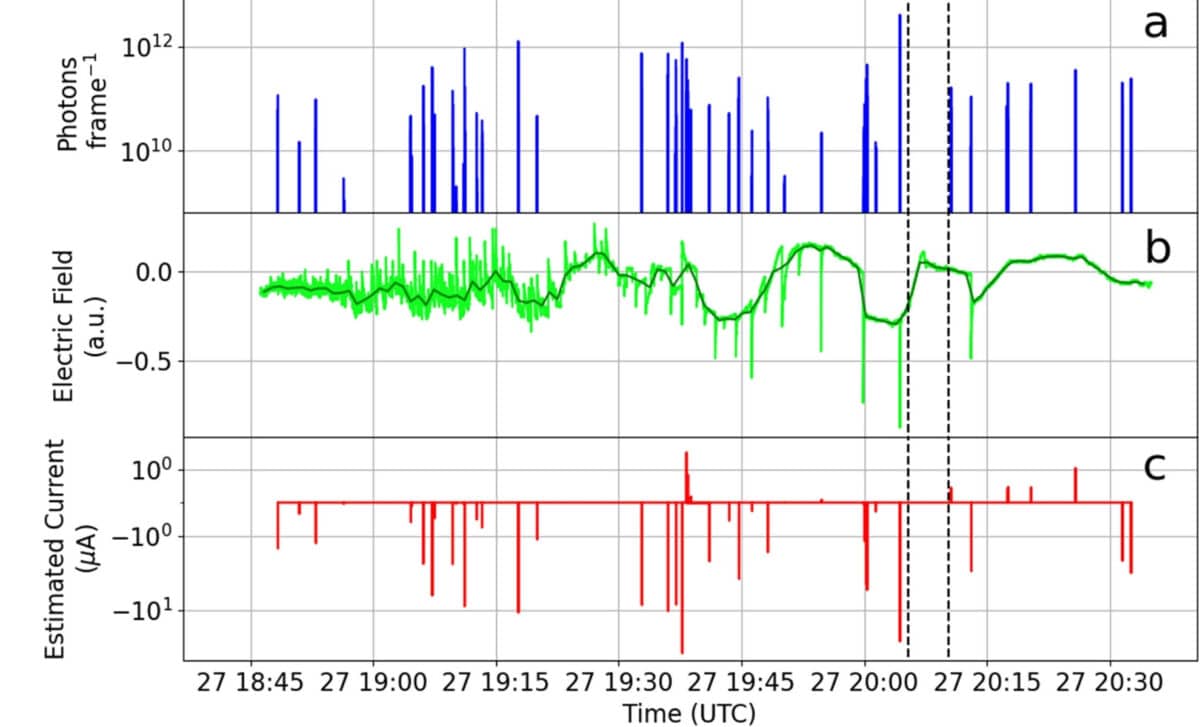
Beautiful, sure, but potentially damaging too. The researchers note that repeated exposure to these electrical surges could kill a tree’s upper branches, in a process not entirely unlike the formation of an upward lightning leader during a cloud-to-ground strike. Beyond forest ecology, the corona effect also carries implications for atmospheric chemistry, specifically the removal of hydrocarbons emitted by trees, and may even play a subtle role in thunderstorm electrification itself.
According to the study’s authors, “the impacts these coronae have on atmospheric chemistry, forest ecology, health, and evolution, and thunderstorm electrification must be re-evaluated and understood, especially as thunderstorms, and therefore coronae, increase in a warming climate.“
In other words, this isn’t just a curiosity. It’s a natural phenomenon that has been silently shaping forests and skies for as long as storms have existed, and we’re only now learning to see it.
First Appeared on
Source link






Leave feedback about this