

A superfluid is supposed to flow forever without friction. Yet researchers have now observed one come to a stop. In classical physics, matter falls neatly into familiar categories: gases, liquids, solids, and plasmas. But as temperatures approach absolute zero, quantum mechanics begins to reshape those categories in ways that defy everyday intuition.
That is how, in January 1938, two independent teams discovered that helium cooled to around 2 Kelvin enters a superfluid state, flowing without viscosity and without losing energy. That discovery raised an enduring question: if liquids have a quantum equivalent, could solids have one too?
The Decades-Long Hunt for a Supersolid
A supersolid is a strange hybrid. It would retain the organized crystalline lattice of a solid while simultaneously allowing frictionless flow, a defining feature of superfluids. The concept has fascinated physicists for decades.
Scientists have never observed a naturally occurring element spontaneously turning into a supersolid. Previous experiments have relied on lasers and optical techniques to coax materials into such states. According to Popular Mechanics, no experiment had yet captured a spontaneous formation resembling this transition. The new study, led by researchers at Columbia University and the University of Texas at Austin, suggests that may be changing.
Graphene and Excitons at the Center of the Experiment
Instead of working with helium, the team turned to graphene, a single-atom-thick layer of carbon arranged in two dimensions. In a carefully arranged setup, two graphene sheets were configured so that one carried excess electrons and the other excess holes. Under these conditions, the system can host quasiparticles known as excitons.
When a strong magnetic field was applied, the excitons formed a superfluid. According to the study, the researchers observed that at high density the excitons behaved like a superfluid. As density decreased, the excitons stopped moving and the material became insulating. When temperature increased again, the excitons returned to superfluid behavior.
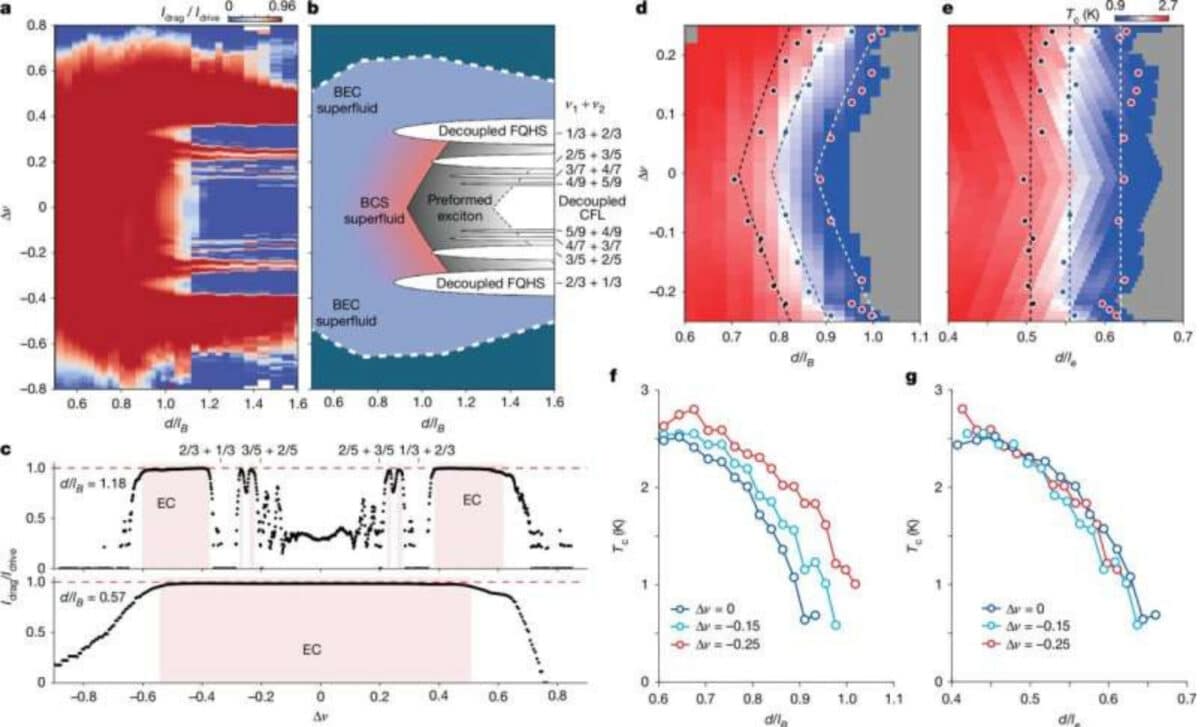
Jia Li, a co-author from UT Austin, stated in a press release that “Superfluidity is generally regarded as the low-temperature ground state.” He added that observing “an insulating phase that melts into a superfluid is unprecedented,” suggesting that the low-temperature phase may be “a highly unusual exciton solid.”
A Supersolid or an Unusual Excitonic State?
The interpretation remains open. Cory Dean of Columbia University acknowledged the limits of current measurements, explaining in a press statement that “We are left to speculate some, as our ability to interrogate insulators stops a little.” According to Dean, the team is exploring the boundaries of this insulating state while developing tools to measure it directly.
While a supersolid is a leading explanation, the system could also be described as an excitonic superfluid arranged in a different configuration. The distinction has not yet been definitively resolved.
One aspect is clear from the study : excitons are thousands of times lighter than helium atoms. That difference means they could form superfluids and supersolids at higher temperatures than helium-based systems. For physicists studying superconductivity and quantum materials, that possibility alone makes the result hard to ignore.
A superfluid that stops flowing may sound like a contradiction. In this case, it may instead signal that quantum matter still has surprises in store.
First Appeared on
Source link






Leave feedback about this