

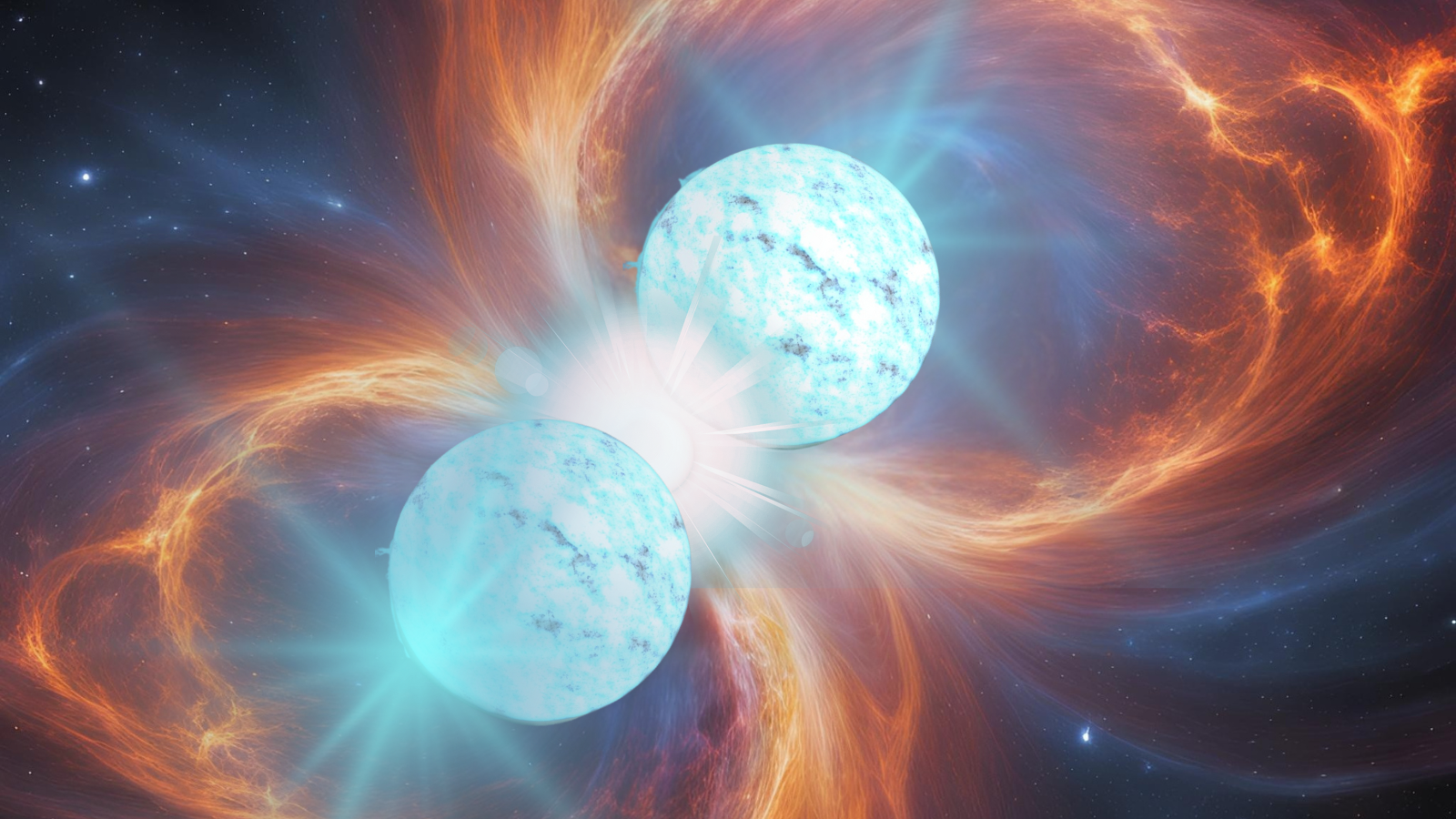
We could soon be able to “see” inside a neutron star and learn what extreme matter governed by exotic physics lurks there, thanks to the imprint of tidal interactions on gravitational waves emitted by pairs of neutron stars spiraling toward an explosive merger.
“One hope is that we’ll be able to get some information about the neutron-star equation of state at densities found in the inner core of a neutron star,” said Nicolás Yunes of the University of Illinois, who led the research, in a statement. “Is there really a quark core, as some have recently claimed? Are there phase transitions occurring inside that we don’t know about yet?”
Article continues below
However, deeper down inside a neutron star, close to its core, things could be even weirder. The gravitational pressure could be so extreme as to crush neutrons into their building blocks, which are fundamental particles called quarks and the gluons that ordinarily bind quarks together to form protons and neutrons.
Scientists call this state of matter a quark-gluon plasma. This state of matter existed during the first fraction of a second after the Big Bang, and outside of particle accelerator experiments, the only other location in the universe where quark-gluon plasma may exist is inside neutron stars.
If scientists could understand the interior of neutron stars, they could therefore learn more about the state of matter immediately after the Big Bang.
Binary neutron stars have long been considered the best bet for deciphering what lurks within. These pairs of neutron stars spiral around one another in elliptical orbits, inching ever closer until they collide and merge in a kilonova. Crucially, their in-spiral sees the release of gravitational waves.
Now, scientists led by Yunes and Abhishek Hegade of Princeton University think they’ve figured out how to decipher the frequency of these gravitational waves to interpret the interior structure of neutron stars.
“As they get closer, tidal forces from one [neutron] star begin to deform the other and vice versa,” said Hegade. “The amount of deformation depends on what’s inside of those stars.”
The problem is that the extreme gravity and high velocity (up to 40% the speed of light) of the neutron stars as they spin about one another means that scientists have to look toward Albert Einstein‘s general theory of relativity for solutions. This is a complex endeavor, but Yunes and Hegade think they now have the answer.
As the binary neutron stars deform the shape and structure of each other through their gravitational tides, they trigger oscillations within their interior, like the ringing of a bell. The patterns of these oscillations are called modes, and the frequency of these modes is imprinted on the gravitational waves that the binary neutron stars radiate away.
A full set of modes is required to understand the binary system. Discerning these modes, however, is complicated by the fact that the tidal forces are dynamical: they change as the neutron stars orbit one another, and the effects of each neutron star overlap, making distinguishing what’s going on even more difficult.
“Without a complete set of modes, it’s entirely possible that you could miss part of the tidal response when you model it, as there could possibly be other pieces you’re omitting from the response’s mathematical description needed to capture all the physics,” said Yunes.
Newtonian physics — that is, the basic physics of gravity according to Isaac Newton‘s law of gravitation — contains a full set of oscillating modes for a regular object. These modes are referred to as a damped harmonic oscillator. However, in relativistic physics, it has not been clear whether all the modes could be derived. For example, gravitational waves that radiate away energy from binary neutron stars are a phenomenon of general relativity, which succeeded Newtonian gravity, and as such they are not considered by Newtonian physics.
“If your system is losing energy, then its modes cannot be complete,” said Hegade.
The solution was to break the problem down, considering each neutron star individually, and its companion as just a source of gravitational tides. Yunes’ and Hegade’s team then divided each neutron star into separate regions of varying gravitational strength at different scales, describing strong gravity and weaker gravity. They found approximate solutions for each scale, and then combined them. They even found that the loss of energy from gravitational waves effectively cancelled out. This allowed them to derive a solution describing all the oscillatory modes of a neutron star’s interior, and furthermore, how these modes would be imprinted on the frequency of the resulting gravitational waves.
“We showed two major things,” said Hegade. “First, we were able to subtract off radiation, finding that a neutron star’s modes do indeed form a complete set. Second, we found that if you consistently solve a certain set of equations using a tidal field that’s sufficiently ‘smooth,’ it’s a solution to the interior of a star, and you can do all the same things in general relativity as in Newtonian gravity.”
This isn’t the end of the story. The work of Yunes’ and Hegade’s team is purely theoretical at this stage, and current gravitational-wave detectors are not sensitive enough at higher frequencies to detect this imprint. However, Yunes and Hegade are optimistic that the next generation of detectors will do the trick.
The findings were published on Feb. 18 in the journal Physical Review Letters.
First Appeared on
Source link






Leave feedback about this