

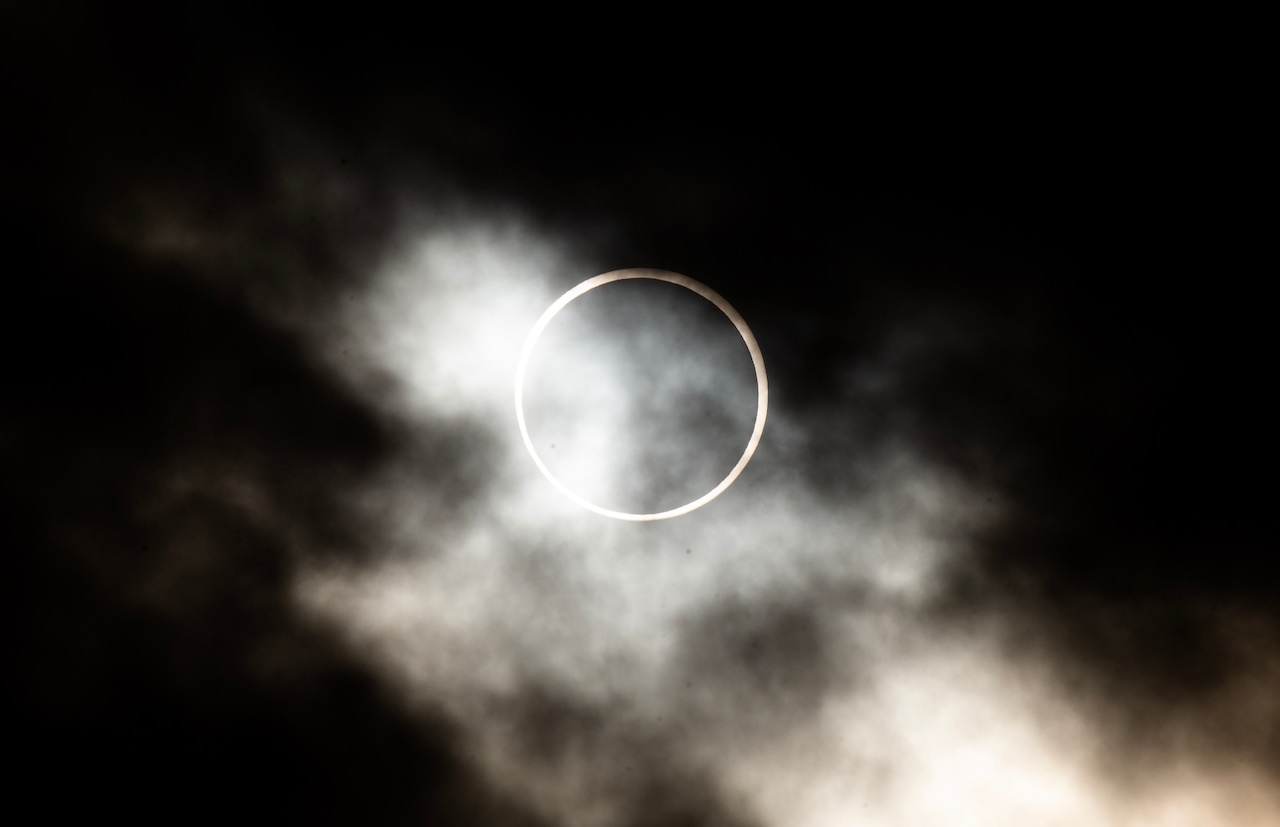
A solar eclipses is often a cause for celebration, with everyone in its path stepping outside to glimpse the rare cosmic event of the moon passing directly in front of the sun.
The solar eclipse coming Feb. 17? Not so much.
There are a few reasons this solar eclipse is coming with little to no fanfare.
For one thing it’s not a total solar eclipse, meaning the moon will not be close enough to the Earth to fully block out the sun. Officially known as an annular eclipse, the event will result in a so-called “ring of fire” that can be seen only with special eclipse glasses.
An annular eclipse was visible in Oregon in 2023, when people gathered for events at Crater Lake National Park and Klamath Falls to watch the cosmic spectacle. An annular eclipse happens roughly every year somewhere in the world, drawing crowds to the places where the full eclipse can be seen.
So why isn’t this annular eclipse expected to draw crowds? Probably because the place where it can be seen has millions more penguins than people.
The Feb. 17 eclipse will be visible over a slice of Antarctica where virtually nobody lives. The slice of the continent is on the coast of the Indian Ocean between South Africa and Australia. There appears to be only one settlement there, Davis Station, a research base run by Australia.
The 100 or so expeditioners at Davis Station will be treated to a great show, which will reach its peak around 4:12 a.m. Pacific Time on Tuesday, according to Time and Date. The rest of the world will have to sit this one out.
The Pacific Northwest is in the middle of an eclipse drought. The region won’t see another solar eclipse until Aug. 12, 2045, when a total solar eclipse will be visible in Northern California.
First Appeared on
Source link






Leave feedback about this