


A new digital reconstruction of an ancient fossil’s face is reshaping how scientists think about early human relatives in Africa.
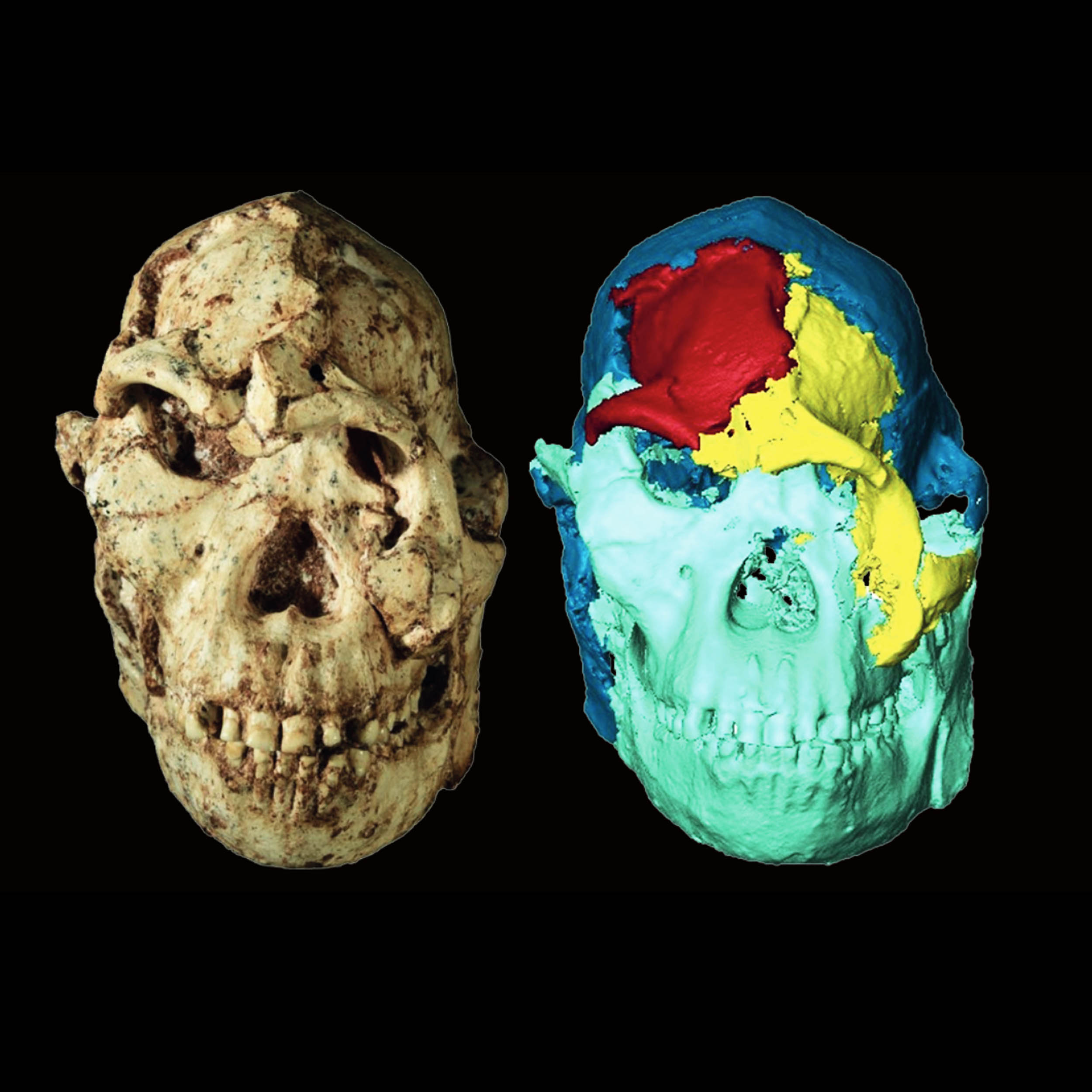
By virtually “undoing” distortions caused by millions of years underground, researchers have produced one of the most complete Australopithecus faces ever assembled.
The rebuilt features suggest that facial evolution between four to three million years ago may have been more complex than a simple, region-by-region story.
Researchers focused on “Little Foot,” a 3.67-million-year-old Australopithecus fossil discovered in the Sterkfontein Caves near Johannesburg, South Africa.
Little Foot is widely described as the most complete early hominin skeleton ever found, however its face has long posed a challenge. Geological forces warped the bones in ways that traditional physical reconstruction could not fix.
Now, high-resolution scanning and virtual reconstruction make it possible to digitally reassemble the facial bones and compare them with other fossils and living apes.
Little Foot was found at the Wits Sterkfontein Caves, about 25 miles (40 kilometers) northwest of Johannesburg, inside the Cradle of Humankind World Heritage Site.
Over the years, much of the skeleton has been studied in detail. But the facial region remained frustratingly distorted, limiting what researchers could confidently say about what this individual looked like, and how it fit into the broader family tree.
The new work tackles that obstacle using imaging that can capture tiny details without physically manipulating fragile fossils.
The team used high-resolution synchrotron scanning at the Diamond Light Source in the UK. They then applied advanced virtual reconstruction methods to digitally “reassemble” the bones, correcting deformation and aligning broken or shifted parts.
The result is a face that can be measured and compared in ways that weren’t possible before.
Once they completed the reconstruction, the researchers analyzed the face as data rather than treating it only as a visual model.
They analyzed nine linear facial measurements and used three-dimensional geometric morphometrics, a method that compares shapes in a detailed, quantitative way.
They compared Little Foot with several living great apes and with three other Australopithecus fossils. Those included a younger South African specimen and two specimens from Ethiopia.
The key finding was unexpected. In multiple aspects of facial structure, Little Foot looked closer to the East African fossils than to the younger South African comparison.
The researchers observed similarities in overall facial size, the shape and dimensions of the eye sockets, and what they describe as the general facial architecture.
Because complete fossil faces are rare, the study can only draw comparisons from a limited set of specimens.
But even with that limitation, the pattern stood out strongly enough to raise new questions about how early Australopithecus populations were related across the continent.
An unexpected link across Africa
The study’s most intriguing implication is that geography may not line up neatly with facial similarity. Little Foot comes from South Africa, yet its reconstructed face appears to align more closely with East African fossils than with the younger South African one.
“This pattern is unexpected, given the geographic origin of Little Foot and suggests a more dynamic evolutionary history than previously assumed,” said lead author Amélie Beaudet, a researcher at Wits University.
One interpretation is that Little Foot represents a lineage with close ties to East African populations. Another is that later South African hominins may have developed more distinctive facial traits through local evolutionary pressures, diverging from earlier forms.
Either way, the result pushes against the idea that early hominin groups were evolving in isolated pockets with clear regional boundaries. Instead, it hints at movement, connection, or shared ancestry across long distances.
Eyes may be a hotspot of evolution
Beyond overall similarity, the researchers also saw signs that one area of the face may have been under special evolutionary pressure: the orbital region, the bones and structures around the eyes.
The team suggests these pressures could relate to changes in visual capacity and ecological behavior.
In other words, shifts in where and how these hominins lived might have shaped eye-related anatomy more strongly than other facial traits.
The study, though limited to one anatomical region and a small number of comparative fossil specimens, provides additional evidence about the relationships between Australopithecus populations across Africa.
The findings also suggest that the orbital region of the face may have been under evolutionary pressure during that time.
The researchers place this in the broader context of a long-term trend in human evolution: faces becoming less projected and more gracile over time.
“While we know that the hominin face evolved through time to become less projected and more gracile, we still ignore when such changes occur, and the nature of the evolutionary mechanisms involved,” Beaudet said.
Early humans across connected Africa
The study also supports a wider idea about early hominin evolution: Africa as an interconnected evolutionary arena rather than a set of separate laboratories.
Populations could adapt to local conditions while still remaining linked through shared ancestry and, potentially, gene flow.
“The study supports the idea of Africa as a connected evolutionary landscape, with populations adapting to ecological pressures while remaining linked through shared ancestry,” said Dominic Stratford, the director of research at the Wits Sterkfontein Caves.
That framing matters because it changes what a fossil like Little Foot represents. It isn’t just a South African data point. It may show broader relationships among populations spread across the continent during a critical window of hominin evolution.
The face is not just a “look.” It’s a working system shaped by feeding, breathing, sensing, and social signaling.
The researchers emphasize that facial anatomy can help reveal how early hominins interacted with their physical and social environments.
Little Foot’s face preserves key anatomical regions involved in vision, breathing, and feeding, and its skull will provide important clues for understanding human evolutionary history.
At the same time, the team stresses that the face is only one piece of the puzzle. Other parts of the skull remain distorted, especially the braincase.
“The face is only part of the story. Other parts of the skull, especially the braincase, remain distorted by plastic deformation and will require similar digital reconstruction to better understand brain size and organization in this early hominin,” Beaudet said.
As researchers complete more reconstructions, they hope to sharpen the story of how early hominins moved, diversified, and stayed connected across Africa.
The findings were published in the journal Comptes Rendus Palevol.
—–
Like what you read? Subscribe to our newsletter for engaging articles, exclusive content, and the latest updates.
Check us out on EarthSnap, a free app brought to you by Eric Ralls and Earth.com.
—–
First Appeared on
Source link






Leave feedback about this