

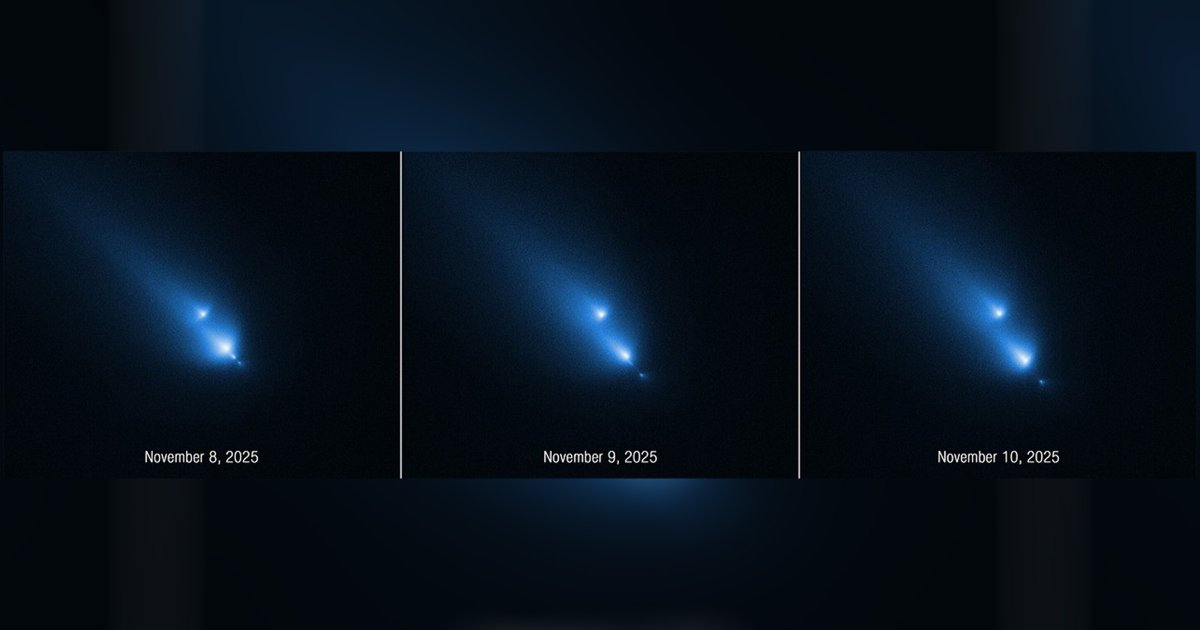
Lady Fortune was on astronomers’ side when they pointed the Hubble Space Telescope at a comet drifting through our solar system. Just as they began observing the comet, it started breaking apart, providing an extraordinary chance to probe how these icy bodies evolve.
“Sometimes the best science happens by accident,” John Noonan, a research physicist at Auburn University in Alabama, and coauthor of a new study published in the journal Icarus detailing the discovery, said in a statement about the work.
After their original plans to observe a different comet fell through, “we had to find a new target,” he explained. “And right when we observed it, it happened to break apart, which is the slimmest of slim chances.”
Shortly before disintegrating, the comet, dubbed C/2025 K1 (ATLAS) — a home-grown snowball, not to be confused with our interstellar visitor 3/I ATLAS — had completed its closest approach to the Sun, a point called perihelion, on October 8, 2025. It came within a third of the Earth’s distance from our star, experiencing intense heating.
The observations were taken between November 8 and November 20 2025, just as it began to unravel. When Noonan looked at the Hubble observations, he noticed a quartet of comets, instead of just one. C/2025 K1 had splintered into four. Each of the fragments had a distinct coma, the cloud of gas and dust that shrouds a comet’s nucleus, which is a solid core of icy material.
Scientists can examine the comas to infer the comet’s composition. As leftover shards from solar system’s formation, they can tell us a lot about the material that our cosmic neck of the woods was built with, which could have implications about the traits of other planetary systems, too. But as principal investigator Dennis Bodewits explains, these samples usually aren’t “pristine,” making it difficult to draw broader conclusions.
“They’ve been heated; they’ve been irradiated by the sun and by cosmic rays,” Bodewits, who is also a physics professor at Auburn University, said in the statement. “So, when looking at a comet’s composition, the question we always have is, ‘Is this a primitive property or is this due to evolution?’
That the astronomers are seeing the comet immediately after fragmenting arguably provides as “pristine” a sample as we’ll ever get.
“Never before has Hubble caught a fragmenting comet this close to when it actually fell apart. Most of the time, it’s a few weeks to a month later. And in this case, we were able to see it just days after,” said Noonan. “This is telling us something very important about the physics of what’s happening at the comet’s surface. We may be seeing the timescale it takes to form a substantial dust layer that can then be ejected by the gas.”
The comet, or its fragmented remains, is now some 250 million miles from our planet. Astronomers, in the meantime, are figuratively trying to put the pieces back together and analyze the gas readings.
More on comets: Please Resist the Urge to Drink the Melted Sludge From 3I/ATLAS
First Appeared on
Source link



Leave feedback about this