

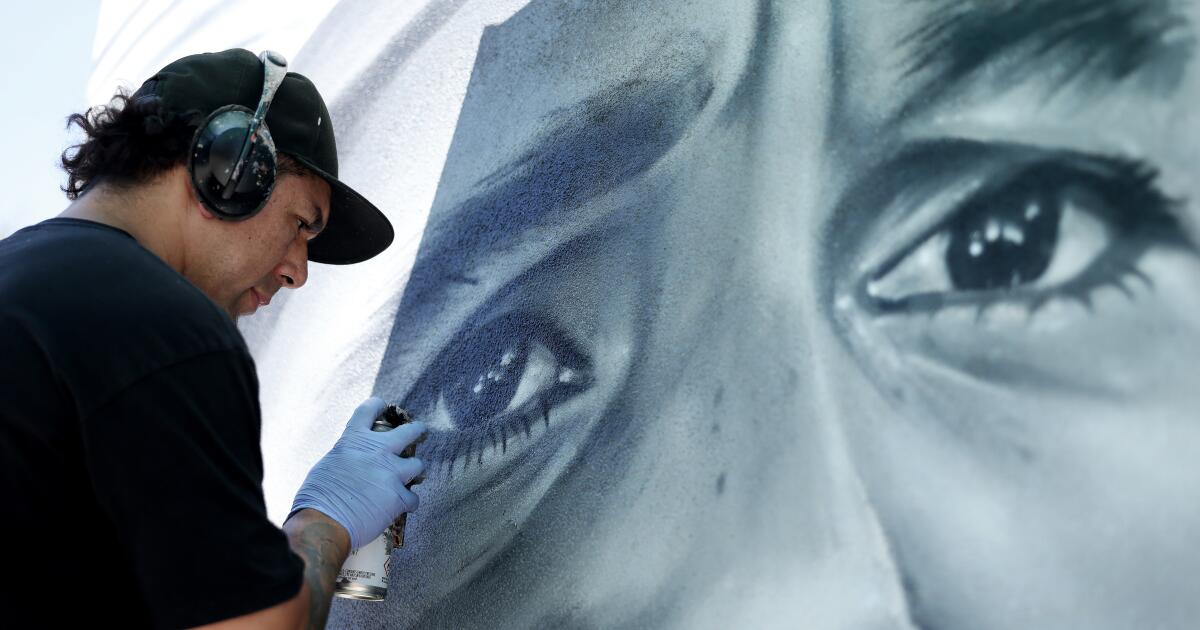
It took three decades of battles and lobbying for Cesar Chavez’s name and likeness to grace hundreds of buildings, roads, parks and schools.
It is taking just days for them to come down.
In the two days after allegations emerged that the famed farmworker rights leader and Chicano figure sexually assaulted minors and fellow labor icon Dolores Huerta, Chavez is being erased at an unprecedented rate. This is especially true in California, where his fight for agricultural workers’ rights was cemented in state history.
In San Fernando, a completely covered Chavez statue was pulled off its pedestal and put into storage. Murals depicting Chavez in Los Angeles were unceremoniously painted over. In Fresno, the City Council voted to strip his name from a major street — just three years after its controversial decision to rebrand it in his honor. Soon, the old street names — Kings Canyon Road, Ventura Street and California Avenue — will return to the nearly 10-mile-long corridor.
California officials and activists said they were shocked by the allegations brought forth in a New York Times investigation and felt it was essential to act right away. But the speed of the changes are unprecedented.
Reassessing place names as the dark side of history becomes more apparent is nothing new. Officials have moved in recent years to change names of other controversial figures — including those tied to the Confederacy and Father Junípero Serra. But those have been slower and in some ways more deliberative.
In the immediate hours and days following the allegations against Chavez, many officials said it was important that communities respond immediately, and redirect the focus from Chavez to the larger movement. Their efforts also send a message that such behavior is unacceptable, they say.
An emotional Mayor Karen Bass is joined by Los Angeles City Council members Ysabel Jurado, from left, Imelda Padilla, Monica Rodriguez, right, and Eunisses Hernandez, off camera, while she signs a proclamation to rename the last Monday of March as “Farm Workers Day’’ at City Hall in downtown Los Angeles on Thursday.
(Genaro Molina/Los Angeles Times)
On Thursday, L.A. Mayor Karen Bass and members of the City Council announced they would abandon the holiday honoring Chavez’s birthday and instead rename it “Farm Workers Day” to honor laborers who toil in the fields.
“I appreciate that my community has the integrity and the strength to reckon with these new revelations in a very expedient way, and as we do in Los Angeles,” said Los Angeles City Councilmember Monica Rodriguez, who added that the effort to rename the holiday was immediate.
Araceli Molar de Barrios labored in the fields for nearly 30 years after arriving in the U.S. in 1995, two years after Chavez’s death. Among her many years toiling in the fields, she cut and packed lettuce, picked cherries and planted watermelon seeds across the Central Valley.
The news that Chavez had sexually abused young teens and Huerta sent a shock wave through the community that she works with daily, as they struggle for improved working conditions and protections. Molar de Barrios said she has been sexually harassed firsthand by supervisors and has seen other women experience harassment.
Although she does not work in the fields today, she said she agrees that cities and elected officials should recognize the hard work of farmworkers, who labor in the heat to supply food for people across the country.
“People don’t know the sacrifice, what it’s like to eat in the hot sun, when they used to not provide shade, when there weren’t bathrooms nearby,” she said. “They’re the ones who deserve everything.”
There has been talk within some communities to removed the Chavez name and replace it with a more generic honor for farmworkers and activists, placing the movement above any individual.
In an interview with Latino USA, Huerta said that streets named for Chavez should be renamed instead after the movement.
“Everything should be named for the martyrs of the Farm Workers Movement. Every street should be named after them,” Huerta said.
But Molar de Barrios added that she would like to see Huerta honored, through the renaming of streets and parks, for her sacrifices to fight for farmworker rights and bearing her secret, “for everything that fell on her.” The allegations, she said, were a reminder that they had power in speaking out.
“We have to use our voices,” she said. “We are no one’s sexual object.”
Irene De Barraicua, director of policy and communications for Líderes Campesinas, a farmworker and women-led organization, told The Times that farmworkers “do not wish to be politicized or romanticized, but simply humanized” and afforded the dignity to work in safe and fair conditions.
There has been a steady drumbeat to honor Chavez after his death in 1993. One of the first was renaming old Brooklyn Avenue on L.A.’s Eastside for Chavez. That faced some controversy from the community who argued the city was erasing their history and burdening them with the cost to change stationery. But over time, naming things after the labor leader became shorthand for honoring Latino civil rights and activism.
As many historical figures’ controversial legacies have become mainstream so has erasing their presence from the public eye.
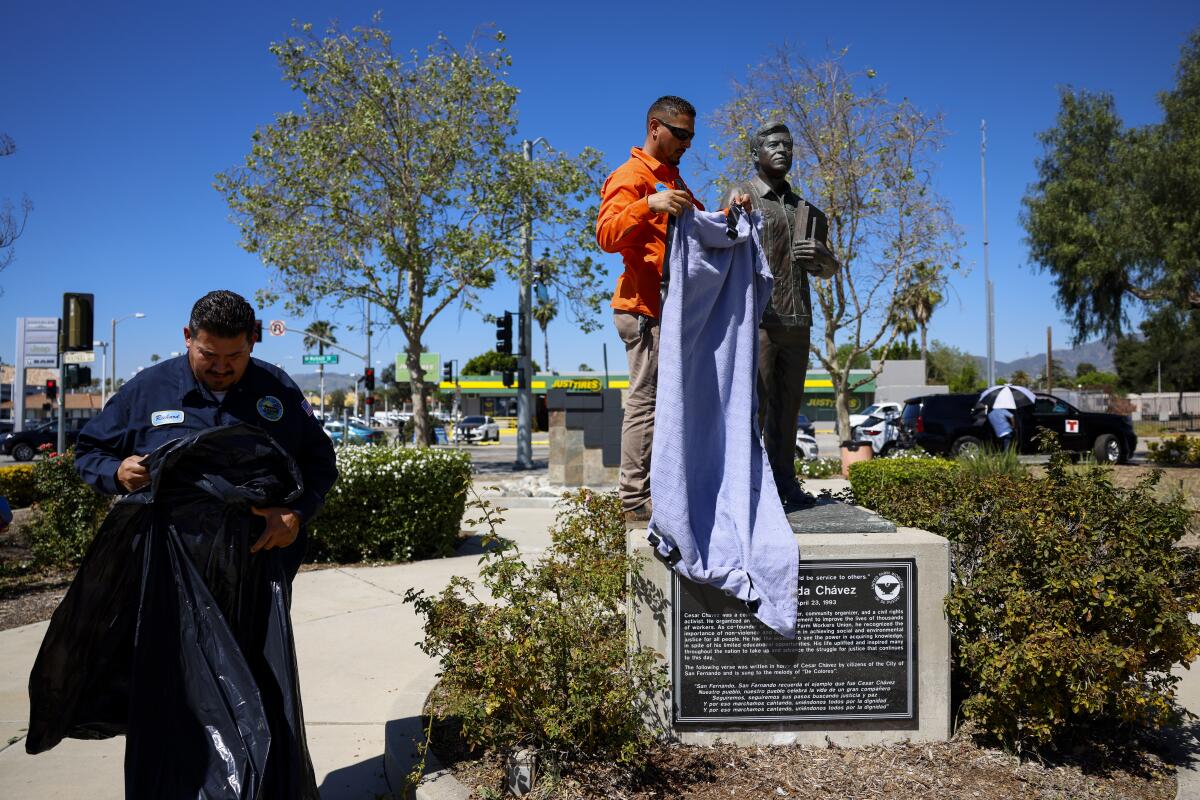
Public Works staff for the city of San Fernando cover the statue at the Cesar E. Chavez Memorial Park on Thursday in San Fernando. The statue and murals of Cesar Chavez have been covered up amid what the National Farm Workers Assn. described as “troubling allegations” against the iconic Chicano figure.
(Kayla Bartkowski/Los Angeles Times)
In 2020, the murder of George Floyd ignited a nationwide reckoning on race, which prompted communities and institutions across the nation, including California, to remove public monuments of former slaveholders or prominent Confederate figures.
It was only then that consideration was given to finally topple statues of the architect of California’s Roman Catholic missions, Father Junípero Serra, whose work during the Spanish colonization marked the beginning of exploitation and decimation for Native Californians since his arrival to the state in 1769.
It sparked debates up and down the Golden State as many people at the time still held a high regard for the Franciscan priest who was canonized in 2015. But statues including one in downtown Los Angeles, south of Olvera Street, were eventually taken down.
Removing Father Junípero Serra took months and also sparked some debate within the Latino community about Serra’s place in history.
The race to wipe Chavez from public view is the easy part, said Catherine Gudis, professor of history and director of the Public History Program at UC Riverside.
“It’s a terrible idea to move swiftly and not have the really complicated and challenging process that is required to actually work towards more than a superficial pretense of revisionist history,” Gudis said.
The real issue is who gets to declare a hero, she argued.
Historians and educators of history, including Gudis, said instead of zeroing in on one person to encapsulate a historical movement or event, there should be a greater effort to uplift lesser-known figures in the community who have contributed to a broader cause. These are people whom the community can actually resonate and connect with.
The Cesar Chavez Foundation and family said on Friday that it is aware of the city of Los Angeles’ intent to rename the holiday that once celebrated its namesake to instead honor farmworkers and supported it.
“The decision about how to commemorate the movement and its participants rests with the local communities who organize those recognitions, events and commemorations. That has always been the case,” the foundation’s statement said. “We support and respect whatever decision they ultimately make.”
First Appeared on
Source link


Leave feedback about this