

At nearly 6,200 meters below the Pacific Ocean’s surface, scientists have discovered mysterious black eggs attached to a rock, structures that turned out to contain a previously unknown species of flatworm.
The discovery was made during a robotic exploration of the abyssopelagic zone, a region defined by extreme pressure, total darkness, and limited biological data. Such depths represent the lower boundary of most ocean basins, where observations remain rare and often fragmentary.
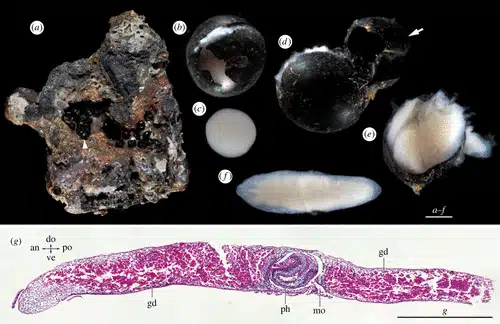
Researchers from University of Tokyo and Hokkaido University retrieved several of these objects for analysis, unsure at first whether they were eggs or another form of life. What followed was a closer look that revealed something far more unusual than expected.
A Robotic Dive Reveals Strange Black Spheres
The objects were first spotted during a remotely operated vehicle dive at approximately 6,200 meters depth in the Pacific Ocean. The study was published in Biology Letters explained that the spheres appeared jet-black and were firmly attached to a rock, standing out against the otherwise sparse deep-sea environment.
Given the scarcity of biological samples from this zone, the team chose to collect a few specimens despite not knowing their origin. Marine researcher Yasunori Kano, who piloted the vehicle, initiated the retrieval so the structures could be examined under controlled conditions.
What the “Black eggs” Really Held?
Once brought to the surface, the samples were sent to invertebrate specialists at Hokkaido University. Initial observations did not immediately clarify their nature.
“When I first saw them, as I had never seen flatworm cocoons (and I didn’t know what cocoons look like),” said researcher Keiichi Kakui first suspected they might be protists.
A closer inspection changed that assumption. When one sphere was opened, a milky liquid emerged, revealing small, fragile white organisms inside. Kakui described the moment, explaining that after dispersing the liquid,
“I found fragile white bodies in the shell and first realized that it was the cocoon of platyhelminths. At that time, I didn’t know how rare this finding was, and couldn’t identify what platyhelminth group they were. I was looking forward to studying them after coming back to my lab.”
Each cocoon contained multiple developing flatworms, confirming that these structures were reproductive capsules rather than simple eggs.
A New Depth Record For Flatworms
DNA analysis later confirmed that the organisms belong to a previously undescribed species within the phylum Platyhelminthes. As stated in the study, they now represent the deepest known record of free-living flatworms.
Earlier observations had placed flatworms at depths of around 5,200 meters, though those findings were uncertain because the specimens were attached to drifting material. This new discovery provides clear evidence of flatworms living at nearly 6,200 meters.
Researchers also noted that these deep-sea specimens appear superficially similar to shallow-water flatworms, showing no major developmental differences despite the extreme environment. This detail raises questions about how such organisms persist in conditions once thought too extreme for their kind.
First Appeared on
Source link





Leave feedback about this