

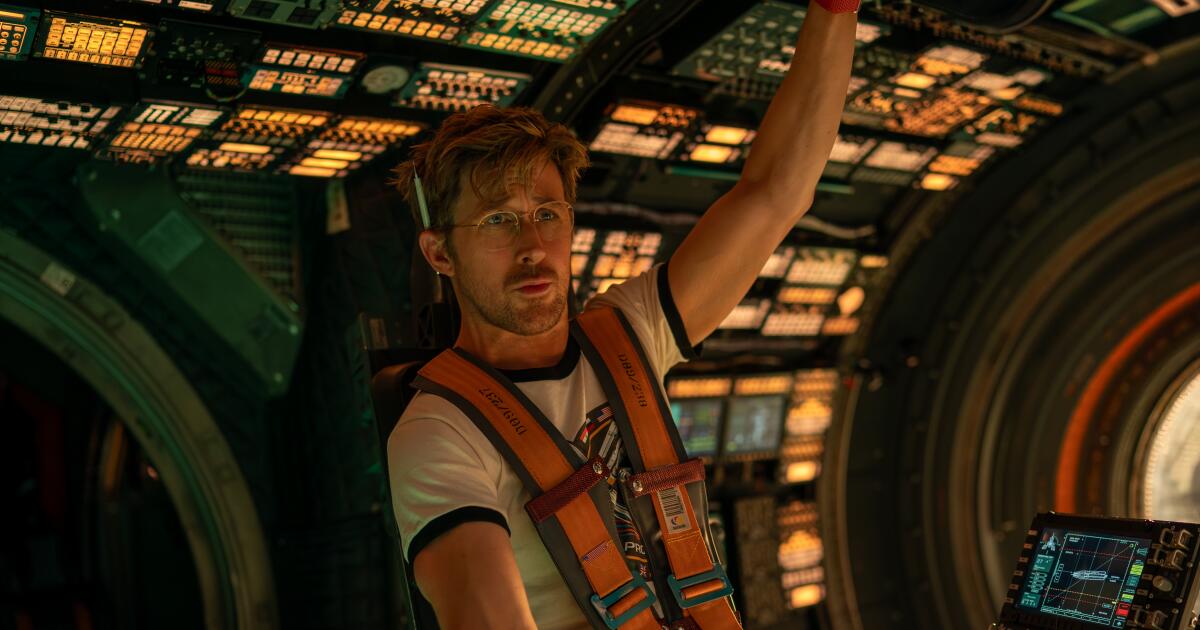
“Project Hail Mary” is wholesome science fiction that satisfies like a jumbo serving of apple pie and milk. A middle school science teacher, Ryland Grace (Ryan Gosling), wakes up from an amnesiac coma on a spaceship and discovers that he alone must save the Earth. “I can’t even moonwalk,” he protests.
Grace doesn’t know who he is and for the first few minutes, his lips barely work. Weakened and raspy from years in suspended cryosleep, when he moans “Where am I?” it comes out “Mrregghh errgh mreeh?” From there, humor-forward directors Phil Lord and Chris Miller (“Spider-Man: Into the Spider-Verse”) put Gosling through a primal physical acting exercise. Rolling off the bed in a silicon sleep cocoon, Grace gradually evolves from a wriggling larval stage into a fully upright, walking and talking smarty-pants. Midway, he passes through a phase best described as hungover Kurt Cobain.
Vaguely, Grace recalls what’s gone wrong back home. Microscopic black particles called astrophage are gobbling the energy of every star including the sun. Earth will enter a new ice age in roughly 30 years, just enough time for a grim German commander, Eva (Sandra Hüller), to send a three-person international crew to the Tau Ceti solar system, the only spot in the galaxy successfully defending itself from the plague, and beam back a report on its survival strategy. It’s a one-way mission and Yáo (Ken Leung) and Olesya (Milana Vayntrub), the only experienced astronauts aboard, accidentally died earlier than planned.
-
Share via
Intelligent, funny, curious and humble, Gosling’s Grace is essentially a clone of the character Matt Damon played in 2015’s “The Martian,” a geek you want to grab an intergalactic beer with. Both adventures are a welcome break from confident alpha heroes or cynical tough guys and they share DNA: They were adapted by Drew Goddard from bestselling novels by author Andy Weir, a tag team that proves audiences will happily get hooked on stories about how to examine amoebas and grow space potatoes if they’re presented by A-list movie-star versions of Bill Nye the Science Guy.
Like “The Martian,” “Project Hail Mary” has a thrilling lack of laser guns or artificially induced palpitations and it’s structured to make us feel smart, even if we’re only peering over Grace’s shoulder as he solves one problem after another. You don’t even have to understand the data. Just keep tabs on whether he’s in good spirits.
Cleverly, Mary (voiced by Priya Kansara), the AI onboard the ship has been written to be pretty stupid, mostly pressuring Grace to shave his beard and record video diaries. (“HAL 9000 this isn’t,” Weir wrote in his 2021 book of the same name.) Lobbing a few commands at the computer, Grace finds Mary to be no more useful than Siri and soon resorts to doing his own math with a dry-erase marker.
Grace isn’t Earth’s most brilliant genius, either. He’s merely one of 347 biologists that Eva assigned to solve the case, so he’s confounded to be in this lonely predicament. The script’s two mysteries — why is Tau Ceti safe and why is Grace not — intertwine in flashbacks that are interesting enough for a while. But the key point where these arcs intersect is pretty flimsy, hinging on convincing us that Grace, the greatest guy in the universe, has a personality defect that we don’t believe.
Charismatic and charming as ever, Gosling easily shoulders the job of being the only human onscreen for an epoch. Grace will eventually make an alien friend, a five-limbed spider-shaped sentient rock he names Rocky. Biologically and linguistically, our two species couldn’t be more different: This seemingly inorganic walking sculpture from the planet Erid communicates in a mix of whale song and stomps. Yet, once he and Grace work out their kinks and get to know each other, the Eridian reveals his own goofy personality — imagine a hybrid of boron and Borat. (Rocky is performed and voiced by the puppeteer James Ortiz.)
At its core, “Project Hail Mary” is as invested in Grace and Rocky’s chemistry as it is in the various lab experiments they concoct to rescue their respective planets. The two delight in discovering each other’s cultural differences, even if the alien is occasionally bossy and annoying, say when Rocky bleats “Dirty! Dirty!” upon entering Grace’s astral man cave. To even the score, Weir’s novel describes ammonia-breathing Rocky as smelling like cat pee, an aside the script politely omits.
The film’s relentless likability leans on a few ticks. Every character has an adorable quirk or two, or at minimum owns a dorky T-shirt with a periodic table joke or a cartoon cat. (Grace sports one of each.) Even dour Eva is a coffee addict and a heck of a karaoke singer. She and Grace exchange a few looks so fraught with meaning that you almost wonder if a romantic subplot got cut.
Gratefully, the mood stays perky-platonic. I hate it when movies shrink a global rescue quest just to the main character’s need to save their own sweetheart or child. That’s not humanism — it’s nepotism. By contrast, “Project Hail Mary” really gets you early on when Grace delivers a eulogy for his fallen colleagues, neither of whom he remembers. Yet, he’s taken the time to study these strangers’ belongings so that he can speak personally about each one and at the end of his modest speech, he sheds a few tears. That’s when it hits you that while Stanley Kubrick’s unsentimental “2001: A Space Odyssey” inspired the iPad, Lord and Miller want to inspire a better version of us.
Things run long in part because the script has too many endings. But what I admire about the directors is that they always make room for moments that honor what ordinary lives are made of — they never take life itself for granted. Forgoing big speeches about the planet at large, they win our hearts with small, relatable beats, like when a still-Earthbound Grace goes to pick up supplies at a hardware store with his military chaperone (Lionel Boyce) and they sneak in a few packs of candy on the government’s dime.
Fittingly, Daniel Pemberton’s score has that same sense of free-ranging curiosity, flitting between genres at will. In one sequence, a solemn Gregorian chant pivots to a tango as Grace and Rocky’s ships connect airlock-to-airlock in spinning orbit. It’s distractingly eclectic but vastly preferable to sci-fi scores that just aim to sound, well, vast. Meanwhile, the vistas of Tau Ceti outside the window are intimidating and gorgeous, with cinematographer Greig Fraser indulging in showers of purple glitter.
Silly but not sappy, “Project Hail Mary” doesn’t gin up much suspense over whether anything bad will happen. This crowd-pleaser simply wouldn’t dare. So much of science fiction is about humanity bringing our problems — class, capitalism, pollution — with us into outer space. Weir’s trick is that he knows that two astronauts is a crowd. A solo explorer can only fight his circumstances, not his co-pilot.
Even though Grace realizes he’s on a suicide trip, if you drill all the way down to the center of him, you won’t find any despair. Ultimately, that’s why this movie fills you with hope. An aspiring blockbuster this grand must have calculated that despite the moral and emotional exhaustion of our own timeline, people yearn to root for this kind of hero: a flexible, generous, empathetic and sensitive man rather than a strong one.
I want to believe that’s true. Otherwise, Grace is a better ambassador for our species than we deserve.
‘Project Hail Mary’
Rated: PG-13, for some thematic material and suggestive references
Running time: 2 hours, 36 minutes
Playing: Opens Friday, March 20 in wide release
First Appeared on
Source link






Leave feedback about this