

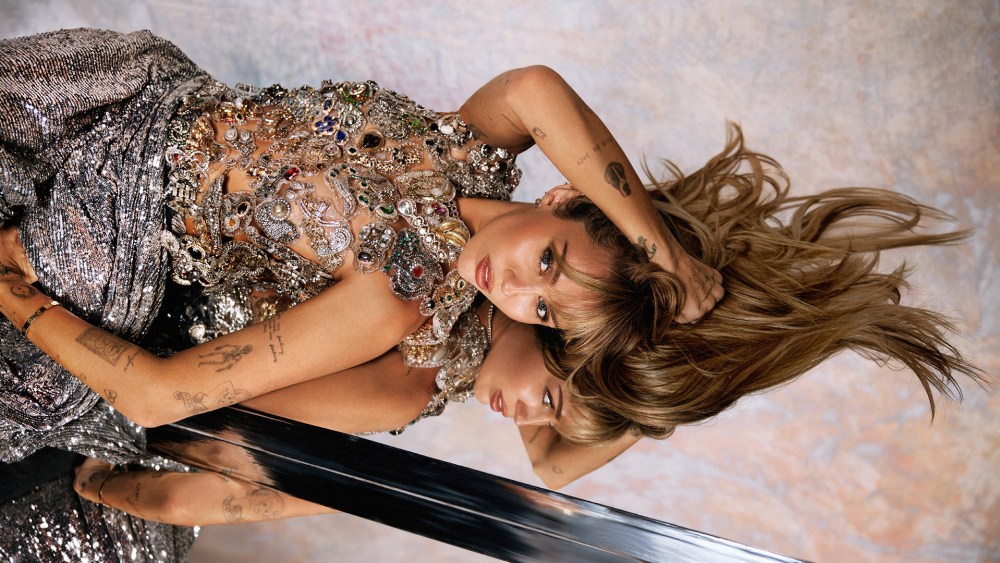
On a stupidly hot Friday in February, 215 lucky fans line up at Sunset Gower Studios in Hollywood to witness the resurrection of a pop icon.
There are women wearing headset microphones, men in orange bob wigs, glittery scarves draped over color-clashing sequined dresses, vintage tour tees, yellow zebra print tights, tiny purses clinging to furry turquoise denim jackets, belts layered on belts layered on belts and a pink fingerless glove. One woman has flown from Texas to witness this mysterious event — another has traveled from São Paulo.
Greg Swales for Variety
Soon, this horde of over-accessorized millennial cuspers is ushered into a soundstage, their phones locked in pouches. On one side: a fake beach and the bedroom closet of a teen girl’s dreams. On the other: an empty stage spangled with twinkling lights. An hour goes by, and then, through a slit in the curtains, Miley Cyrus flashes a smile and tips her oversize black sunglasses. She steps onstage in a sparkling floor-length black dress and greets the screaming fans.
“Welcome to the Hannahversary,” she says, sweeping aside her blond bangs as she launches into “This Is the Life,” the country-tinged song that introduced the world to “Hannah Montana” exactly 20 years ago. Then, lifting up her mic stand under the glow of a spotlight, Cyrus belts the power ballad “The Climb.”
“You’re about to be so gagged for what’s to come,” says Cyrus before disappearing behind the curtain for an outfit change. She may be speaking about the next number — “The Best of Both Worlds” — or the broader celebration: This concert is being filmed as part of an hourlong “Hannah Montana” anniversary special airing on Disney+ on March 24.
Aside from Cyrus’ voice — now thicker and raspier — the tunes sound exactly, gloriously, the same.
“I didn’t want to do this modern approach to Hannah,” Cyrus says a few days later at a homey, mostly empty café in Silver Lake. “I wanted to keep it preserved. But also, now Hannah wears Gucci,” she says, drawing out the word like “Gew-chee.” “She’s elevated. She’s gotta look a little less Galleria,” Cyrus adds, referencing the Glendale mall where she used to buy some of Hannah’s bedazzled tank tops and skinny jeans.
But “Hannah Montana” was about much more than the fashion; it was a multimedia phenomenon that turned Cyrus into one of the most famous child stars in history. From 2006 to 2011, the series, about a teenager named Miley Stewart who lives a double life as a pop singer, was the crown jewel of the Disney Channel empire at the peak of its stronghold over American youth. (Its legacy endures: More than half a billion hours of the show have been streamed this decade on Disney+.) The Season 1 album was the first TV soundtrack to debut at No. 1 on the Billboard 200, and Cyrus’ 2007 “Best of Both Worlds” tour sold out 71 arenas across North America. The accompanying documentary was the highest-grossing concert film ever upon its release. “There were times where Hannah Montana felt like the Beatles or something,” Cyrus says. (Indeed, an entire section of the doc is devoted to girls shrieking at the top of their lungs.)
I showed up early to this Eastside café and told the hostess I was meeting someone high profile, and could we please have a table tucked away in the back? She didn’t care — this is L.A.; everyone thinks they’re famous — and after awhile, I worried the idle staffers thought I’d been stood up by a date. But when Cyrus arrived, a hushed curiosity washed over the place: She’s a real star, a rare star that shifts the gravitational center of any room she inhabits.
Her hair is arranged into tousled, gilded bangs, and she’s wearing tinted glasses and a white T-shirt that showcases the collage of scattered tattoos crawling up her arms. Her presence is warm and calm. Double-fisting an oat-milk latte and a chamomile tea, she looks like the grown-up version of the world’s most famous fictional pop star, reemerging after a 15-year hiatus. She’s here, in part, to talk about the special, and she sums it up with these words: “It felt like home again.”

Miley Cyrus and her father, Billy Ray Cyrus, on the set of “Hannah Montana”
Disney General Entertainment
After “Hannah Montana” ended, Cyrus forged her own career, becoming the chart-topping, chameleonic singer-songwriter behind “Wrecking Ball,” “Party in the U.S.A.” and the Grammy-winning “Flowers.” At 33, she’s one of the most accomplished and, for a long time, scrutinized artists of her generation. (More on that later.) Cyrus once shed her Disney-clean image, but she has now returned to her golden-blond roots to “reclaim” Hannah Montana.
“A lot of artists feel like to become the next version of themselves, they have to leave something behind,” Cyrus says. “But I’d rather be more like a gorgeous patchwork blanket. I’d rather take every little piece of all the things that I’ve been and create a mosaic of exactly who I am now — not trashing any of that past but allowing it to come with me.” She hopes the special inspires people to “not take everything so seriously.”
Last year, Cyrus started teasing plans for the 20th anniversary of “Hannah Montana,” hinting in interviews and on red carpets that she had something “special” up her sleeve. At the time, she was lying. Or shall we say manifesting?
“I learned this terrible habit — but I actually think it was good advice — from Dolly,” she says, referring to the country legend she calls her godmother. “She told me that if you want something to happen, promote it before it exists. Then no one can say no. So I just started promoting a ‘Hannah Montana’ 20th-anniversary special that literally did not exist.”
“I think even Disney sometimes forgets the connection between me and Hannah,” she adds. “It’s not just a TV show. I see daily how important Hannah is to people. When I travel, people bring me ‘Hannah’ merch. They ask, ‘Are you ever going to do another season?’”
Greg Swales for Variety
So Cyrus planted the seeds last summer, sat back and watched the hype grow. She began sending fan reactions to Disney, saying, “I’m telling you, this would be huge.”
“She willed it into existence,” says Disney exec Charlie Andrews, who helps foster new fandoms for old Disney Channel shows. The company started planning in December, and it’s been a “mad dash” since January executing Cyrus’ vision. “The thing she was adamant about is that this is for the fans. That has gone into literally every decision she has made.”
Cyrus first recruited “Call Her Daddy” host Alex Cooper, a self-professed “Hannah Montana” superfan, to interview her in the special. “She understands Hannah in a way that I couldn’t,” Cyrus says. “I never got to experience Hannah being crazy in the pit with other kids.”
With that in mind, Cooper helped design the event around what fans actually care about, even shooting down some of Cyrus’ ideas. “She would go, ‘As a Hannah fan, no one wants that,’” Cyrus says.
Guided by that fandom, they made sure to incorporate the little things that would make viewers nostalgic: the hair flips, the Disney Channel wand commercials and, of course, the “Ooh-whoa-ooh-whoa-ooh-ooh-whoa” transition music. Cyrus’ mom, Tish, brought out dozens of outfits, fan letters and scrapbooks from the archives, and Disney re-created the sets of the Stewart house. One thing Cyrus did not want to replicate was Hannah’s wig, so she dyed her hair and styled it with bangs instead.
Cooper also arranged for a cameo from fellow Disney kid and “Hannah Montana” guest star Selena Gomez, who surprised Cyrus on set. “I love Selena, but I didn’t know how much our friendship meant to the fans,” Cyrus says.
It was Cooper’s idea, too, to open the special on an emotional moment, with Cyrus driving from Malibu to the soundstage. “I didn’t think about the correlation between Hannah’s house in Malibu and my house in Malibu,” Cyrus says, “and my house burning down and me rebuilding.”
Then came the performances. Cyrus hadn’t sung “Best of Both Worlds” since 2008, but it only took three passes of rehearsal to snap right back into it. “It was literally a bike. The dancers were doing stuff, and I’m like, ‘That’s not original!’” she says with a waggy finger, dialing up her Southern staccato. “And they’re like, ‘Well, we’re trying to make it modern.’ I’m like, ‘It ain’t broke — don’t fix it!’” Still, she will freshen things up by performing a new, original song in the special too.
Greg Swales for Variety
It was important to Cyrus to preserve the spirit of Hannah’s music. She may be belting the same Disney theme song she sang at 13, but there’s not a hint of camp or snark. “We did not want irony. This is not a joke,” she says. “I didn’t want this to be a viral moment. My point of doing this was not to break the internet.” Her point, Cyrus says, was to make the fans “feel seen.” “My entire life is because of that loyalty.”
At the taping, the studio audience is told to chant “Hannah … Hannah …” before Cyrus returns to perform “Best of Both Worlds.” But before Cyrus reappears, the chant changes to “Miley.” “That was really emotional for me,” she says later. “I think they felt like, ‘We want to make sure Miley feels like we’re equally celebrating her 20th.’ It’s not just about the show itself. It’s about the entire evolution of myself growing.”
“I love the present, and I love the future. But the past is not somewhere I love to live too much,” Cyrus says, squeezing honey from a plastic tube into her tea.
So back to that scrutiny: In 2008, while she was filming the “Hannah Montana” movie, a 15-year-old Cyrus was snapped on the cover of Vanity Fair wearing nothing but a bedsheet. The backlash to the risqué photo was so intense that Cyrus issued an apology, which landed on the front page of The New York Post with the headline “MILEY’S SHAME.”
“I remember sitting at the family computer looking at what people were saying about me,” Cyrus says. “I wasn’t sorry so much as I was embarrassed by the reaction, and it felt like it would put out a lot of fires for me to be apologetic.” In hindsight, Cyrus says, “I don’t think it was apology-worthy, because I didn’t do anything wrong.”
In the years following, Cyrus made more headlines for harmless teenage antics. At 18, she lost a multimillion-dollar Walmart deal due to a leaked video of her smoking a bong. And a year later, she was fired from a lead role in “Hotel Transylvania” because of a leaked photo of her posing with a penis-shaped birthday cake. These scandals stung at the time, but looking back, Cyrus wouldn’t have changed a thing. “Regret is so in the past and pointless,” she says.
If Disney sometimes forgets the connection between Cyrus and Hannah, it’s perhaps because, for a long time, it seemed like Cyrus wanted to forget it too. In 2013, a year after the show ended, a 20-year-old Cyrus launched what was seen as a rebellious rebrand. She swapped the Hannah wig for a bleached-blond, slicked-back pixie cut. She hung out with rappers and smoked a lot of weed. She stuck out her tongue so much it prompted think pieces in The Atlantic and The Guardian. And she incinerated the remains of her Disney Channel image in an infamous performance at the VMAs in which she twerked on Robin Thicke.
Cyrus twerks Robin Thicke during the 2013 MTV Video Music Awards
Kevin Mazur/WireImage for MTV/Getty Images
A couple months later, she hosted “Saturday Night Live” and declared, jokingly, that Hannah Montana had been “murdered.” Celebrating the show’s 10th anniversary in 2016, Cyrus wrote on Instagram, “Even though HM is chopped up into little tiny pieces and buried in my backyard, she will always hold a very special place in my heart!”
But on this anniversary, Hannah Montana is very much alive. Contrary to popular belief — and to some of her past comments — Cyrus says, “I wasn’t trying to kill Hannah off. I was just progressing.”
“Being recognizable as a teen going through different phases and stages was sometimes awkward,” she continues, “but that’s what helped me relate to the kids watching at home.”
Cyrus notes that reinventing herself was a risk, when she could have starred in more “Hannah Montana” movies and other Disney projects.
“I boldly and unapologetically presented myself to the world at that time, where I could have gone the other way and played it safe,” she says. “Maybe that would have been successful at the time, and it wouldn’t have been such a cross to bear, but I wouldn’t have had the reward. I don’t know if I would have had the sustainability that my career has now.”
Throughout all of Cyrus’ different eras, one constant in her life is the support of her mother. “When you’re a kid, your parents don’t want to buy you a jacket that’s your actual size because you’re still growing; they buy you a size up so it can last longer,” she says. “That’s what my mom did for me in my career.”
Tish even immortalized their mother-daughter journey in ink. “My mom literally has ‘The Climb’ lyrics tattooed down her back,” Cyrus says. “Like a full chorus and a bridge.” She laughs. “People always ask her, ‘What were you thinking when Miley was doing those wild things?’ She’s like, ‘I was the one telling her to do it!’”
Cyrus was born in 1992, the year her father, Billy Ray Cyrus, had the No. 1 country song in America. Her name was Destiny Hope Cyrus, but her sunny disposition earned her the family nickname “Smiley,” later shortened to Miley. The family lived in Tennessee, and Tish would drive Cyrus across state lines for auditions. By the time she was 12, Cyrus had only a few credits to her name: three episodes of the medical drama “Doc” alongside her father, a minor part in Tim Burton’s “Big Fish” and a commercial for chicken pot pie.
When Disney started to cast a new sitcom about a middle schooler secretly moonlighting as a pop star, Cyrus initially auditioned for the sidekick role, Lilly, who was ultimately played by Emily Osment. The network then asked Cyrus to tape herself as the main character — a girl named Chloe.
Cyrus as Miley Stewart in 2009, and in the “Hannah Montana 20th Anniversary Special.”
From left: Bob D’Amico/Disney Channel/Getty Images; Ser Baffo/Disney
But Disney went in a different direction, deciding Cyrus was too small and young. So she went back to cheerleading at her middle school in the Nashville suburbs, and Disney shot a pilot with a different cast.
A year later, the Cyruses’ phone rang; it was the producers. “Hannah Montana” just wasn’t working, and they wanted Cyrus to fly to Los Angeles to audition again — this time in person. Cyrus remembers going to the mall in Tennessee to pick out an outfit for the audition. She saw her fate hanging on a clothing rack: a blue-and-white T-shirt that read, “I Should Have My Own TV Show.”
She booked the part, and then it came time to select Hannah’s dad. As Tish remembers it, a Disney casting director, smitten by Billy Ray, joked, “Too bad we can’t afford her real dad,” and Tish said, “Oh, maybe you can.” She convinced her then-husband to fly to California to audition. Billy Ray had been shooting “Doc” in Toronto, splitting time between Canada and Tennessee. Tish viewed “Hannah Montana” as an opportunity to reunite their family.
“But my dad is too nice,” Cyrus says. She recounts a story that has become family lore: “He goes out into the parking lot, grabs other dads, brings them into Disney and is like, ‘You should hire this guy! He’s a great actor!’ And my mom was behind him, squeezing his back, saying, ‘Shut up! We need you to get the role so we can all move out here!’”
“My dad always says, ‘When you knock ’em out, you don’t need a judge.’ We knocked ’em out,” remembers Cyrus. “It was so obvious, after all the other dads, that you can’t fake the kind of connection that we have. The inside jokes, the nicknames, the handshakes, singing the songs together. It was a TKO.”
The rest is history: Billy Ray starred in 99 episodes of the series as a retired country singer who manages and writes songs for his pop-star daughter.
The past few years have seen a reckoning in children’s television, boosted by a 2024 docuseries focused on the alleged abuse during producer Dan Schneider’s tenure at Nickelodeon. Cyrus believes having Billy Ray on set helped shield her from the dark side of child stardom.
“My parents didn’t need me to be famous to survive or to be stable,” she says. “What happens to a lot of these kids is their parents want it more than they do, or the kids become responsible for the entire income of the family. That was never my job. Every penny I ever made went into my bank account because my parents were good.”
Throughout “Hannah Montana’s” five-year run, Cyrus’ dressing room was connected to her dad’s, and between them was a kitchen-turned-office where her grandmother Loretta “Mammie” Finley managed her fan club. “My dad was on set every single day, so there was nothing that could happen that he wouldn’t know about,” Cyrus says. “There was never a time where I was going to be alone in that dressing room.”
As her parents’ marriage hit the skids toward the end of “Hannah Montana,” Cyrus’ relationship with her dad began to fracture. Their estrangement played out publicly through Billy Ray and Tish’s drawn-out divorce, which was finalized in 2022. The two didn’t speak for years. Then, in 2025, Cyrus wrote a song for him called “Secrets,” a peace offering featuring Lindsey Buckingham and Mick Fleetwood, because Fleetwood Mac is her dad’s favorite band. In the song, Cyrus sings, “Call off all your forces / A white flag in the war.”
Billy Ray cried when he heard it, writing on Instagram: “One great song can do more for the soul than a million therapy sessions.”
The two reunite on the “Hannah Montana” special, hip bumping in a replica of the Stewart family living room.
During the pandemic, when she was in her mid-twenties, Cyrus made a decision that changed her life. She got sober.
“It’s no surprise that I had my experiences with drugs and alcohol,” she says, reflecting on the vertigo of childhood fame. “I was so used to living at a high, and I don’t think I ever learned how to come down from that. Now, through a sober lens, I can have compassion and understanding for myself.”
In addition to traditional therapy, she also tried EMDR, a type of psychotherapy based on guided eye movement. She credits the technique with helping her confront the source of her anxiety — and curing her stage fright. “You didn’t see any nerves, right?” she asks about the “Hannah Montana” concert taping. “In the past, that would have taken over my entire body. I would have been frozen.”
This doesn’t mean Cyrus plans to tour again. She swore off arenas after 2014’s “Bangerz” tour and has since mostly performed at select festivals and live TV events, as well as her intimate private concerts at L.A.’s Chateau Marmont. “I actually miss and love live shows,” Cyrus says. “But me being on the road for six months out of the year and leaving my family and my normalcy and my routine is just not best for me.”
Greg Swales for Variety
Cyrus is currently the betting favorite to headline next year’s Super Bowl. Would she accept an offer to perform?
“I always think the Super Bowl feels like too much pressure,” she says. “I would have to do the mental work of making it not about the Super Bowl, because then you can’t help but go, ‘It’s millions of people, and it’s the most-watched thing in the world.’”
“But if I could find a way to make it exactly what the Hannahversary was — taking a journey through the discography and appreciating each song, each era for what it is — I think I could find it in myself.”
Cyrus is similarly open-ended about acting. Her last real screen role was in a 2019 “Black Mirror” episode in which she plays, naturally, a pop icon. She says she’s “very interested” in returning to acting: “I just haven’t found the right role for me.” She has even started to write down a couple of her own ideas. “I’d want a character that felt like an extension of me. Or something completely different from who I am.”
If the future seems unscripted, it’s because Cyrus prefers it that way. “I love changing,” she says. “Anything I say could be out the window tomorrow.”
At the same time, she has finally reached a point where everything feels aligned. “My life is so beautiful. It never feels like I’m swimming upstream anymore,” she says. Last year, she got engaged to her longtime boyfriend, the musician Maxx Morando. “I like the way people see me. And when I first left ‘Hannah’ and put out ‘Bangerz,’ I did not feel that way.”
Back then, it seemed like Cyrus was burdened by the weight of the Magic Kingdom. In the years since, she thinks the public’s expectations of child stars have changed. And while Cyrus stays off social platforms, she believes the media is less cruel now than it was during the tabloid boom. “We’re much more tolerant and celebratory of people’s individuality than we were 10 years ago,” she says. “I would like to think that I’ve championed some of that.”
As she’s grown up, Cyrus has been lucky to rely on music legends like Parton, Joan Jett and Stevie Nicks as mentors. And she hopes to one day take on a similar role for younger artists following in her footsteps. When Chappell Roan opened up about her challenges with fan harassment, Cyrus was among the first celebrities to reach out to her.
“I never bow down to bullies. Anytime I feel like somebody is being bullied, I feel very protective of them,” Cyrus says. “When I see people struggling, I’m always the first one to ask, ‘Can I get in contact with them?’ I’d like to show artists how they can have a balanced life.”
Back on the soundstage, as the band resets between songs, Cyrus gazes at the fans with the headsets and the wigs, struck, perhaps, by the fact that they’re not little kids anymore.
“I used to think of Hannah as something separate from myself,” Cyrus says into the gold-studded microphone. She viewed Hannah as a fantasy — a wig she put on to play pretend. But recently she had an epiphany. “This special,” Cyrus says, “is my reclaiming of merging Hannah and Miley together.”
She continues this thought at the café, explaining how living a double life on TV taught her to compartmentalize the different aspects of her identity: If Miley Stewart represented the sacredness of normalcy and Hannah Montana symbolized magic and possibility, then for many years, Miley Cyrus — the real girl — stood for freedom and authenticity. But she was also a shield.
“I think I created a Miley Cyrus persona to protect myself,” she says, “so I could have the Miley behind closed doors. But as I’ve gotten older, I’ve been able to integrate what I love about all of them into one being.”
At the end of “Hannah Montana,” after revealing her true identity, Miley Stewart turns down a major movie role and instead decides to attend college with Lilly. She chooses normalcy over the life of a superstar. But for Cyrus, it’s not that binary.
“I get so much of every single thing I want,” she says. “My relationship is private, my business is successful and I get to have the small things people take for granted, like waking up in my own bed and feeding my dogs.”
Cyrus leans forward, her eyes widening behind those tinted lenses. “But then I also get to be Hannah again and have people sobbing because they just saw ‘This Is the Life’ live. I love that I’ve curated my life that way.”
It’s not the best of both worlds, but something whole. It took 20 years to develop, but this is Cyrus’ new theme song: “I can actually have it all.”
Production: Alexey Galetskiy; Location: AGP West; Production design: Milena Gorum; Styling: Bradley Kenneth/A Frame Agency; Makeup: Janice Daoud/The Wall Group; Hair: Bobby Eliot/The Wall Group; Manicure: Miho Okawara; Look 1 (Cover and opening spread): Full look: Maison Margiela; Look 2 (Blue top): Full look: Paco Rabanne Archive; Look 3 (Hat): Full look: Valentino; Look 4 (Gold): Full look: Roberto Cavalli
First Appeared on
Source link

Leave feedback about this