

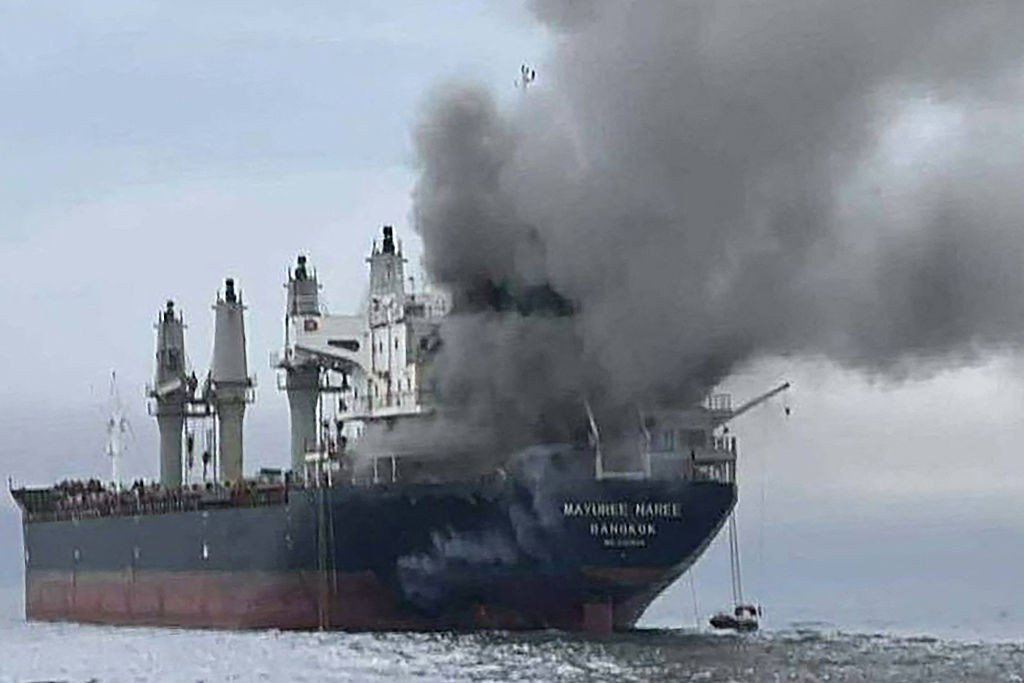
Most people of a certain vintage think back to 1973 when seeking a historical parallel to the global energy crisis radiating from the Third Gulf War — the war of choice launched by President Trump against Iran in conjunction with Israel. While the comparison with the 1973 oil shock is usually made too quickly and without sufficient precision, it is directionally correct: America and the world will soon be in the grips of an energy crisis as dramatic and as world-historically transformative as the one that defined the Seventies.
Indeed, there’s plenty of evidence that the second oil crisis is already here.
On October 17, 1973, the Arab members of OPEC announced a 5% monthly production cut after Washington airlifted weapons to Israel during the Yom Kippur War. Next came a full embargo against the United States and the Netherlands (the latter boasted one of Europe’s most pro-Israel governments at the time and was used as a staging ground for US support to the Jewish state).
The price of crude surged to $11 a barrel, up from $3, in a matter of weeks. American gasoline prices jumped 40% by November. Lines formed at filling stations. The Western world was in crisis. The US economy tipped into stagflation and remained there for the rest of the decade. By the end of the Seventies, then-President Jimmy Carter gave a speech diagnosing a national “malaise” and a “crisis of confidence”. He also urged his countrymen to wear sweaters in lieu of burning fuel to warm themselves.
The embargo lasted five months. The damage lasted a decade. Japan, which imported almost all its oil, restructured its entire industrial base around electronics and fuel efficiency. That pivot made Japan’s economy more innovative, the envy of the world for the next 20 years. The crisis also created the International Energy Agency and the first serious strategic-petroleum-reserve frameworks that still exist today: after what the global economy went through that decade, countries wanted to deal with the issue collectively, coordinating in preparation of the next embargo.
But there is a crucial difference between then and now. In 1973, the disruption resulted from a political decision by producers to turn off the tap. Supply could theoretically have been restored the minute politics changed.
What we confront now, as a consequence of Trump’s Iran war, is more complicated: chokepoint closure, damaged infrastructure, insurance markets in disarray, fields shutting in (temporarily closed). And the scale is simply not comparable. Around 20 million barrels a day move through the Strait of Hormuz, roughly 20% of global consumption and nearly a third of all seaborne oil trade. The 1973 embargo, damaging as it was, didn’t come close to these conditions. This is a supply disruption brought about by Iran in response to Tehran being attacked by two nuclear powers, and its ramifications won’t soon be contained, much less reversed.
The Strait of Hormuz is 21 nautical miles wide at its narrowest. That makes room for two shipping lanes, each two miles across. Around 100 vessels a day transited the Strait in normal times, 60% to 70% of them tankers or liquid-natural-gas carriers. Saudi Arabia moves 38% of the crude, Iraq another 22%, and the United Arab Emirates 13%. The top five exporters between them account for 93% of all the crude that goes through that passage.
Saudi Arabia and the UAE have constructed pipelines for just this type of contingency. Together, they can route about 2.6 million barrels a day around the Strait, approximately a third of Gulf export volumes. Iraq and Kuwait have no such option, however. And Qatar, which supplies roughly a fifth of the world’s LNG, has no alternative route to market, either. This is a structural problem that sheer capacity alone can’t overcome.
Since 28 February, commercial shipping through the Strait has nearly ground to a halt. Tanker traffic dropped 70% in the first days and then fell to near-zero as jacked-up insurance premiums rendered the economics impossible. Most of the vessels still moving are from the Iranian dark fleet. Washington has been reluctant to target them, wary of what Tehran would do to Gulf energy infrastructure in retaliation. Protection-and-indemnity war-risk coverage was suspended as of 5 March. The Trump administration floated the idea of sovereign-level tanker insurance, but Treasury Secretary Scott Bessent quickly walked back the brainstorm. That would have put US taxpayers on the hook for damaged cargo, while the US Navy has made it clear that it lacks the ability to offer protective escorts in the near future.
In short, without insurance, ships don’t move.
Iraq’s three main southern oilfields have seen production collapse by 70%, falling to roughly 1.3 million barrels per day, down from 4.3 million. Onshore storage is filling because there is nowhere to send the crude. Fields that shut in don’t simply restart if and when a ceasefire is announced. Reservoir pressure, infrastructure condition, damaged terminals — all factor in, to the world economy’s detriment.
“The timeline for restoration is weeks at best and months in the most realistic cases.”
The timeline for restoration is weeks at best and months in the most realistic cases. Even today, the market is pricing a clean restart. Yet that assumption has very little basis in how the Middle East actually operates.
Brent, a key oil benchmark, is now trading north of $106 a barrel. That is the number that gets attention, but it is everything that this number triggers that needs to be examined.
Liquified petroleum gas and naphtha (liquid hydrocarbon used in the petrochemicals industry) move through the Persian Gulf in enormous volumes, and almost nobody outside the energy sector thinks about them. Naphtha is what petrochemical plants, heavily concentrated in Northeast Asia, run on. Those plants make plastics, fertilisers, packaging, and the agricultural chemicals that go into growing the food we consume. When naphtha supply is disrupted, the effects don’t show up at the pump. They show up six to 12 weeks later in the price of a bag of flour, a bottle of cooking oil, a box of cereal.
We watched this in slow motion after Russia invaded Ukraine in 2022. Russian and Ukrainian wheat, corn, sunflower oil, and fertiliser were never formally sanctioned. But the disruption to trade finance, shipping insurance, and port logistics was enough to send food prices into a commodity super-cycle that hit Egypt, Lebanon, Pakistan, and Bangladesh harder than anywhere else. Governments already stretched by their Covid fiscal response had nothing left to absorb the extra shock. The Third Gulf War threatens a repeat — on a much wider scale.
Then there’s LNG. Qatar has declared force majeure on LNG exports, freeing itself from delivery obligations, after drone strikes hit its export infrastructure. Qatar accounts for roughly a fifth of global LNG supply. The IEA estimates a full Hormuz closure would pull more than 300 million cubic meters per day out of the global gas market, about twice what Nord Stream carried at its peak. There is no spare liquefaction capacity sitting idle somewhere that can cover that. Australia, the United States, and West Africa are all running near full capacity. Asia and Europe will end up competing for the same cargoes, bidding up prices that eventually land on ordinary consumers.
A ceasefire in the next 30 to 60 days, followed by a slow normalisation of shipping, probably keeps Brent somewhere between $110 and $130 and takes at least half a point off global GDP. That is the optimistic scenario, and it requires things to go well politically in a region where things have a habit of going, well, boom.
Beyond 90 days, the picture darkens considerably. Shut-in fields, damaged port infrastructure, an insurance market that can’t simply switch back on, storage constraints that have permanently altered production profiles in some fields. Iran’s own military spokesperson has already warned publicly to get ready for oil at $200 a barrel. Analysts at Rystad Energy have Brent at $135 by June if the war runs for four months. Markets are not pricing that yet. They were not pricing a pandemic in February 2020, either.
The IEA, founded in the wake of the 1973 crisis, has now coordinated the largest emergency stockpile release in its 50-year history: 400 million barrels across more than 30 countries, with the United States contributing 172 million barrels from its Strategic Petroleum Reserve. It is an extraordinary intervention. It is also, as analysts at Bernstein noted, only about 15% of the daily supply lost due to the Hormuz closure. The barrels also take 60-90 days to meaningfully reach the market. It buys time but doesn’t fundamentally deal with the problems outlined above.
The United States isn’t insulated from these price shocks. The Trump administration has been fighting to tame inflation, and that fight gets considerably harder if oil stays above $100 a barrel for any length of time. Trumpian spokesmen gloat about domestic production, serenely unaware that oil and gas are fungible global commodities: a chokepoint several thousand miles away will drive up prices everywhere else — that is, unless Washington is prepared to contemplate an export ban.
The picture is still bleaker elsewhere. As consumers, China, India, Japan, and South Korea together account for around 75% of the crude that transits the Persian Gulf. China alone sources more than half of its 11-million-barrels-a-day import requirement from the Middle East. For those countries, this is literally the lifeblood of their economic development.
And as it was in 1973, the people who absorb the worst of it will not be the ones with the hedges and the trading desks. They will be in Cairo buying cooking oil, or in Karachi watching the price of flour move out of reach. They will be working-class Trump voters on low incomes who need to fill up their tanks to get to work. Half a century on from the first oil crisis, a narrow passage can still bring the global economy to its knees.
First Appeared on
Source link





Leave feedback about this