

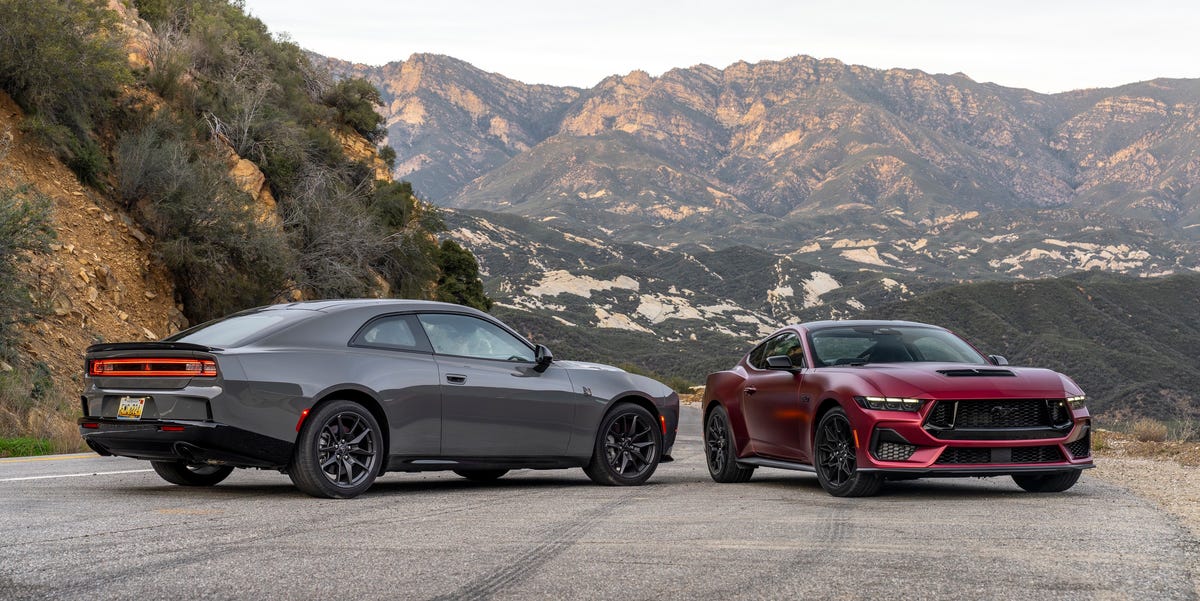
The muscle car has felt like an endangered species for some time, but 2026 brings the welcome chance to compare a new offering to the segment’s longest-running player. Dodge launched the new Charger in Daytona EV form, but the brand has since added a much more traditional take powered by a twin-turbocharged inline-six, also offering the segment innovation of all-wheel drive. The obvious point of reference is the evergreen Ford Mustang, which continues to offer the combination of a naturally aspirated V-8, rear-wheel drive, and an available manual gearbox. Which is the more compelling choice in what has become an either-or part of the market?
The Contenders
2026 Dodge Charger Scat Pack Plus 2-Door
- Base price: $56,990
- Price as tested: $70,950
Many will regret the lack of a Hemi V-8 under the Charger’s long hood, but thanks to turbocharging, the new Hurricane inline-six makes more power than the old 6.4-liter V-8–powered Scat Pack did, producing peaks of 550 hp and 531 lb-ft from just 3.0 liters. An eight-speed automatic gearbox is standard, as is an adaptive all-wheel-drive system, which can vary the torque split between axles. For those seeking more old-fashioned muscle-car thrills, there is also a selectable rear-wheel-drive mode. Our test car rode on the 20-by-11-inch wheel option, bringing larger 305/35ZR20 all-season Goodyear Eagle tires; there is currently no factory summer-tire option.
2026 Ford Mustang GT Premium Fastback
- Base price: $53,075
- Price as tested: $73,700
While heavily revised in 2024 to become the seventh-generation “S650,” much of the current Mustang is common to the version that launched in 2015. That’s a long time in any fashion-conscious part of the market, but the gentle pace of the GT’s evolution is proof of just how good the basics are, with a Coyote 5.0-liter V-8 making 486 hp and 418 lb-ft. A 10-speed automatic transmission is optionally available, but a six-speed manual incorporating a rev-matching function on downshifts is standard, and that was the one we chose for the comparison. Our test car was also equipped with the Performance package, which brings Brembo performance brakes, Pirelli P Zero summer tires, and a Torsen limited-slip rear differential with a 3.73 axle ratio.
Where We Tested
There are many outstanding roads in California, but none could pose a tougher test for these two than the CA-33 that runs north from Ojai into the Los Padres National Forest. The so-called Maricopa Highway climbs to a 5160-ft summit next to Pine Mountain in 30-odd miles and is packed with corners of almost every shape and severity. It’s a perfect place to analyze chassis balance and transient responses, all while looking at spectacular views and vistas. Farther north lies the high desert of the Cuyama Valley, where the road gets straighter and faster. Alternatively, turning around and heading back down the grade toward Ojai gives a stern test for any brake system’s resilience.
On the Road
The sight of our challengers parked together in the California sunshine created a sense of time shifting, the basic forms made familiar by the long lineage of each. Decades and generations have passed, but the cultural DNA from the original 1968 Bullitt movie stretches unbroken.
The big, obvious difference is size, with the Charger being much larger. In essence, the Dodge is a coupe-sized two-door version of a four-door sedan, and for 2026, it is available in both body styles. Next to it, the Mustang looks short and almost svelte. The Charger’s 206.6-inch length sits atop a 121.0-inch wheelbase, while the Ford is 189.4 inches long and has 107.0 inches between its axles. That’s reflected in weight, with the 4800-pound Scat Pack being about 850 pounds heavier than the GT.
Despite this, ultimate performance is close, although the characters of each car’s powertrain are very different. We didn’t run figures on the cars we tested, but when Car and Driver recently put an automatic Mustang GT against the Scat Pack, they recorded identical 3.7-second runs to 60 mph in each.
Despite forced induction, the Charger’s six-cylinder feels like a more traditional muscle-car engine, thanks to both its abundance of low-down torque and the sharp throttle mapping, which makes it eager to launch hard. The Dodge has a brooding, bass-heavy exhaust note at lower engine speeds. This isn’t obnoxiously loud, and nothing like the strange Fratzonic resonator system of the Charger Daytona EV, but the Scat Pack is definitely one of those cars pedestrians are going to feel as well as hear when it rumbles past. At higher revs the Scat Pack gains a different character, especially with the exhaust in its louder Sport mode, with a raspy BMW-like note overlaid with turbo whoosh. It’s a fine noise but one that gets diluted in the cabin with too much digital enhancement through the speakers, the volume of this dependent on drive mode.
The Scat Pack isn’t a big revver. Peak power arrives at a quoted 6200 rpm, but the engine is already starting to tighten before it reaches that point. At lower crank speeds there is also noticeable part-throttle delay as the sizable turbochargers build boost; Dodge quotes an impressively boosty 30-psi peak, which takes a couple of beats to build. The result is an engine that’s happiest exploiting its midrange muscle, this despite the need to contend with the lowness of its gearing. Unusually, the Scat Pack needs to change to third before it reaches 60 mph, and at the same speed in fourth gear, the engine is already turning at 4000 rpm. The automatic transmission isn’t the smartest when left in drive, often upshifting midcorner, and manual control through the steering-wheel paddles suffered from an irritating response delay.
Yet the Scat Pack has serious muscle. Swapping between Mustang and Charger proved that, regardless of driver, the Dodge had a definite advantage when accelerators were floored on straight sections of road, building a gap with its initial surge of urge that the Ford couldn’t claw back. At least, not until the next corner arrived.
The GT has less low-down urge, but the engine gets better the harder you work it. The Coyote V-8 has always been a machine for converting fuel to fury, and it does this exceptionally well. Sometimes 10-mpg well, while even the hardest use didn’t get the Scat Pack under 13 mpg. The Ford’s throttle response is good across the board, but it doesn’t start to pull really hard until at least 3000 rpm is showing on the digital rev counter. From that point onward, it pulled with increasing enthusiasm all the way to the 7250 rpm at which peak power arrives, the limiter calling time soon afterward. The GT’s exhaust note is less muscular than the Charger’s at lower engine speeds, but thanks in part to the active exhaust on our test car, it harmonizes compellingly and addictively as the redline approaches. This is a car that encourages the hardest possible use and seems to relish the challenge while doing so.
Of course, the Charger also has a rear-wheel-drive mode. While it would be technically possible to select this while moving, it can only be chosen with the car stationary and in Sport mode. That restriction is sensible, as engaging rear-wheel drive unlocks a new dimension to the driving experience. The good news was a marked improvement in the willingness of the front axle to stick to an intended line. The bad news was a corresponding reduction in the discipline at the back end, where the tires were easily overwhelmed by the engine’s full output. On the tighter curves the battle for traction was too ragged to feel truly enjoyable, the Dodge never finding the Ford’s light-footedness. But find a wide, empty space, and the Scat Pack is as happy to hoon as the most wayward of its ancestors.
The Mustang felt much more athletic. The GT’s steering was direct and rich in feedback compared with the Scat Pack’s numb rack. On CA-33, much of the difference in grip and agility between the cars was down to the Ford’s summer tires. But the Mustang’s lesser weight was always apparent, as was the firmer-than-standard suspension tune of the Performance pack, which also brings the Pirelli P Zero tires. It changed direction with much greater enthusiasm, while handling bumps and imperfections in the road surface without drama. Ford also offers Magneride adaptive dampers on the GT (a $1750 option), but on CA-33, the passive setup felt pretty much ideal. It’s a car that really does love to be driven hard on a demanding road.
Neither contender ran short of brakes while being driven as hard as the road would permit, but the Ford’s firmer-feeling pedal definitely gave more reassurance and feel than the Dodge’s softer one. The Ford’s optional Recaro buckets also gave much better lateral location than the Charger’s flatter seats. But strangely, choosing this upgrade in the GT means having to do without seat heating, while the Charger kept both heating and ventilation.
In the Cabin
In terms of practicality, it isn’t even close. The Charger’s big advantage is its sheer size, with pretty much all of the extra length over the Mustang going to improved space in the cabin. If you want a two-door American coupe with genuine room for four—or five at a squeeze—this is it. The Dodge’s rear liftback also gives access to a much more spacious 23-cubic-foot trunk, and luggage space can be increased to 37.4 cubic feet with the rear seats folded. Beyond the inconvenience of climbing past the folded front seats, the Scat Pack has enough space for six-footers to sit behind each other. And for easier access, there’s also the four-door version.
Nobody is likely to be considering a Mustang coupe expecting a spacious cabin, and although driver and front passenger sit a little closer, there is still plenty of room up front, and the lowest seating position is closer to the ground than in the Charger. The Ford’s rear is tight for anyone other than small kids; you can squash full-size adults back there if needed, but they won’t enjoy it. Access to the Mustang’s 13-cubic-foot trunk is also restricted by a narrower aperture and a lid hinged beneath the rear glass. The Mustang’s smaller size also made it feel more wieldy on tighter roads, and it’s easier to park than the extra-large Charger.
Neither contender had cabin quality to reflect the price points their options pushed them to. The Dodge’s material mix definitely felt plusher, with microfiber on the lower dashboard and part-suede seats that were lovely to touch. Fingers didn’t have to explore far in the Mustang to feel some hard, cheap-feeling plastics, and the row of buttons beneath the center air vents deflected noticeably when used. The Ford also requires temperature adjustment to be made through the central touchscreen, while the Dodge still has a row of physical controls.
Both cars have digital instrument packs, and the Mustang’s were much clearer—the Charger’s rendered rev counter was hard to read in any of its various configurations. The Ford also lets you select different instrument layouts from various eras of Mustangs; the one from the 1993 SVT Cobra, recalibrated for the modern car’s higher rev limit and top speed, was my favorite.
Bang per Buck
The Ford’s basic $53,075 had been augmented with the GT Performance pack ($5660), Recaro seats ($1995), Active Valve Exhaust ($1595), B&O audio system ($1160), and Nite Pony pack ($1960), which brought black wheels and a black roof. It also had Molten Magenta paint ($995) wearing the matte clear film ($5995) over this. The last of these options looked good in the pictures, but the poor quality of the edges up close means it’s one box I would have left unticked.
The Scat Pack’s $56,990 is a higher base, but it carried less in options: Customer Preferred pack (360-degree camera system, 16-inch digital instrument cluster, head-up display, LED headlights, power operation for hatch and steering adjustment; $4995), Carbon and Suede pack ($2095), Alpine audio upgrade ($1795), glass roof ($1395), Blacktop pack ($1295), Wheel and Tire pack ($1195), Destroyer Gray paint ($695), and Demonic Red seats ($495). Go easier with the optioning and you could have a fine example of either car for much closer to $60,000.
And the Winner Is…
There’s lots to like about the new Charger Scat Pack, but on the most important Road & Track criteria of driving pleasure, it has to finish this two-horse race in second place.
Design is always subjective, but the Charger’s size and muscular lines give it a presence the Ford struggled to match, in part because of just how familiar this Mustang has become. I’m not sure the Dodge necessarily looks better, but it certainly looks more—and isn’t that the point of muscle cars?
The Charger is more practical, and the fact that all-wheel drive is standard on both the R/T and the Scat Pack gives a definite advantage over the Mustang in parts of the world that feature regular snow. The loss of the option of a Hemi V-8 definitely removes character compared with its rowdy predecessor, but raw performance can’t be faulted. It just needs more dynamic polish. Also, the option of a good summer performance tire.
Despite that, the winner was clear, and this test has been a welcome reminder of just how good the Mustang GT still is. Reviewers’ heads might have been turned by the Dark Horse and the millionaire-grade GTD, but you don’t need to climb too high up the Mustang tree to be listening to a V-8 and having a good time pretty much all of the time. The GT’s charismatic engine, manual transmission, and playful chassis—especially when ordered with the Performance pack—really do mean it can claim to be both a sports car and a muscle car at the same time.
First Appeared on
Source link





Leave feedback about this