

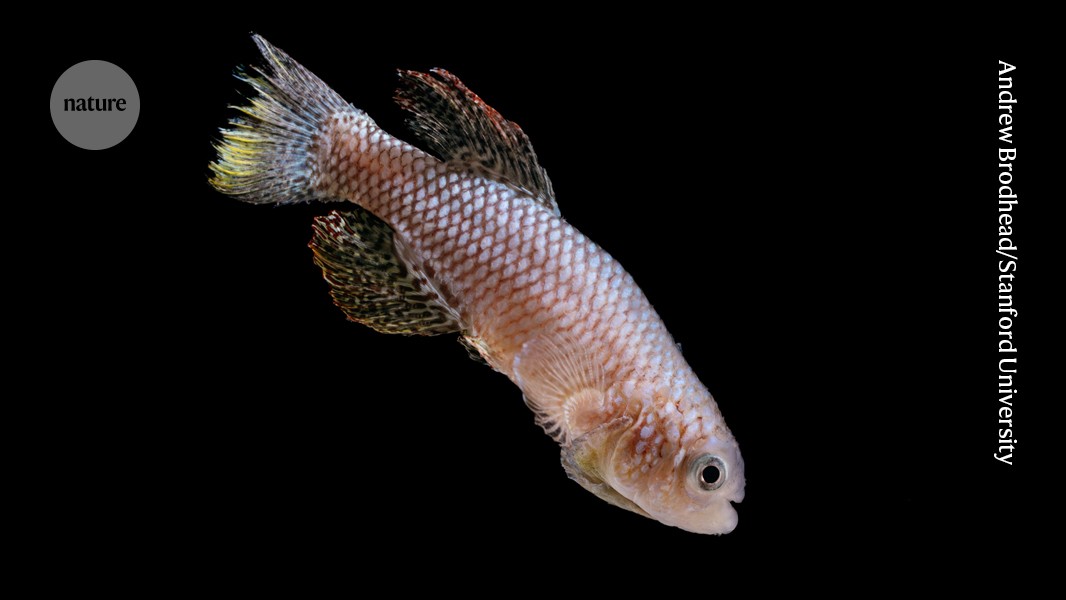
You snooze, you lose: young killifish (Nothobranchius furzeri) that take daytime naps have relatively short lives. Credit: Andrew Brodhead/Stanford Univ.
Sleep patterns and activity levels can predict whether lifespan is long or short, according to a study1 that tracked fish from adolescence to death.
The study found that young fish that spent more of their waking hours being active tended to live longer than did more-sluggish fish. Young fish that restricted their sleep schedule to evening hours also reached a riper age than did those that slept more during the day.
The findings suggest that even early-adulthood behaviour can predict future lifespan, says Agustín Ibáñez, a neuroscientist at Adolfo Ibáñez University in Santiago, Chile, who was not involved in the study. The study also hints that it might be possible to estimate how ageing will unfold long before signs of disease emerge, he adds. “This opens several exciting possibilities.”
The findings were published today in Science.
Behaviour as a window
In humans and other animals, ageing is a complex process that is shaped by both genetics and environmental factors. Behaviour can be a handy way to understand ageing because it offers a window into an animal’s internal state, says study co-author Karl Deisseroth, a neuroscientist at Stanford University in California. “It’s a very powerful way to gain insight into the brain,” he says. But the relationship between behaviour, ageing and lifespan remains poorly understood, because tracking every single movement over an animal’s lifespan is a huge challenge.

Coffee linked to slower brain ageing in study of 130,000 people
To fill this gap, Deisseroth and his colleagues turned to the African turquoise killifish (Nothobranchius furzeri), a guppy-sized fish that has a median lifespan of four to eight months. The researchers tracked 81 killifish from their adolescence to death using cameras to capture the animals’ every move for 24 hours a day. They also built a machine-learning model to identify patterns in various behavioural characteristics, such as the fishes’ movements, speed and rest.
At the age of 100 days — the killifish equivalent of pre-midlife — animals that would eventually have relatively long lives were, on average, more active, more vigorous and faster-moving than were those that would go on to have shorter lifespans. Long-lived fish — those that survived beyond 200 days — also tended to get more of their sleep during the night, whereas fish that did not reach a ripe old age often napped during the day.
First Appeared on
Source link






Leave feedback about this