

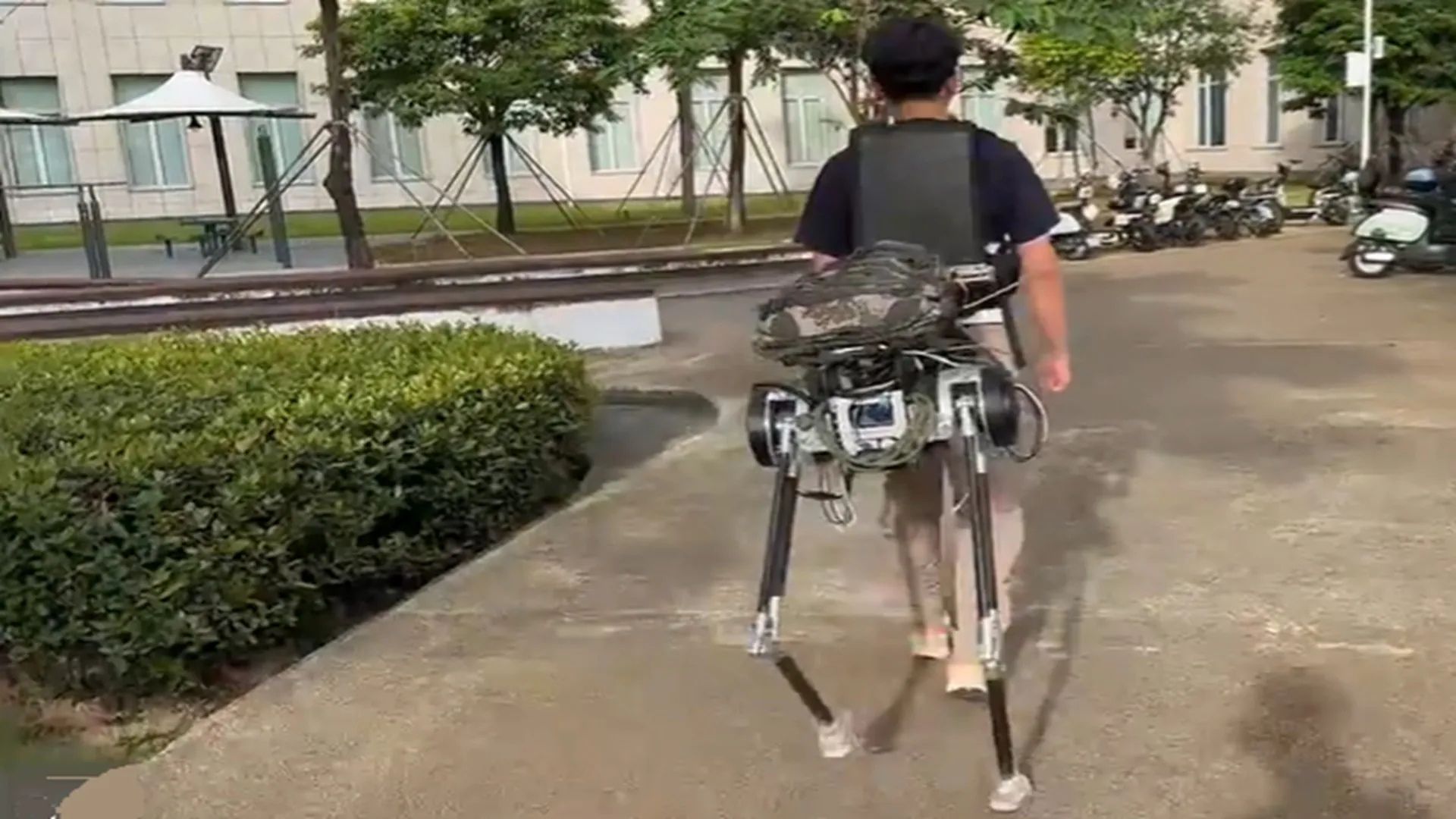
Researchers in China have developed a wearable robot that adds two mechanical legs behind a human, helping carry heavy loads while reducing the energy required to walk. The system effectively creates a human-robot hybrid that moves like a four-legged centaur.
The wearable platform, developed by a team at the Southern University of Science and Technology in Shenzhen, walks in sync with a human user while supporting part of the load normally carried in a backpack.
The robot legs move alongside the wearer, sharing the weight and assisting forward motion.
Unlike traditional exoskeletons that attach to the human legs, the system operates as a separate robotic pair of limbs connected to the user through an elastic interface on the back.
This allows the robot to take over much of the load-bearing task while the human remains responsible for balance and navigation.
Tests showed the robot could significantly reduce physical strain. When participants carried a 44.09 pounds load, metabolic energy use dropped by about 35 percent, while foot pressure was reduced by roughly 52 percent compared to walking without assistance.
Walking with robotic legs
The design takes a different approach from most wearable robotics. Conventional exoskeletons run parallel to the user’s legs and mainly assist joint motion.
The centaur-style robot instead forms a hybrid walking system where the robotic legs provide propulsion and weight support.
The researchers introduced an elastic coupling with nonlinear stiffness between the human and the robot. Under lighter loads the connection stays firm, helping maintain coordination.
When the load increases, the system becomes more compliant, allowing the robot to absorb forces and carry more of the burden.
This separation of responsibilities allows the human and robot to work together more efficiently. The human focuses on steering and balance, while the robot performs most of the mechanical work required to transport heavy cargo.
The team also developed motion planning and control strategies that allow the robotic legs to coordinate with the user’s walking speed and direction.
The robot uses model predictive control and trajectory planning to maintain stable movement across different walking conditions.
Designed for heavy tasks
During trials, the system demonstrated stable movement while walking with heavy loads. Researchers found that the robotic legs could support more than half of the carried weight while maintaining natural walking patterns.
The platform also helped improve stability while walking under load. Step width variability decreased and the walking pattern remained similar to normal walking without additional weight.
The researchers believe such wearable robots could help workers who routinely carry heavy equipment.
Potential applications include military logistics, disaster rescue operations, and industrial transport tasks where workers must move heavy supplies across uneven terrain.
By combining vertical load redistribution with horizontal traction assistance, the system provides both weight support and forward propulsion. This allows users to walk longer distances with reduced fatigue while carrying large loads.
The study describing the wearable centaur robot was published in The International Journal of Robotics Research.
First Appeared on
Source link






Leave feedback about this