

Amman
—
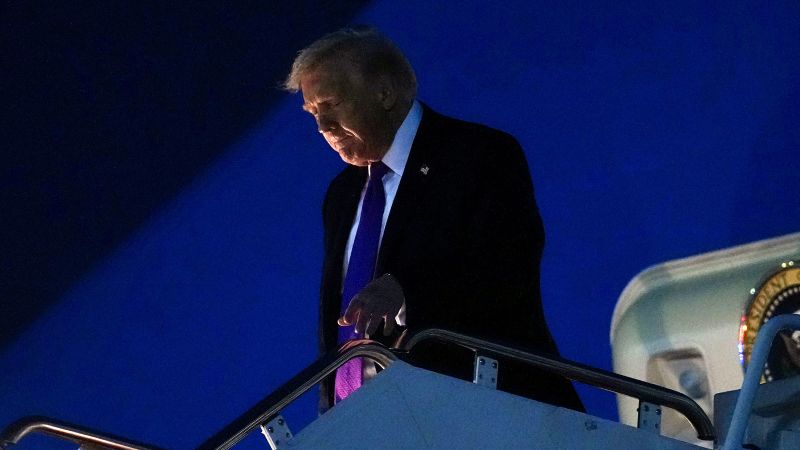
A war that is “won” but also “not finished yet.” An “excursion” that requires Iran’s “unconditional surrender.” President Donald Trump’s rhetorical knots fit well with his style of dictating America’s information diet, but fall flat when they hit the gritty reality of conflict.
The “win” in war is not as it is in sports: a score does not declare the victor after a previously agreed duration. The bravado and gamer-style videos of the US government as it pursues its assault on Iran belie the extraordinary seriousness of an intractable moment: how far do the Americans have to go, not to just declare “we won,” as Trump did Wednesday in Kentucky, but to make Iran behave as if it has suffered a defeat?
Trump is now caught in the oldest trap of modern warfare – believing a swift, surgical military operation will yield quick, enduring political results. The Soviets did it in Afghanistan; the US in Iraq in 2003; Putin did it in Ukraine, and is still fighting. Whatever force a military fails or succeeds in applying at the start, the people it is attacking have greater commitment to defending their lands and homes.
The White House may have rushed into this, seizing the opportunity for a decapitation strike, provided by Israeli intelligence. Israeli Prime Minister Benjamin Netanyahu has very different objectives regionally, and a long US involvement against Tehran suits his desire for an Iran in rolling collapse that is no longer a threat. But the death of Supreme Leader Ali Khamenei on February 28 has caused as many problems as it has solved.
There is no Delcy Rodriguez waiting in the wings for Trump to anoint, as was the case when US forces seized Venezuelan President Nicolás Maduro. Rather, Iranian hardliners have filled the vacuum with Khamenei’s son, Mojtaba – the very man Trump publicly said he did not want.
It is unclear if Mojtaba is in good enough health to record a video announcing his leadership, although what Iranian state media said was his first message since he became supreme leader was read out on air Thursday.
It is very clear the Islamic Revolutionary Guard Corps (IRGC) is seeking a blood revenge for the relentless assassination of its commanders, much as you might anticipate US troops would, if Trump, the Joint Chiefs, and much of the US’s intelligence community were killed.
This anger handicaps Trump’s immediate prospects for an end. Iran has – within 13 days – turned this into an endurance test that it seems to be surviving.
The US can bomb for months, but not without depleting its vital munitions stocks, and facing both greater political damage ahead of November’s mid-term elections and the risk of more US casualties.
Iran will continue to lose launchers, drone bases, personnel and infrastructure, but enough will likely survive that its forces never have to stop, and drop to their knees. The IRGC’s leaders have prepared for this moment for years. It is their calling. They may run out of bombs, drones, or even people, but not motivation. This, too, was the lesson of Iraq and Afghanistan.
Iran is divided in its support for the regime. But aerial bombardment makes for strange bedfellows among the bombed. The short-sighted notion that enough precision strikes would potentially ensure a wide Iranian popular uprising has slowly been exposed as a sham. Democracy and regime change are now an aspiration in the rear-view mirror of Trump as he seeks an end to the war.
Instead, the limitations of US airpower are exposed. It can alter regimes – in terms of their capabilities or leadership figures – but has yet, with Iran, to force a regime to change its methods, or force a change of regime. And over time, the barrage will likely become less effective and more deadly to civilians – as the target list thins out and the items the Americans and Israelis need to hit become more enmeshed in civilian life.
For the Iranians, the risk versus reward calculus is going the other way: they can harass and destroy ships in the Strait of Hormuz, keeping the price of oil above $100, and forcing the global economy to protest that Trump should have seen this coming. Iran’s missile barrages may become fewer, but their mere persistence is a win.
Now Trump has begun talking of the end, daily, and of victory, he has made it far too palpable that he wants to stop. Message discipline is helpful in war, and he has let his enemy know he wants out now.
And so for Iran’s regime, the path to victory – or at least not to defeat – is suddenly very clear, albeit long. It just has to survive. Trump or Israel could kill a second Khamenei, but the resulting Iranian resolve would be harder to defeat still. (The Americans learned in Afghanistan that their nightly raids on Taliban leadership actually made it harder to wind down the war – they were left with only hot-headed, grieving sons of dead leaders to try to talk to.)
Yet this is no “Forever War,” for now. It is 13 days old. It is more likely that silent diplomacy, or sheer exhaustion, will see the violence peter out in the coming weeks, in such a way both sides can claim a win.
Then, Iran’s regime will rebuild, more hardline, more violent, more brutal – its members aware the entire might of US military power can kill their supreme leader, devastate their military, but still not dislodge their unpopular cabal. That is a big psychological triumph. Russia and China will no doubt help them get back on their feet – not 10 foot tall, but stable enough to throw a punch.

The US will likely have to consider a repeat onslaught, at some time in the future, to diminish a rebuilt Tehran. It may also face the same dilemma Europe now does with Ukraine. Russia is needling Ukraine’s European allies with asymmetrical warfare – sabotage and cyberattacks – to perhaps provoke a wider conflict while imposing costs. Iran will likely fall into the same pattern: irritate the US frequently enough that the US failure to suppress Iran is clear, but not enough it risks open conflict again.
The most serious decision any US president can make is to send his troops to war. Trump is not alone in fumbling this ball: George W. Bush did it (twice). Barack Obama thought he could win Afghanistan, if he tried a little harder, and the chaos of Joe Biden’s withdrawal defined how poorly the US grasped its failures there.
Trump declared a win after 12 days that he has not yet earned or seen accepted by his adversary. He now faces the impossible task of reconciling his insurmountable need to appear the victor with Iran’s dogged desire to never seem to stop. Waiting for exhaustion is not a gameplan, but it appears to be the only one at hand now.
First Appeared on
Source link




Leave feedback about this