

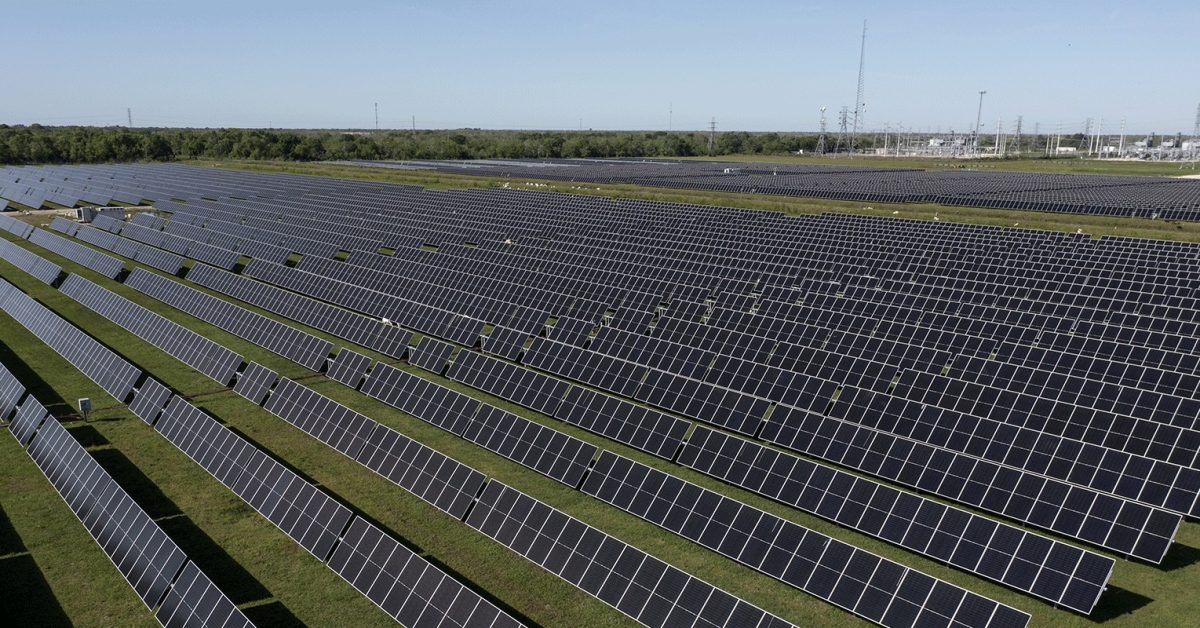
The US installed 43 gigawatts (GW) of new solar capacity in 2025, marking the fifth straight year that solar has been the largest source of new power added to the grid.
According to the latest “US Solar Market Insight 2025 Year in Review” from the Solar Energy Industries Association (SEIA) and Wood Mackenzie, solar and energy storage together accounted for 79% of all new electricity generation capacity installed during the first year of the Trump administration.
In other words, nearly four out of every five new power plants built in the US last year were solar or batteries.
Solar growth in red states
More than two-thirds of the solar installed in 2025 was built in states that Donald Trump won in the 2024 election.
Texas, Indiana, Florida, Arizona, Ohio, Utah, and Arkansas all ranked among the top 10 states for new solar capacity last year. Texas once again led the country by a wide margin, installing 11 GW of new solar in 2025.
Several other states also saw major growth. Indiana installed nearly 3 GW of solar last year, up sharply from 1.6 GW in 2024, while Utah also saw a surge in new projects.
Overall, 11 states set new annual solar installation records in 2025, and 12 states added more than 1 GW of new solar capacity.
Solar keeps winning on economics
Despite regulatory pressure on clean energy and changes to tax policy in 2025, the economics of solar remain strong.
One big reason is rising electricity demand, particularly from data centers. Solar can be built faster than most other types of power plants, making it one of the quickest ways to add large amounts of new electricity to the grid.
Wood Mackenzie and SEIA expect the US to add another 490 GW of solar capacity by 2036. If that happens, total installed solar capacity in the US would reach nearly 770 GW.
Michelle Davis, head of solar at Wood Mackenzie and the report’s lead author, said solar is expected to remain the dominant source of new power capacity in the US even as gas generation grows.
“Strong demand growth combined with escalating costs of new gas plants will allow solar to remain competitive, even without tax credits,” Davis said.
Policy still matters
The report notes that future solar growth will depend heavily on policy decisions.
Final guidance on Foreign Entity of Concern provisions, the outcome of pending trade actions, and the ability of projects to secure permits will all shape how much solar ultimately comes online.
The residential solar sector, in particular, is facing headwinds after the premature end of the 30% tax credit in 2025.
A more restrictive policy could slow solar deployment, thus choking power supply and raising electricity prices.
Utility-scale solar remains one of the lowest-cost sources of new electricity generation, while rooftop solar paired with battery storage enables households to manage their own power costs.
US solar manufacturing continues to expand
2025 was also a major year for domestic solar manufacturing.
With the opening of a wafer manufacturing facility in Q3, the US now has the capacity to produce every major component of the solar supply chain domestically.
Cell manufacturing capacity continued to grow last year, and module manufacturing capacity jumped more than 50% to reach 65.5 GW.
The report suggests the buildout of US solar manufacturing could continue as demand for new power rises across the US.
Read more: EIA: 99%+ of new US capacity in 2026 will be solar, wind + storage

If you’ve ever considered going solar, make it easy by finding a trusted, reliable solar installer near you that offers competitive pricing by checking out EnergySage. It has hundreds of pre-vetted solar installers competing for your business, ensuring you get high-quality solutions and save 20-30% compared to going it alone. Plus, it’s free to use, and you won’t get sales calls until you select an installer and share your phone number with them.
Your personalized solar quotes are easy to compare online, and you’ll get access to unbiased Energy Advisors to help you every step of the way. Get started here.


FTC: We use income earning auto affiliate links. More.
First Appeared on
Source link






Leave feedback about this